Hunting: Gallinule Style

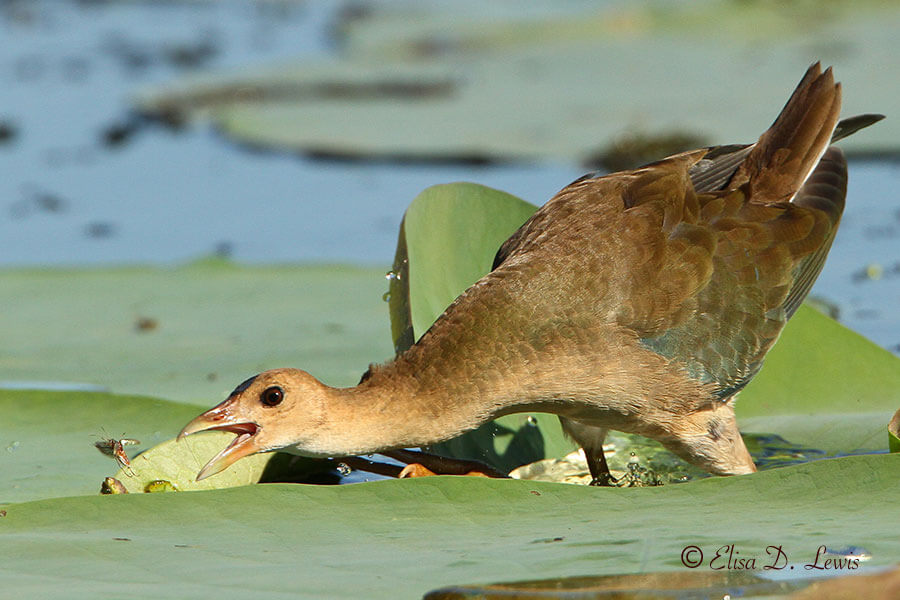
Female_Purple_Gallinule_hunting_aquatic_leaf_beetle
An aquatic leaf beetle, Donacia sp., tries (and ultimately fails) to escape the Purple Gallinule jaws of death.

I’ve been looking forward to putting this post together since I took these photos on the first day of fall this year. I just love it when all the tumblers fall in place and I capture an interaction that tells a story. I was camped out along the banks of Elm Lake at Brazos Bend State Park watching Purple Gallinules methodically turning over what seemed like each and every lotus leaf in their paths. Grab; step; fold; hold. Grab; step; fold; hold.  Again and again, they applied the technique as they criss-crossed back and forth across the carpet of lotus leaves. I assumed they were hunting but, for what? Strangely enough they ignored the aquatic snails conspicuously stuck to the undersides of the overturned lily pads. The snails looked pretty good to me, and snails are on the typical Purple Gallinule menu – along with seeds, insects, crustaceans, fish, eggs, and marsh bird nestlings (!) – but they passed on the snails. Not even a “no thank you” helping. It wasn’t until I was able to look at my photos closely that I was able to identify the special of the day – aquatic leaf beetles.

This slideshow requires JavaScript.

Over a period of about an hour and a half, I captured 17 unique predator-prey interactions and nine of those involved Donacia, the aquatic leaf beetle. Two involved fish and the remaining four menu items – unidentified. This juvenile Purple Gallinule found its beetles either sandwiched between overlapping lotus leaves or nestled within enrolled emergent lotus leaves. I also saw the gallinule peek inside the rolled up leaves presumably checking for beetles before ripping a small hole in the side to extract the snack. (I’ll post that series later.)
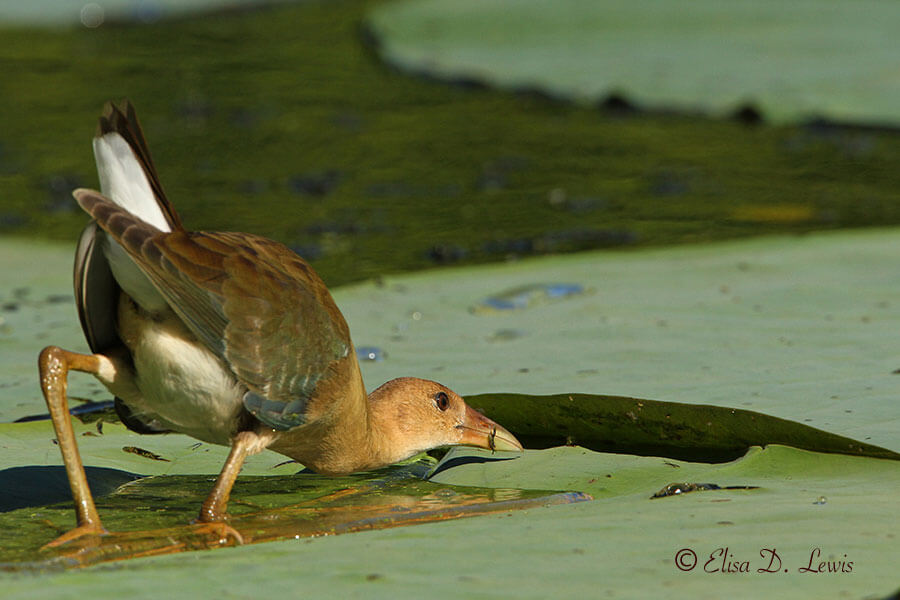
Female Purple Gallinule peeking under a lily pad
Come out, come out, wherever you are! An immature Purple Gallinule looks for aquatic leaf beetles under American Lotus leaves on Elm Lake at Brazos Bend State Park, Texas.

©2013 Elisa D. Lewis. All rights reserved. No text or images may be duplicated or distributed without permission.
Blue Dashers: Dragonflies for All Seasons

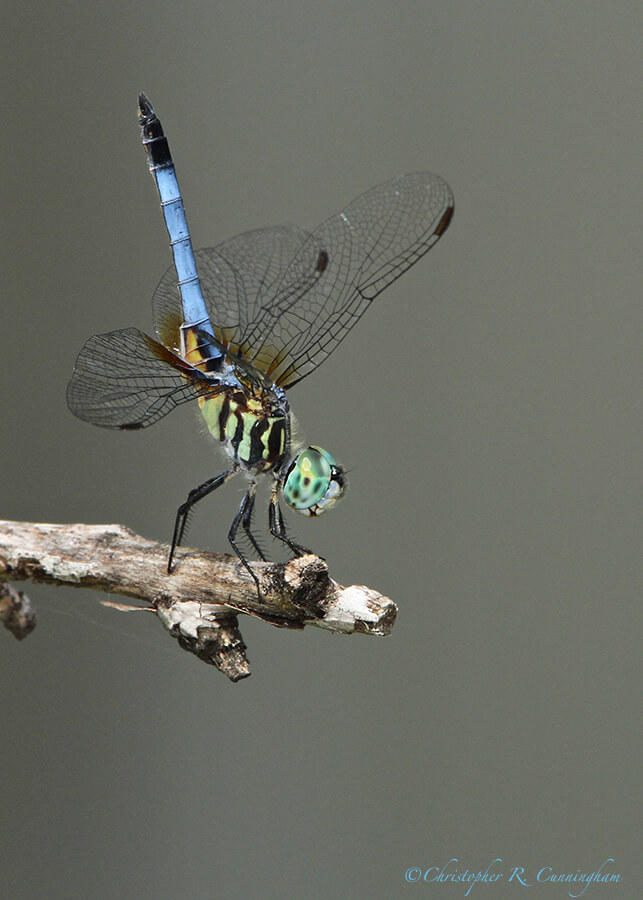
Male Blue Dasher in obelisk posture, Houston, Texas
Male Blue Dasher Dragonfly (Pachydiplax longipennis) in Obelisk Posture, Houston, Texas. Photo taken on a broiling late July afternoon. This posture has been implicated in territorial displays and thermoregulation. Canon EOS 7D/500mm f/4L IS (+1.4x TC). High-speed synchronized fill-flash.

Certain living organisms conjure scenes of the past in my paleontologist’s brain. Seeing a pelican skimming the crests of waves over Galveston Bay spark thoughts of pterosaurs gliding above the Cretaceous Niobraran Sea of western Kansas. Dragonflies bring visions of sweltering Late Paleozoic coal swamps teeming with monstrous arthropods.

Despite knowing that some insects are endothermic (“warm-blooded”) and are active over a wide range of temperatures, I was surprised to see a variety of active dragonflies on a recent chilly mid-November day at Lafitte’s Cove, Galveston Island, Texas. Perhaps this surprise was because of my bias toward thinking of dragonflies as a hot weather phenomenon.

In general, dragonflies fall into two types: “flyers” and “perchers.” Flyers like Green Darners (Anax junius) are endotherms, their elevated body temperatures largely the result of physiological processes supporting their highly active lifestyles. Perchers like Blue Dashers typically are closer to what are commonly called ectotherms, or “cold-blooded” organisms. These creatures regulate their body temperatures primarily through behavioral mechanisms like basking in the sun to raise body temperature, or conversely, as in the case of Blue Dashers, adopting the “obelisk posture.” In the obelisk posture, the abdomen is pointed toward the sun, thus decreasing the profile illuminated by the sun.

In any case, a major source of avian nutrition has stretched much deeper into the cool weather than I expected—and with it my dragonfly photography!

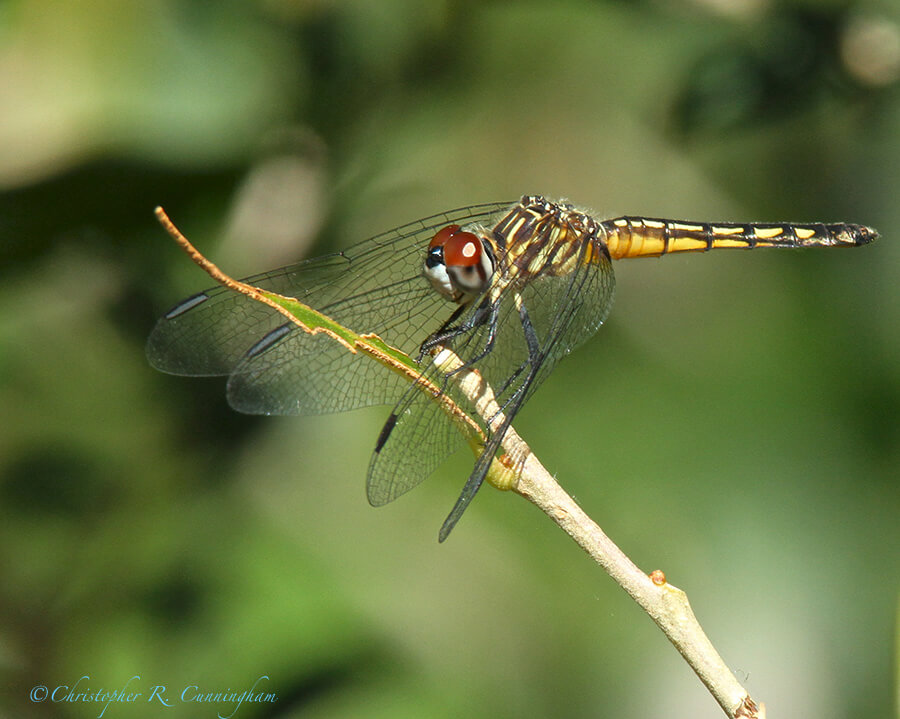
Female Blue Dasher at Lafitte's Cove, Galveston Island, Texas in mid-November.
Female Blue Dasher Dragonfly on a Chilly Morning at Lafitte’s Cove, Galveston Island, Texas in mid-November. The temperature was in the upper 40’s ℉. I have seen these same insects acting more or less the same—alternately basking and hunting—on days when the temperature was well over 100℉. Canon EOS 7D/600mm f/4L IS (+1.4x TC). Natural light.

“I tried to discover, in the rumor of forests and waves, words that other men could not hear, and I pricked up my ears to listen to the revelation of their harmony.”—Gustave Flaubert, November

 ©2013 Christopher R. Cunningham. All rights reserved. No text or images may be duplicated or distributed without permission.
Another Snowy Egret Fishing Technique

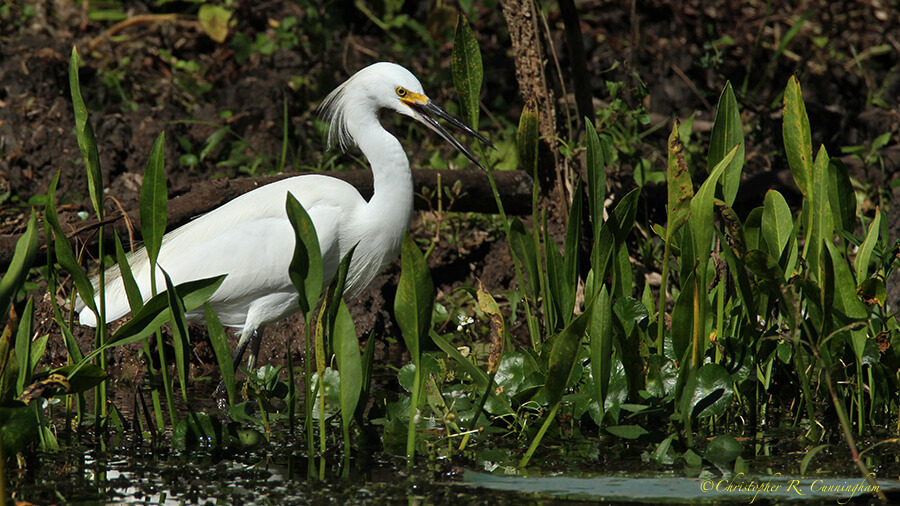
Gaping Snowy Egret at Elm Lake, Brazos Bend State Park.
Gaping Snowy Egret at Elm Lake, Brazos Bend State Park, Texas. This bird spent the morning on the shore shadowing Pied-billed Grebes as they hunted. Canon EOS 7D/600mm f/4L IS (+1.4x TC). Natural light.

Snowy Egrets are known for shuffling their bright yellow feet in the shallow water to scare up dinner. This summer I also caught one employing a bubble-blowing hunting technique to attract invertebrates and small fish.

On Saturday (11/2) at Elm Lake, Brazos Bend State Park, Texas I noticed another Snowy Egret fishing/hunting strategy that was new to me–and one that also involves scaring up prey. The egret shown above tracked Pied-billed Grebes back and forth as they chased fish and crawfish in the shallows, perhaps 3-4 feet from the shore. Likely fish and invertebrates scatter as grebes go swimming past–and likely this egret was making use of this to pick off prey responding to the grebes. During this shadowing behavior, the egret was quite good at predicting just where the grebe would surface. Perhaps the grebes were visible, at least sometimes, from the egret’s vantage point? Or was this wader ESP? In any case, the egret would often dash to a position on the shore closest to where the Grebe would suddenly emerge from the water.

Commensalism, a symbiosis in which one organism benefits and another is largely unaffected, is likely the label an ecologist would place on the above relationship. But could it be mutalism? Did the grebes benefit from the presence of the egret? Perhaps the egret could have revealed the presence of predators lurking in the shallows or the weeds? Did the grebes have one eye out on a friend on the shore who might signal (through behavior) the presence of an alligator lurking on the shore otherwise undetected? Or a nasty old alligator gar floating, log-like in the shallows? Perhaps the egret chased prey items (like plump juicy frogs) from the shoreline into the water? Food for thought.

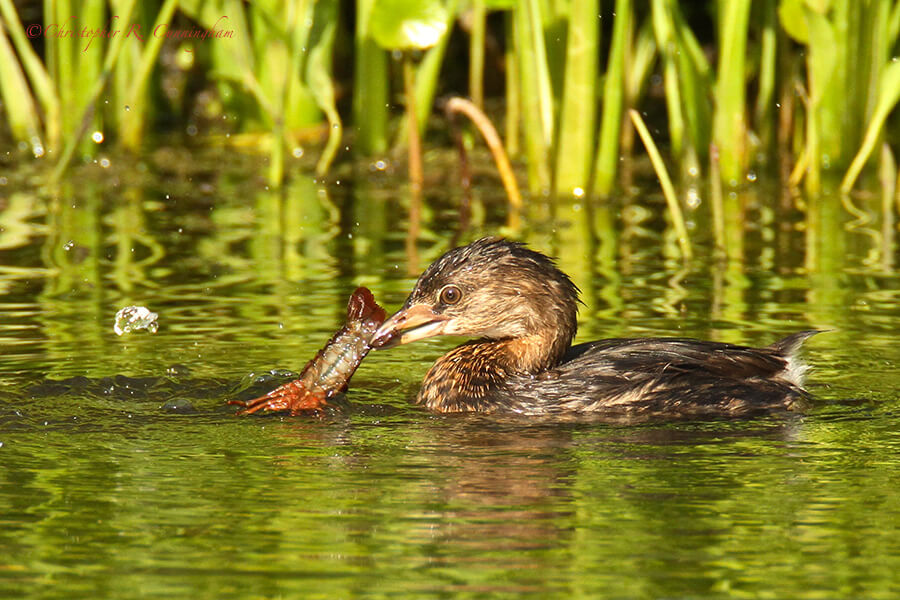
Pied-billed Grebe with Red Swamp Crawfish at Elm Lake, Brazos Bend State Park.
Pied-billed Grebe with Red Swamp Crawfish at Elm Lake, Brazos Bend State Park. Note the large blob of water frozen in mid-air by high shutter speed as this grebe engaged in an epic struggle with a crawfish one-third its size. Canon EOS 7D/600mm f/L IS (+1.4x TC). Natural light.

Competition has been shown to be useful up to a certain point and no further, but cooperation, which is the thing we must strive for today, begins where competition leaves off.–FDR 

 ©2013 Christopher R. Cunningham. All rights reserved. No text or images may be duplicated or distributed without permission.
Photographing Birds in Flight at East Beach, Galveston Island, Texas

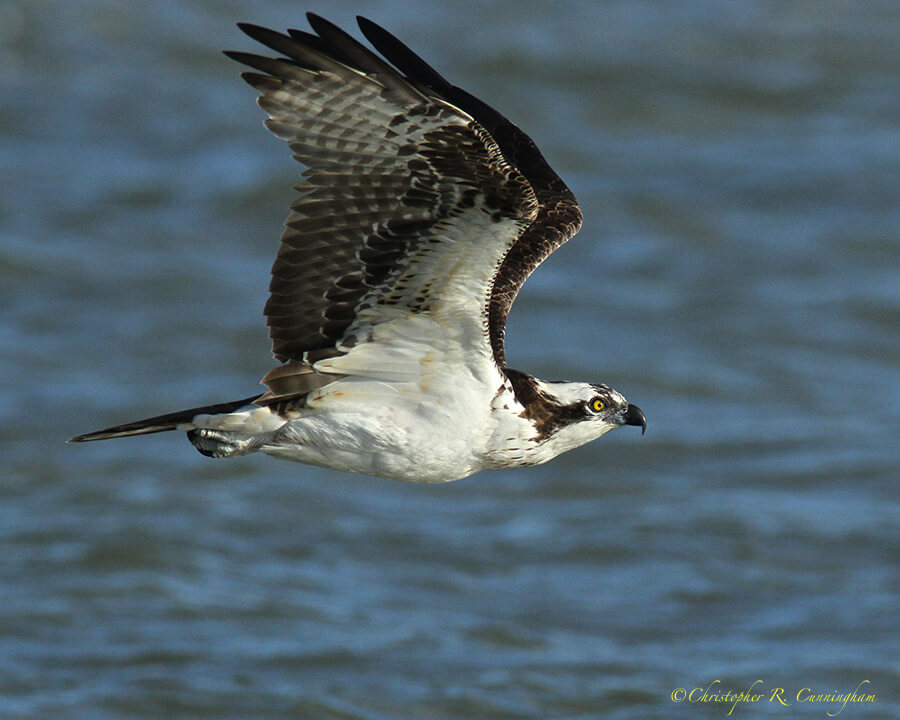
Osprey in Flight, East Beach, Galveston island, Texas.
Osprey in Flight, East Beach, Galveston Island, Texas. Canon EOS 7D/600mm f/4L IS (+1.4x TC): ISO 640, 0 EV, f/9, 1/2500, tripod; IS Mode 2.

The best technique for shooting birds in flight (BIF) arguably involves spotting a bird at distance and then tracking it in the viewfinder until it fills a significant part of the frame. For this technique to be employed, the photographer must be able to predictably track the bird over a long distance without significant obstructions. A large number of birds following along a similar glide path is also helpful. Because of these requirements, getting BIF shots is highly dependent upon a special place.

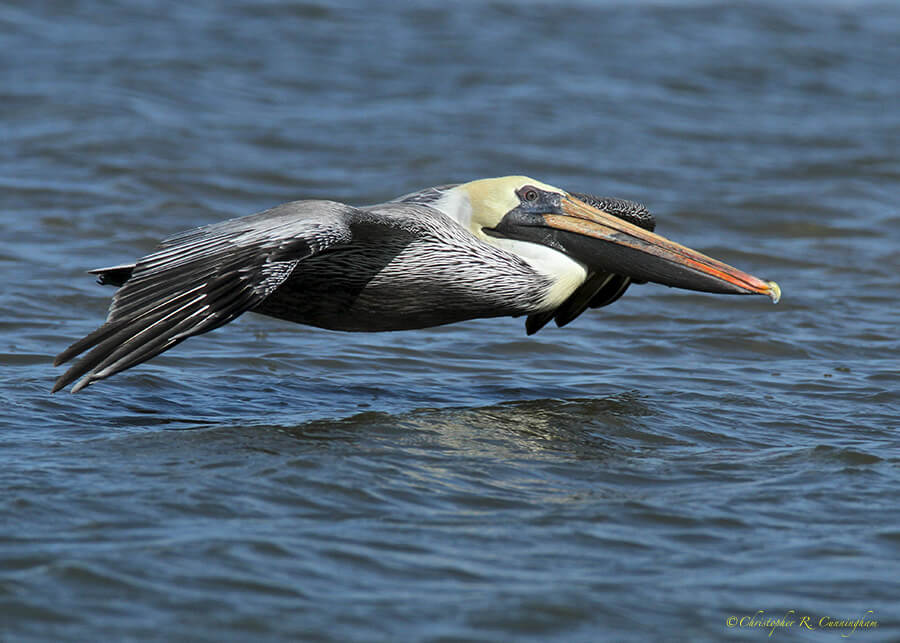
Wave Skimmer: Brown Pelican in Flight at East Beach, Galveston Island, Texas.
Wave Skimmer: Brown Pelican in Flight at East Beach, Galveston Island, Texas. Canon EOS 7D/600mm f/4L IS (+1.4x TC): ISO 500, 0 EV, f/9, 1/3200, tripod, IS Mode 2.

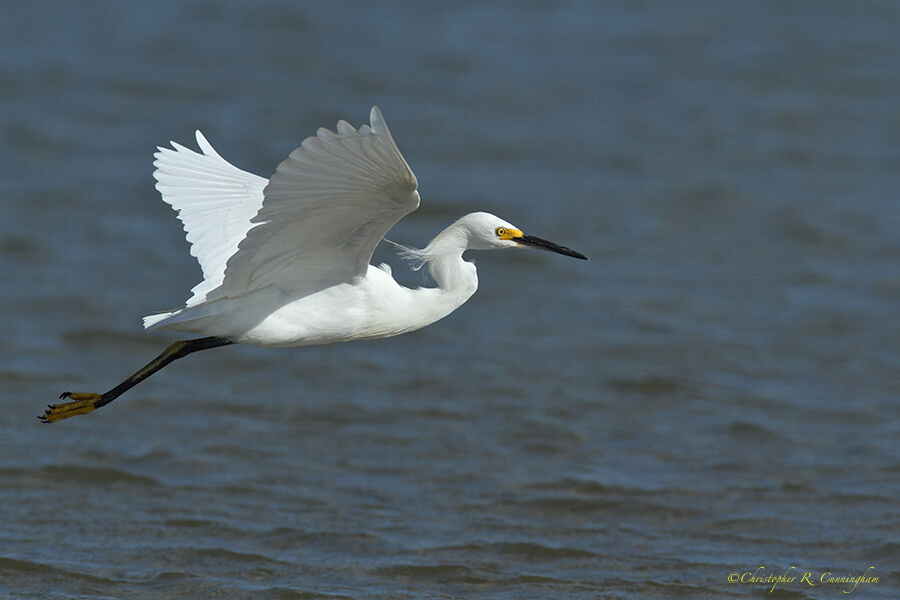
East Beach, Galveston is such a place. Numerous shorebirds and waders typically fly parallel to the shore. Obstructions are few–mainly ships that appear in the background. The morning sun is at your back while you shoot toward the sea. And after a blue norther, with a cold wind in your face the place is . . . paradise.

Snowy Egret in Flight, East Beach, Galveston Island, Texas.
Snowy Egret in Flight, East Beach, Galveston Island, Texas. Canon EOS 7D/600mm f/4L IS (+1.4x TC): ISO 500, 0 EV, f/9, 1/3200, tripod; IS Mode 2

The sea is everything. It covers seven tenths of the terrestrial globe. Its breath is pure and healthy. It is an immense desert, where man is never lonely, for he feels life stirring on all sides.–Jules Verne

©2013 Christopher R. Cunningham. All rights reserved. No text or images may be duplicated or distributed without permission.
Fall 2013 Songbird Migration Tapers Off

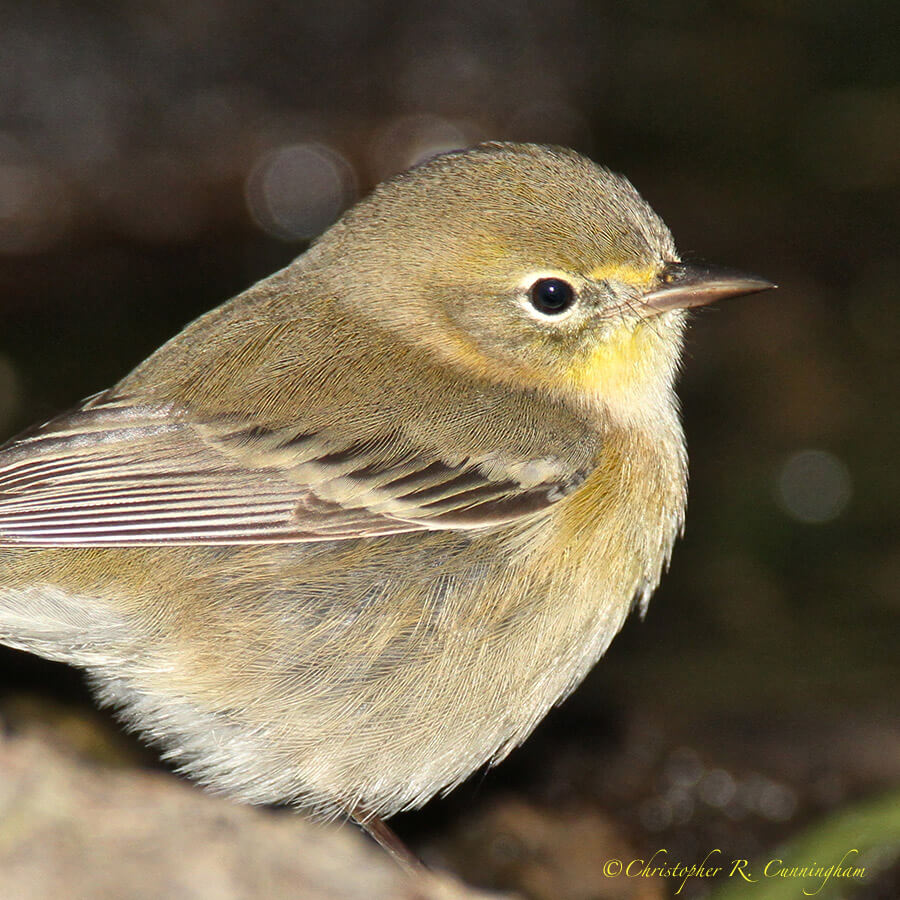
Portrait: Pine Warbler. Pine Warblers were the only warblers I saw at Lafitte's Cove last weekend.
Portrait: Pine Warbler. Pine Warblers were the only warblers that I saw at Lafitte’s Cove, Galveston Island last weekend (10/26). Canon EOS 7D/600 f/4L IS (+1.4x TC). High-speed synchronized fill-flash.

Lafitte’s Cove, Galveston Island was a-hoppin’ with half a dozen warbler species the weekend before last (10/19), but last weekend (10/26) only Pine Warblers were in attendance. Technically a “partial migrant,” Pine Warblers winter on the Upper Texas Gulf Coast–one of only a few warbler species that do so.  We have, once again, arrived at a time when the Neotropical migrants are mostly back or well on their way back to the tropics.

Likewise, intracontinental migrants are still moving through or settling into their winter Texas homes. Of these North American wanderers, I most look forward to the ducks and can’t wait to hit their hot spots along the Texas Coast like Rockport, the Hans and Pat Suter Wildlife Refuge City Park (Corpus Christi), and the Birding Center on South Padre Island. Loons and grebes, too, will soon begin arriving in Galveston Bay and environs, imparting a definite northern feel to the coastal Texas waterscape.

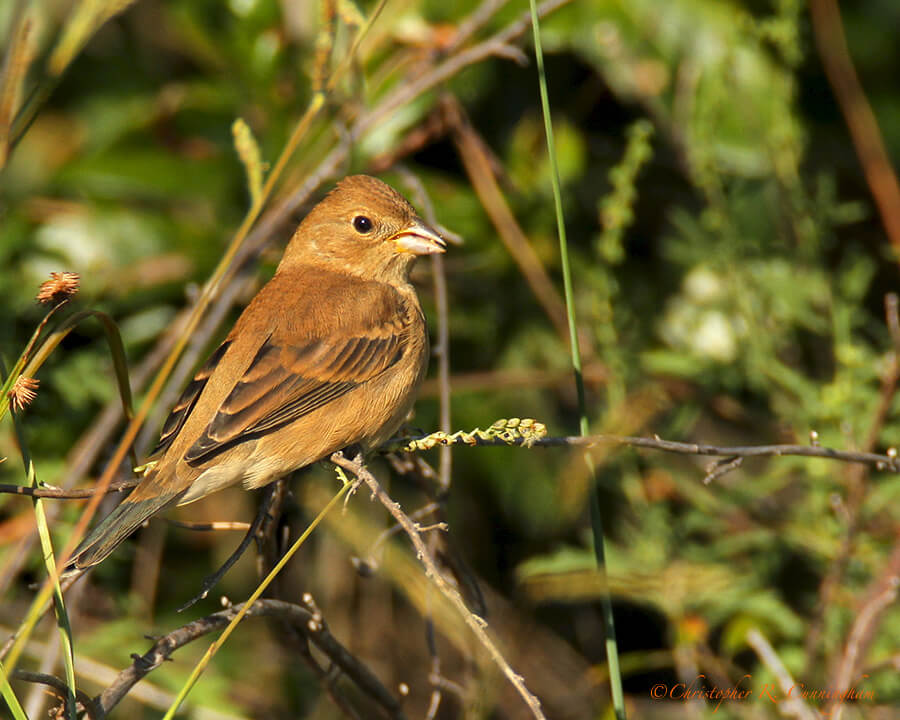
Munching Seeds: Female Indigo Bunting at Lafitte's Cove, Galveston Island, Texas
Munching Seeds: Female Indigo Bunting at Lafitte’s Cove, Galveston Island, Texas. Indigo Buntings accompanied the latest wave of migrating warblers to hit the Texas Gulf Coast. Canon EOS 7D/600mm f/4L IS (+1.4x TC). High-speed synchronized fill-flash.

“When you’re young you prefer the vulgar months, the fullness of the seasons. As you grow older you learn to like the in-between times, the months that can’t make up their minds. Perhaps it’s a way of admitting that things can’t ever bear the same certainty again.” ― Julian Barnes, Flaubert’s Parrot 

©2013 Christopher R. Cunningham. All rights reserved. No text or images may be duplicated or distributed without permission.