A Season of Extravagance

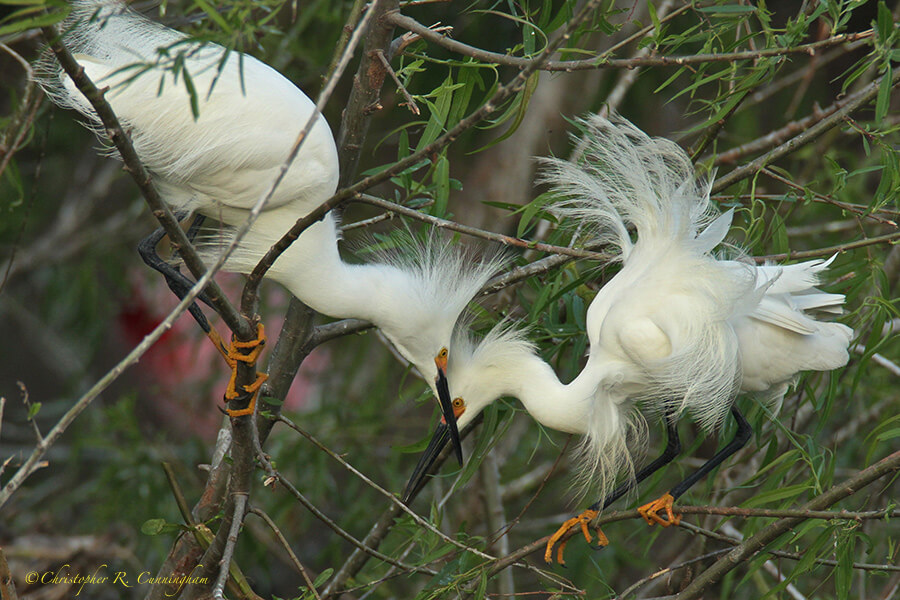
Snowy Egrets in High Breeding Plumage, Smith Oaks Rookery, High Island, Texas
Snowy Egrets in High Breeding Color and Plumage, Smith Oaks Rookery, High Island, Texas. The lores and feet of Snowy Egrets turn from yellow to pink and orange, respectively, at the peak of breeding season. Photo taken in April. Canon EOS 7D/600mm f/4L IS (+1.4x TC). Natural light.

We are now entering a season of extravagance—extravagance of avian color, plumage, and behavior. Soon, displays, mating and nesting will be going on all along the Texas Gulf Coast. Early birds have already begun. Some waders are sporting nuptial (breeding) plumes, and lore and leg/foot colors are beginning to pop. Hormones are surging through bloodstreams. Many of the waders and other water birds are on edge: Common Moorhens are fighting it out amongst themselves for dominance, and Great Blue Herons are nesting deep in the marshes. A Great Horned Owl, too, is currently nesting in the woods west of 40-Acre Lake, Brazos Bend State Park.
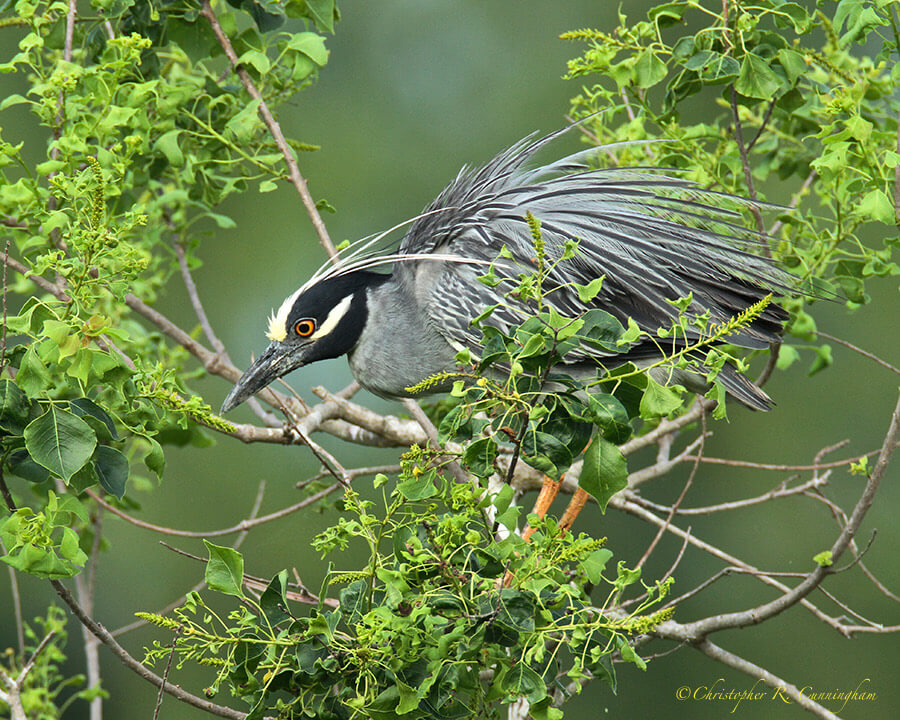
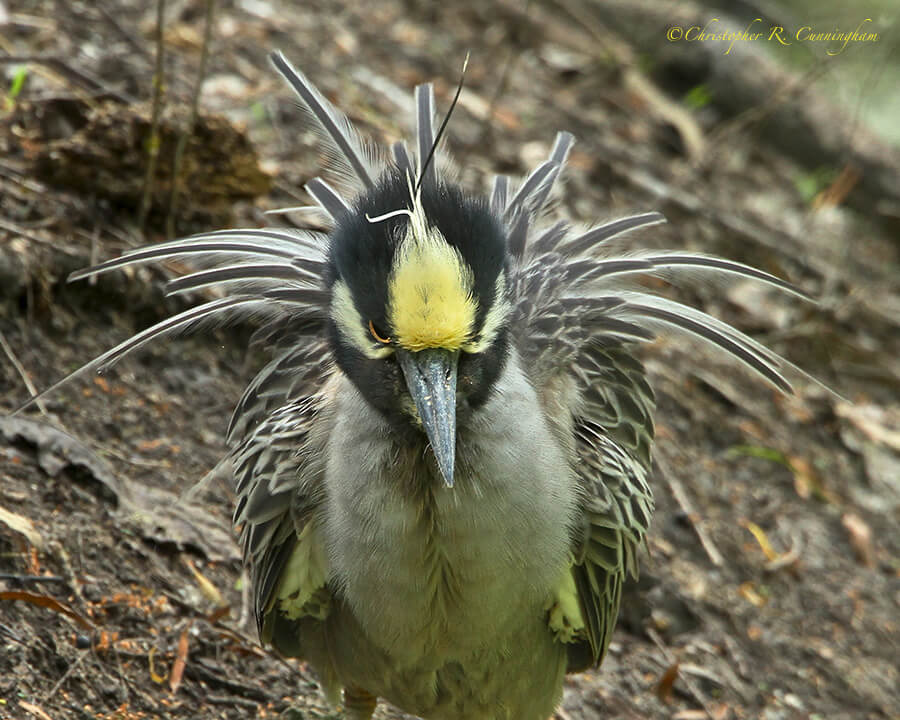
Yellow-crowned Night-Heron in Display Mode, Brazos Bend State Park, Texas
Yellow-crowned Night-Heron in Display Mode, Brazos Bend State Park, Texas. This may have been a threat display directed at the photographer: no other birds were around (that I noticed). Photo taken in late May, when Yellow-crowned Night-Herons are raising young at Brazos Bend SP. During breeding, the legs of these birds turn from yellowish to a pinkish orange. Canon EOS 7D/500mm f/4L IS (+1.4x TC). Natural light.
Yellow-crowned Night-Heron, Brazos Bend State Park, Texas
Back-off, Camera Boy! Yellow-crowned Night-Heron, Pilant Slough, Brazos Bend State Park, Texas. Another probable threat display during nesting season (May) directed at the photographer. Canon EOS 7D/500mm f/4L IS (+1.4x TC). Natural light

Soon, an exciting time of the year for birding will become the most exciting time. Neotropical migrant songbirds will be showing up in droves along the coast. For now, as far as migrants are concerned, we’ll have to settle for American Bitterns. Recently American Bitterns have been extremely active at Brazos Bend State Park (especially Pilant Lake). They have been hunting, calling, and engaged in threat displays among themselves and in the face of humans. American Bitterns do not often breed in Texas, and are sometimes described as “winter visitors” to Texas. Brazos Bend Bitterns are most likely on their way to their breeding grounds in the northern U.S. or Canada.
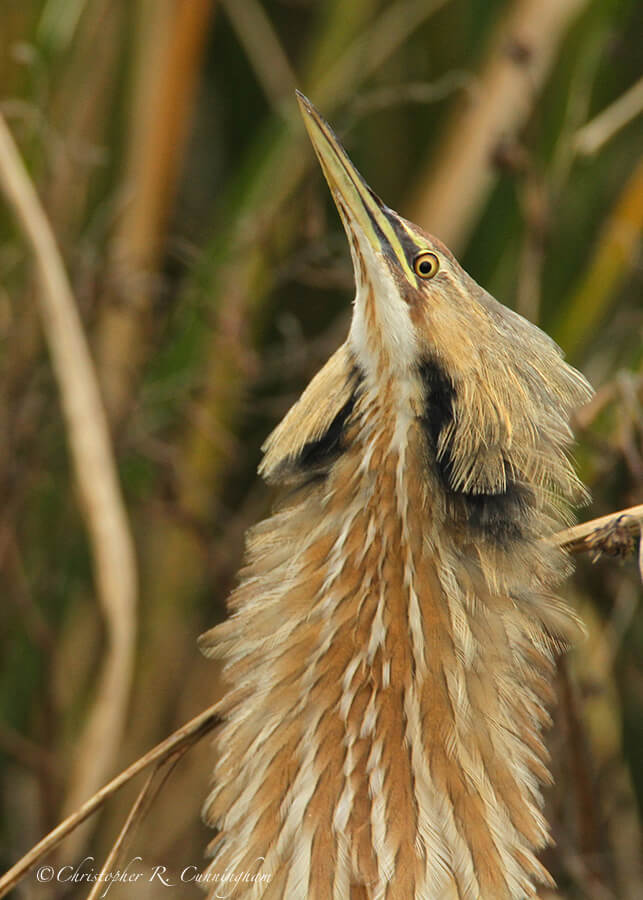
American Bittern Threat Display, Pilant Lake, Brazos Bend State Park, Texas
American Bittern Threat Display, Pilant Lake, Brazos Bend State Park, Texas. Again, I think this was for my benefit: no other birds were around. Photo taken in February. Canon EOS 7D/600mm f/4L IS (_1.4x TC). Natural light.

Although the weather continues to look pretty bad for adventures in the out-of-doors, anticipation of the spring excitement ahead keeps me looking up (and down and sideways)! And then it’s summer and the mountains!
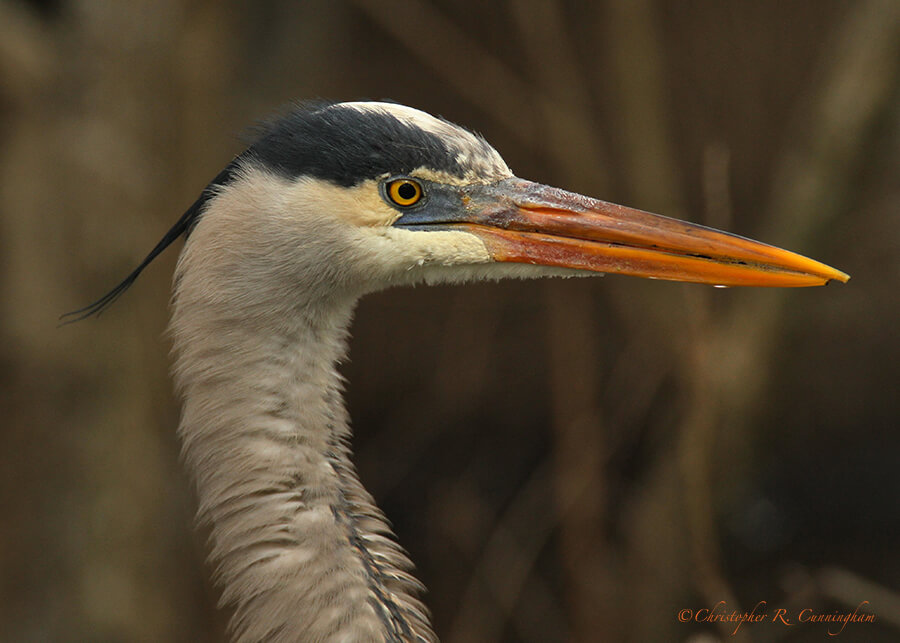
Great Blue Heron in Breeding Colors (in February!), Pilant Lake, Brazos Bend State Park, Texas
Great Blue Heron in Breeding Colors (in late February), Pilant Lake, Brazos Bend State Park, Texas. During breeding season, the lores become a deep blue and the beak turns to a deep orangish red. Similarly, the legs change from a grayish black to an orangish red. Note the erect black eyebrow feathers. This bird was jumpy. Canon EOS 7D/600mm f/4L IS (+1.4x TC). Natural light.
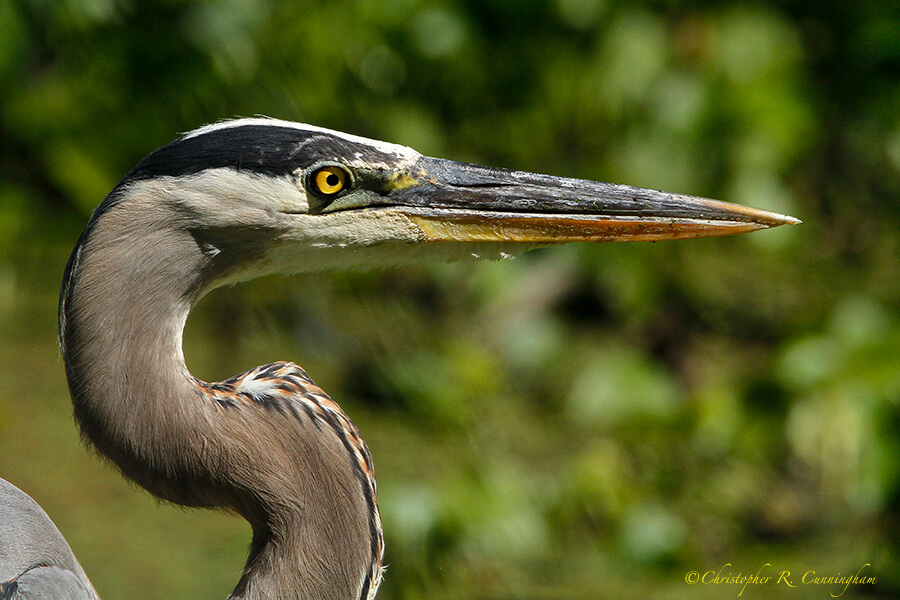
Great Blue Heron in Non-breeding color, Pilant Lake, Brazos Bend State Park, Texas
Great Blue Heron in Non-breeding (Post-breeding) Color in late May, Pilant Lake, Brazos Bend State Park, Texas. Canon EOS 7D/500mm f/4L IS (+1.4x TC). Natural light.

Where there is no extravagance there is no love, and where there is no love there is no understanding.—Oscar Wilde

©2015 Christopher R. Cunningham. All rights reserved. No text or images may be duplicated or distributed without permission.
Stalking Winter Raptors

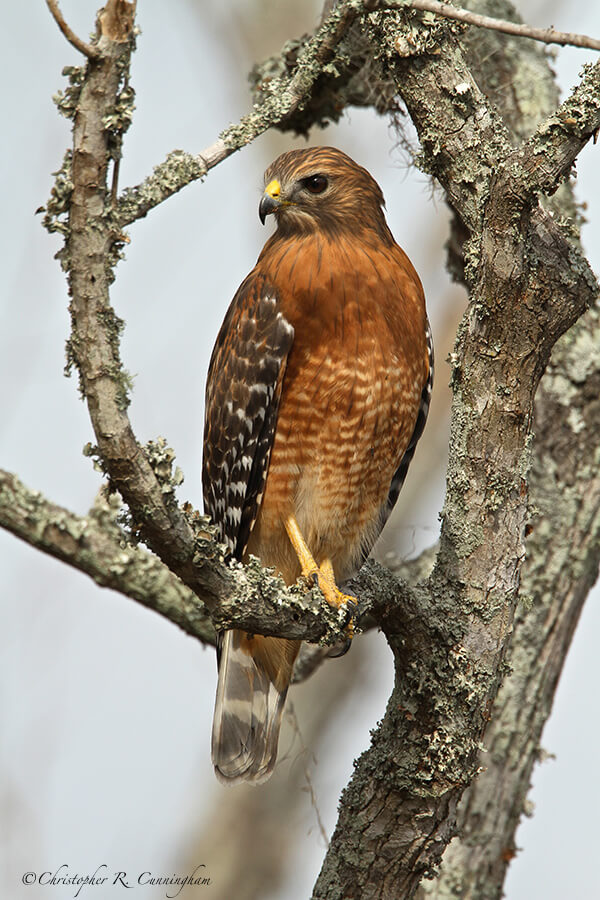
Red-shouldered Hawk, Brazos Bend State Park, Texas
Red-shouldered Hawk, Brazos Bend State Park, Texas. These hawks are common, year-round residents of the Upper Texas Coast. Canon EOS 7D/500mm f/4L IS (+1.4x TC). Natural light.

Birds of prey are always exciting to see and photograph, and winter is generally the best time to see them on the Upper Texas Coast. It could be argued, I suppose, that migrations are better in that the possibility exists of seeing transient species like Swainson’s Hawks or Broad-winged Hawks, but winter residents like American Kestrels, Peregrine Falcons, Northern Harriers, Cooper’s Hawks, and Ospreys are common enough to count on and really seem like part of the landscape.

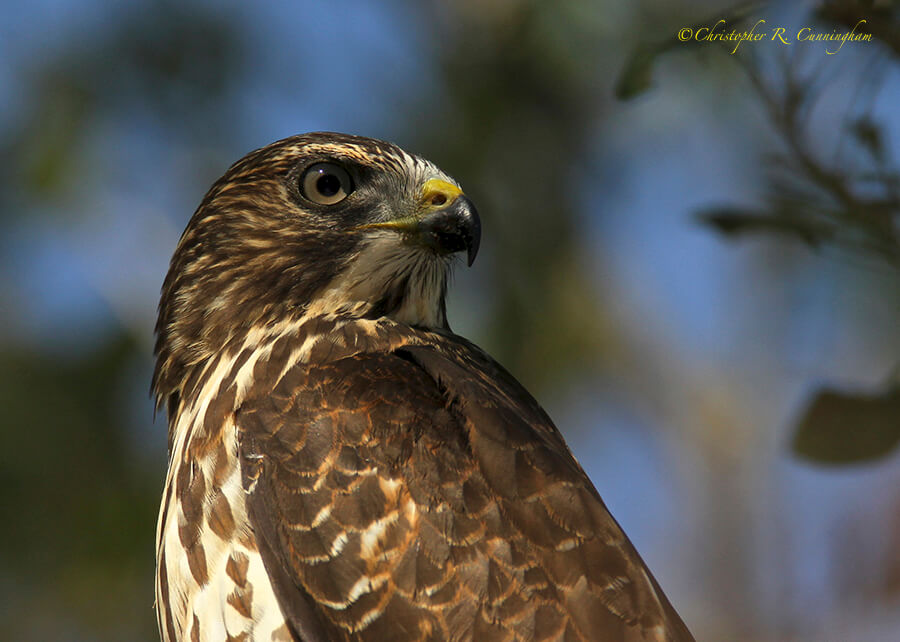
Juvenile Cooper's Hawk, Lafitte's Cove, Galveston Island, Texas.
Portrait: Juvenile Cooper’s Hawk, Lafitte’s Cove, Galveston Island, Texas. Canon EOS 7D/600mm f/4L IS (+1.4x TC). Natural light.

Wintering species plus year-round residents usually mean a visit to places like Anahuac NWR or Galveston Island State Park will yield sightings of at least a few raptor species. Inspection of fence posts and wires, power lines, and treetops at the margins of grassy areas will almost always be fruitful. It’s generally a good idea to keep the camera ready while driving to the coastal sanctuaries as birds will allow a close approach by a vehicle, but will bolt immediately if a door is opened to fish equipment from the back seat or boot.

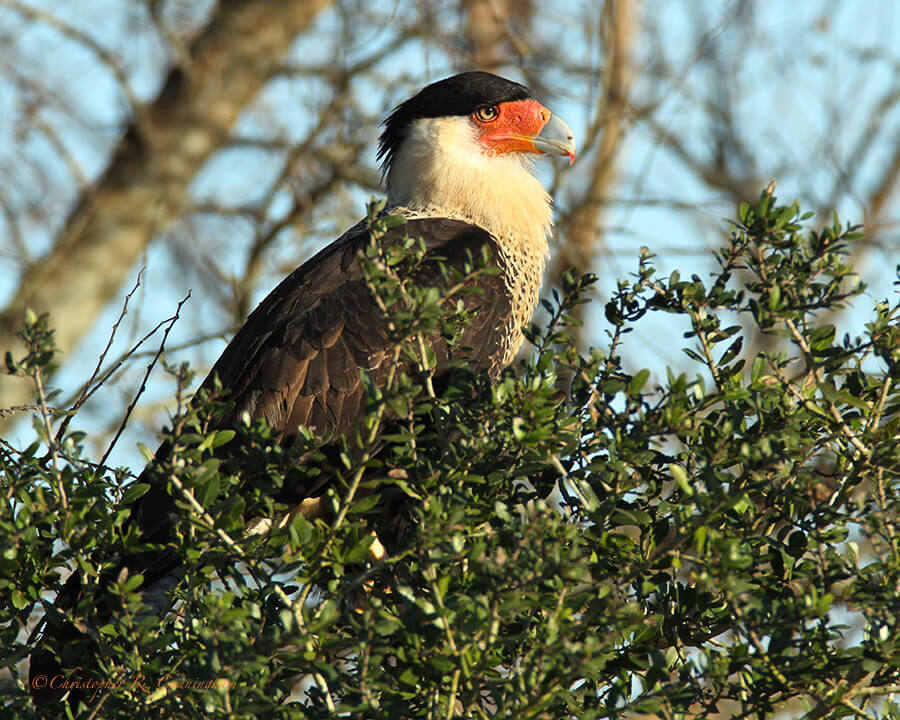
Northern Crested Caracara at Anahuac National Wildlife Refuge, Texas.
Northern Crested Caracara on Yaupon at Anahuac National Wildlife Refuge (Main Tract), Texas. Crested Caracaras may be the most unusual falcons. Within this family, caracaras are perhaps the least graceful aerial hunters. They must, however, be among the most graceful of scavengers. This bird was feeding on road-kill with a small group of Black Vultures: Note the blood on the beak. Northern Crested Caracaras are year-round residents of the Texas Gulf Coast. Photo taken from a truck-as-blind. Canon EOS 7D/600mm f/4L IS (+1.4x TC). Hand-held, natural light.

Because many raptors like to perch in trees to scan for prey below, the absence of deciduous leaves during the cooler times of the year really helps to find and photograph these birds. Perching high in trees, though, can be troublesome for photography given the “belly-shot” problem. Case in point: I still need to find time to return to Bear Creek Park this winter for a group of wintering Merlins. I have seen these birds several times, but in each case they were perched so high in the trees that getting good shots was impossible.

On a final note, photographing raptors really drives home to me the fact that birds live in a hostile world. Most of the raptors I see are immature. This can make identification difficult as many young raptors are hard to tell apart, but more importantly it indicates to me that many of these birds don’t make it to adulthood. Humans, of course, are a big part of this equation, and it saddens me every time I see those striped tail feathers on the road.

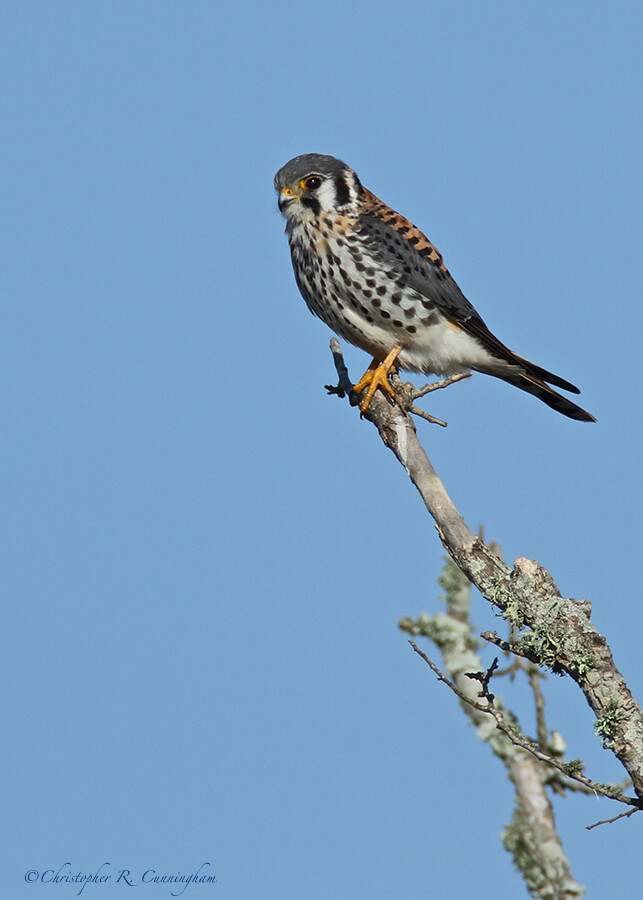
American Kestrel, Anahuac National Wildlife Refuge (Skillern Tract), Texas
Perched Male American Kestrel, Anahuac National Wildlife Refuge (Skillern Tract), Texas. This bird is surveying tall prairie grasses from the edge of a woods. Canon EOS 7D/600mm f/4L IS (+1.4x TC). High-speed synchronized fill-flash.

Once the amateur’s naive approach and humble willingness to learn fades away, the creative spirit of good photography dies with it. Every professional should remain always in his heart an amateur.—Alfred Eisenstaedt

©2015 Christopher R. Cunningham. All rights reserved. No text or images may be duplicated or distributed.

And so it begins . . . .

For everything that lives is holy, life delights in life.—William Blake

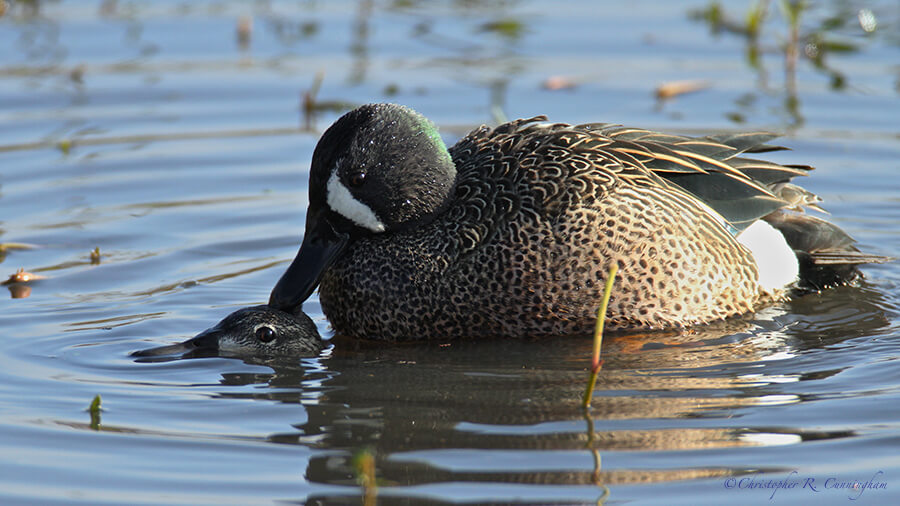
Mating Blue-winged Teal, Pilant Lake, Brazos Bend State Park
Mating Blue-winged Teal, Pilant Lake, Brazos Bend State Park (BBSP), Texas. Canon EOS 7D/600mm f/4L IS (+1.4x TC). Natural light.

Having grown up among the frozen wastes of Minnesota during the 1960’s and 1970’s (when it was cold!), it’s always a shock to me how early spring begins here in the Texas subtropics. This year breeding behavior seems to have begun even earlier than usual, probably due to the unusually warm winter weather (82° F in Houston on 2/9/15?). February has barely begun and the air is full of birdsong, the four-note song of the Carolina Chickadee being especially prominent. Northern Cardinals and Carolina Wrens are also singing proudly from the bare branches.

On 2/7/15 I observed a pair of Blue-winged Teal mating on Pilant Lake, BBSP. Blue-winged Teal nest primarily in grassy areas around calm ponds and lakes on the prairies (“pothole prairie” habitat) across North America, especially the upper Midwest. In Texas, Blue-winged Teal breed primarily in the Panhandle, although they are known to breed sporadically along the Upper Texas Coast down to the Rio Grande Valley. Females are known for their secretive nesting behavior, so Blue-winged Teal nests and ducklings are definitely worth keeping an eye out for this spring at BBSP.

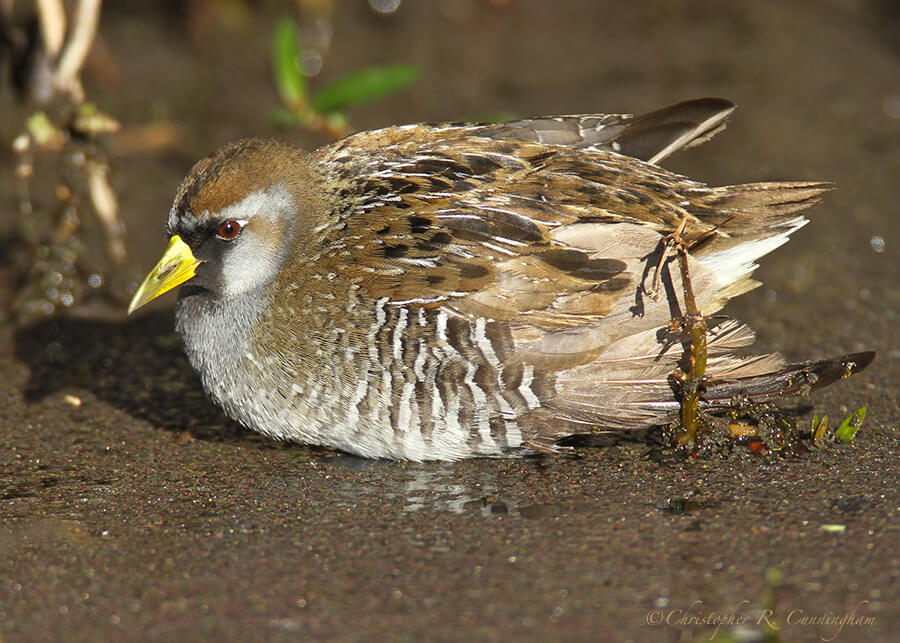
Sunning Sora, Pilant Lake, Brazos Bend State Park, Texas.
Sunning Sora, Pilant Lake, Brazos Bend State Park, Texas. Canon EOS 7D/600mm f/4L IS (+1.4x TC). This Sora sat right out in the open sunning on a chilly winter morning—so much for the “secretive” Sora! High-speed synchronized fill-flash.

Despite the oft-purported “widespread” and “common” nature of the Sora reported in the literature, I am always excited to see these quirky and charming (and often—nay usually—photographically uncooperative) rails. One caught my eye recently along the southern margin of Pilant Lake. This bird saw me and ambled into a hollow patch of brush under a fallen limb and kept an eye on me. This foolish bird thought it could wait me out! Me!

Sure enough, after half an hour the bird gave up on the silly man with the camera and came back out for a sun bath. Interestingly, the spot where the rail rested had two trails of tamped-down grasses leading up to it. The spot had several features in common with published descriptions of nesting sites. Although Sora nests are rare in Texas, and the spot this bird hunkered down in was probably just a hidey-hole, hope springs eternal that I found a nesting site, and I’ll keep my eye on it in the weeks to come.

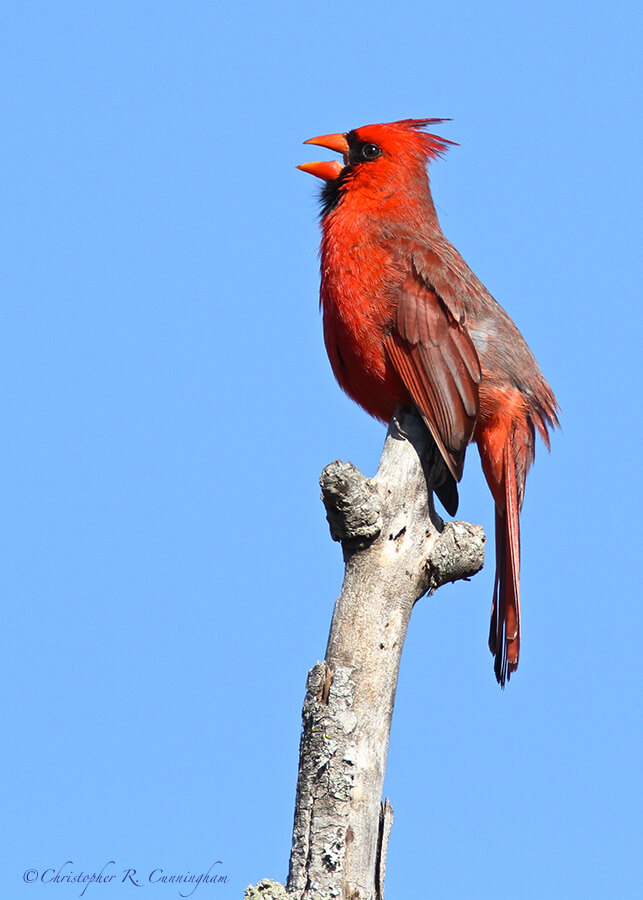
Singing Male Cardinal, Pilant Lake, Brazos Bend State Park, Texas.
The Singing Tree: Male Cardinal, Pilant Lake, Brazos Bend State Park, Texas. Northern Cardinals sing all year long, but step it up in spring and into summer. Several species of birds sing from this dead tree in the shallows of Pilant Lake. Canon EOS 7D/600mm f/4L IS (+1.4x TC). Natural light.

 ©2015 Christopher R. Cunningham. All rights reserved. No text or images may be duplicated or distributed without permission.
More Snowy Egret Fishing Techniques

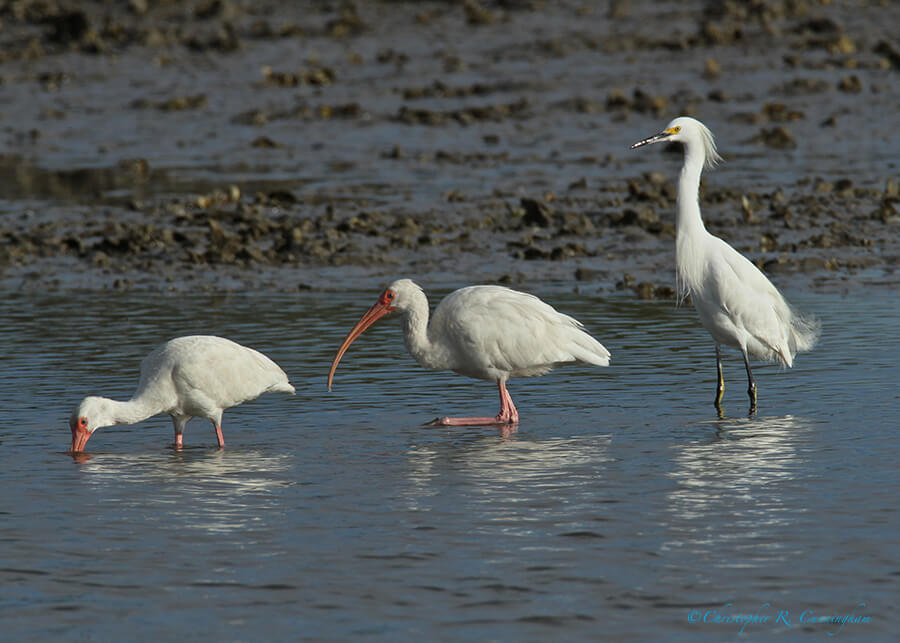
Snowy Egret shadowing two White Ibis, Frenchtown Road, Bolivar Peninsula, Texas
A Snowy Egret Shadows Two White Ibises, Frenchtown Road, Bolivar Peninsula, Texas. Canon EOS 7D/600mm f/4L IS (+1.4x TC). High-speed synchronized fill-flash.

Salt marshes, tidal channels, and lagoons along Frenchtown Road, Bolivar Peninsula, Texas often make for exceptional birding. On our last visit to Frenchtown Road (8-10 AM, 1/17/15), I observed several interesting avian fishing techniques at low tide among the exposed oyster patch reefs. Although a number of bird species (including Short-billed Dowitchers, Killdeer, Spotted Sandpipers, and American Avocets) were taking advantage of the low water level, a Snowy Egret was being especially opportunistic. I made observations referenced in this post on the north shore of the western extremity of the east-west channel. j

Among waders, Snowy Egrets may have the widest repertoire of hunting and fishing techniques, and I have written about several of them, including blowing bubbles to attract prey and shadowing Pied-billed Grebes from the shore as the latter spooked up prey, among others. At Frenchtown Road, this Snowy Egret shadowed a group of White Ibises as they hunted the shallows for infaunal invertebrates along the margins of the exposed oyster reefs at low tide. Presumably the ibises flushed prey, thus saving the egret the energy of exercising its most famous hunting technique, that of waving its bright yellow feet.

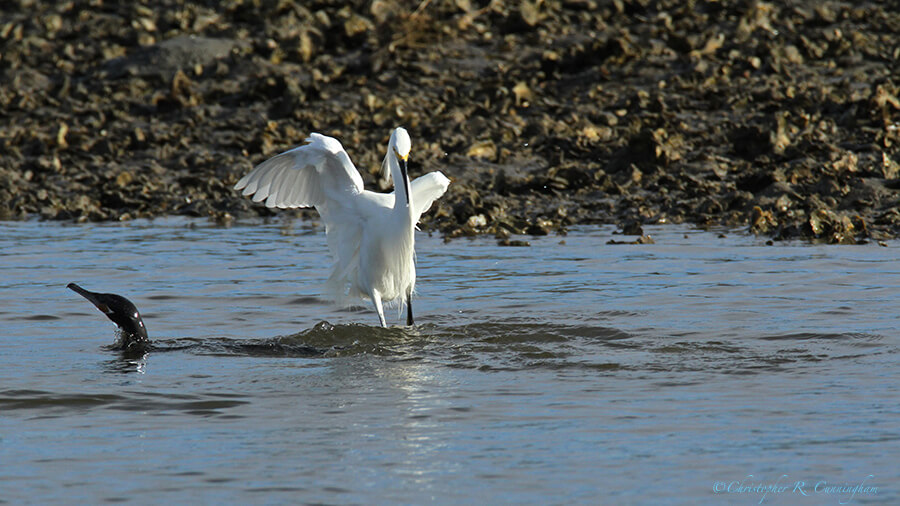
More interesting was when a Double-crested Cormorant went zooming back and forth, through the channels between reefs. As the cormorant swam past, the Snowy Egret launched into a frenetic dance and struck at prey in the cormorant’s wake, not unlike the dancing between bouts of underwing fishing exhibited by Reddish Egrets and Tri-colored Herons. This type of commensal behavior has been documented previously in the scientific literature (Bennett and Smithson, 2001; Emlen and Ambrose, 1970) and on-line for interaction of Snowy Egrets with such species as White Ibises, Double-crested Cormorants, Blue-winged Teal, and Red-breasted Mergansers.

These observations suggest several questions: Why do Snowy Egrets Exhibit such a wide range of hunting behaviors relative to other waders? How many new strategies remain to be be discovered? Given the widespread distribution of Snowy Egrets across the Americas, do Snowy Egrets interact with only a handful of other species, or rather do they simply look for prey-flushing disturbances, irrespective of the species/source? Clearly, there are many more observations and interpretations to be made.

Snowy Egret Wake Fishing, Frenchtown Road, Bolivar Peninsula, Texas
Wake-fishing Snowy Egret, Frenchtown Road, Bolivar Peninsula, Texas. The cormorant was patrolling the channels between exposed oyster reefs like a submarine when the Snowy Egret leapt into the wake in search of prey. Canon EOS 7D/600mm f/4L IS (+1.4x TC). High-speed synchronized fill-flash.

You can observe a lot by watching.—Yogi Berra

References:

Bennett, J., and Smithson, W. S. 2001. Feeding associations between Snowy Egrets and Red-breasted Mergansers. Waterbirds 24 (1): 125-128.

Emlen, S. T., and Ambrose III, H. W. 1970. Feeding interactions of snowy egrets and red-breasted mergansers. Auk 87: 164-5.

©2015 Christopher R. Cunningham. All rights reserved. No text or images may be duplicated or distributed without permission.