“To a man, ornithologists are tall, slender, and bearded so that they can stand motionless for hours, imitating kindly trees, as they watch for birds.”–Gore Vidal
Galveston Island has been a central focus for our birding activities during spring migration 2013. Over the past week I have been quietly adding images to my Galveston Island Birds Collection. Please take a look.
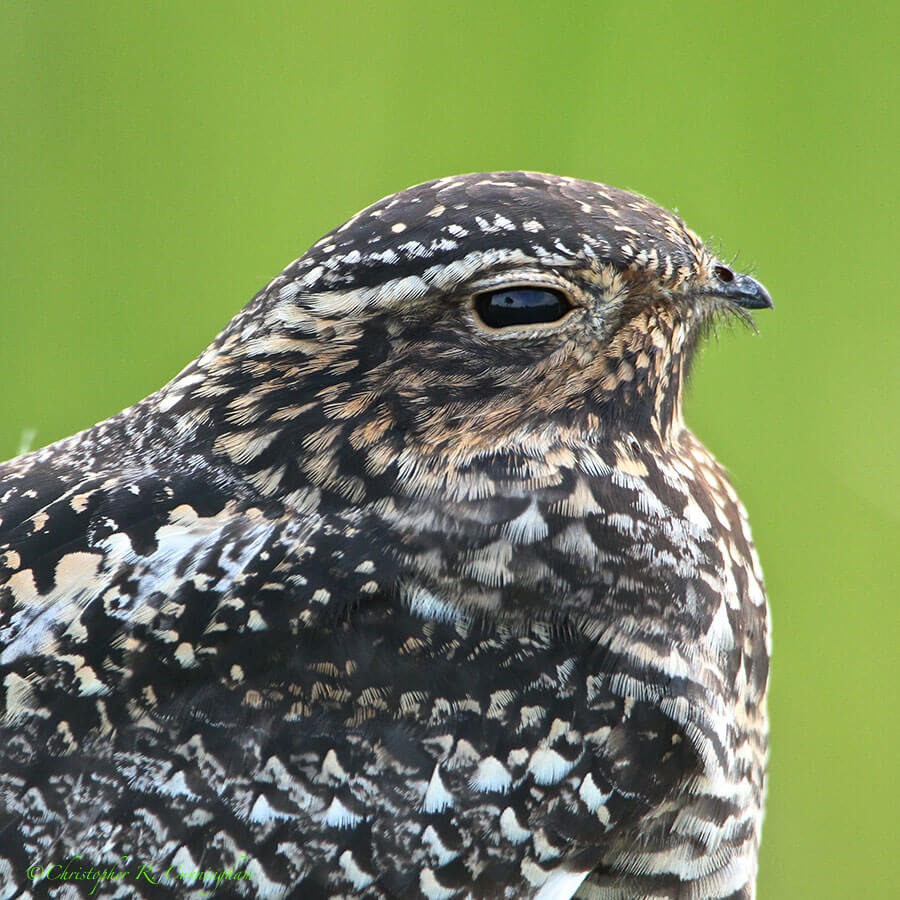
Portrait: Common Nighthawk. As a child in Minnesota I watched nighthawks feeding on insects high in the air. I never dreamed I would get such a close look. Lafitte’s Cove, natural light.
Soon I will be trying to acclimate to the broiling Gulf Coast summer–and dreaming of staking out coastal migrant traps during fall migration 2013. It’s not that far off . . . the earliest crop of migrants should start showing up in late July! Can’t wait!
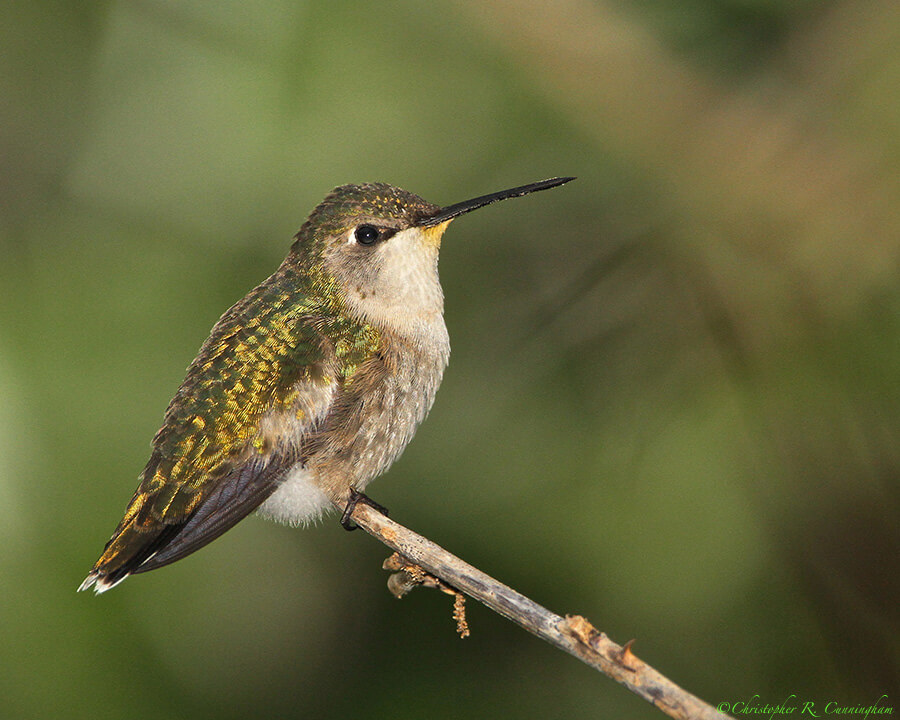
Ruby-throated Hummingbird at Lafitte’s Cove, Galveston Island, Texas. Shots like this showing specular reflection and structural color sparked some reading on the optics of avian color–and may have hatched an area of research regarding those hard to identify female and juvenile hummingbirds. High-speed synchronized flash.
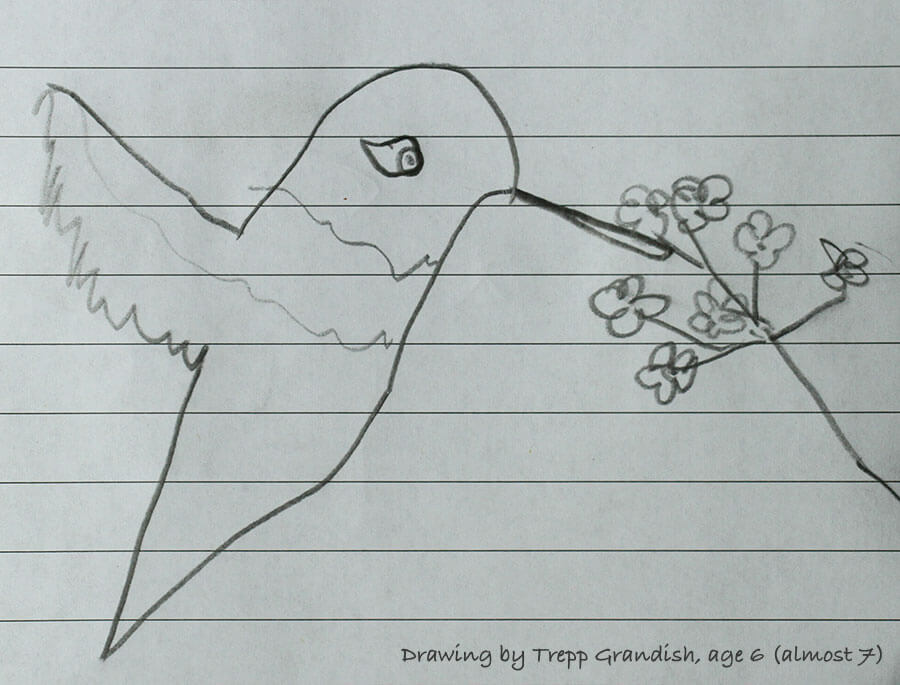
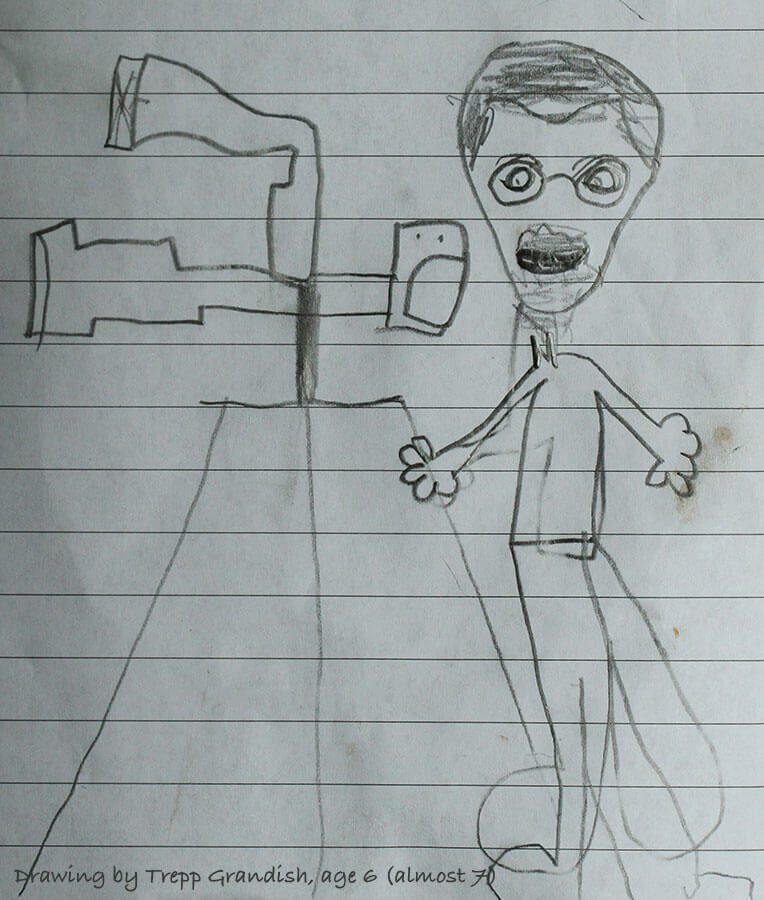
Trepp’s interpretation of my Ruby-throated Hummingbird image. Nature illustration is one of many ways young people express their interest in and curiosity about the natural world.
We don’t often see children out birding. Frankly, as high school teachers, we inked that feature into the “pros of birding” column when we were auditioning feasible hobbies. Children, it seems, neither make happy birders nor birders happy.
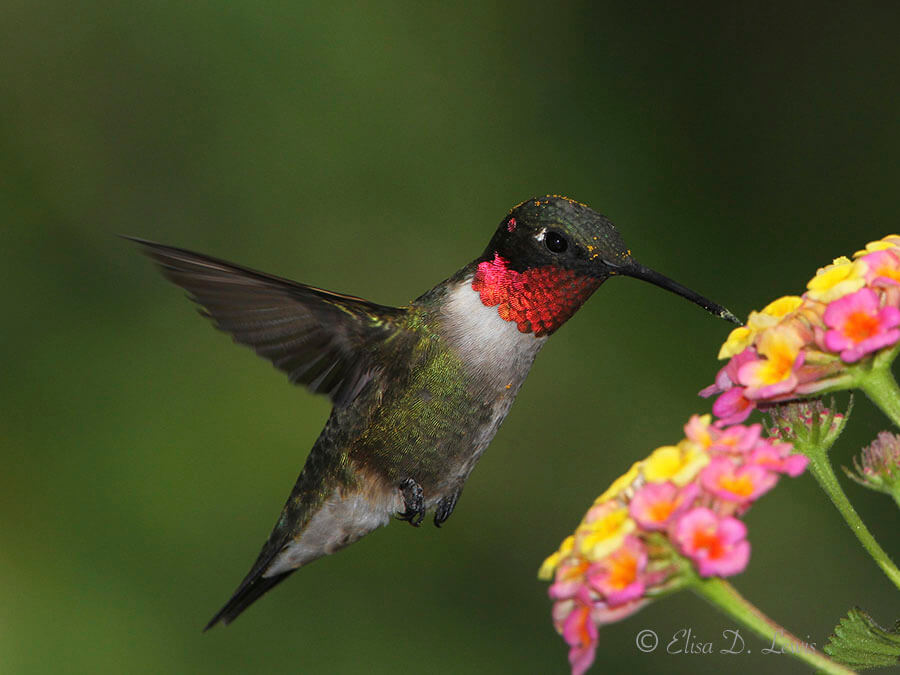
A Ruby-throated Hummingbird feeds from a lantana flower cluster at Lafitte’s Cove Nature Preserve on Galveston Island, TX. Notice the dusting of pollen on his headTrepp captured Chris discussing our camera set-up during the HANPA April 2013 meeting.
It may seem ironic but, we were pleasantly surprised to see two young visitors to our “Behind the Blog” presentation at the Houston Audubon Nature Photography Association (HANPA) meeting in April. (Willing students are always appreciated!) Brothers Richard and Trepp, eight and six, stayed as long as their bedtime would allow. We were impressed by the quality and depth of their questions and received several wonderful sketches capturing parts of the program. Encouraged by this passionate interest at such a young age, I was reminded that birders need to cultivate the next generation of birders if bird conservation – let alone nature conservation – is to have a future.
Flashback to the late 1990’s when Chris and I lived in Austin: We were the only “kids” in the creek beds during school-term weekends. We were re-living our childhood–where were the real kids spending theirs? Was this a generational shift to the indoors or a shift born of crime statistics, real and imagined? My parent friends tell me it was fundamentally the latter. Computer activities were (and presumably still are) the safer option. How do we foster exploration and conservation if the great outdoors needs a chaperone?
“The sun, with all those planets revolving around it and dependent on it, can still ripen a bunch of grapes as if it had nothing else in the universe to do.” –Galileo Galilei
After a slow start, spring migration rallied, and now has begun to taper off. Some highly unusual weather patterns made the first week in May absolutely wonderful for birding, although the birds may have suffered for it. Massive cold fronts brought record-breaking cold and dry weather to Texas (and many other places). Some birds were so exhausted after flying into strong head-winds that they staggered and stumbled through the ground cover devouring every bug they encountered, oblivious to birders standing inches away. Sadly some didn’t survive their epic flight across the Gulf of Mexico: here and there gloriously colored little bodies lay among the leaf litter–a Scarlet Tanager, here, a Magnolia Warbler, there.
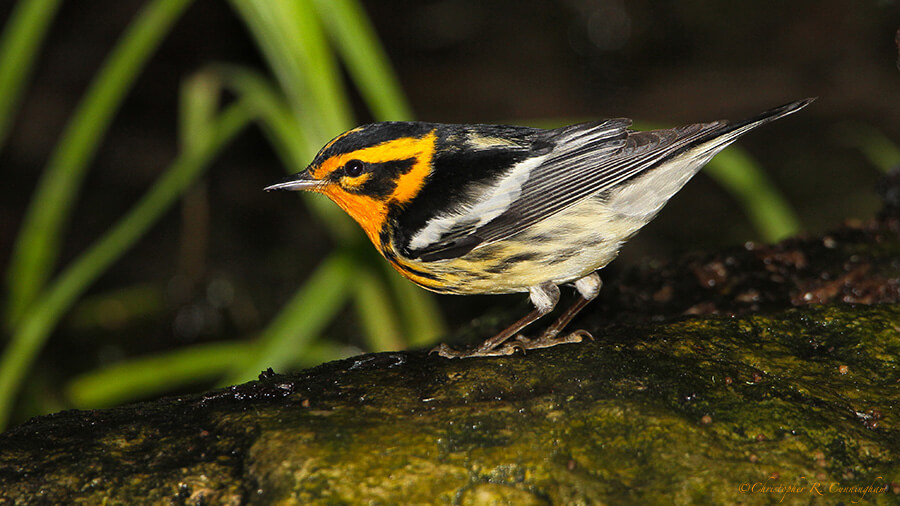
Male Blackburnian Warbler at the dripper, Lafitte’s Cove, Galveston Island, Texas. The first week in May at Lafitte’s Cove was amazing. High-speed synchronized flash.
Monster rain storms at the end of April soaked the Texas Gulf Coast, clearing allergens from the air. Cool dry weather afterward meant comfortable birding. Cold fronts with dew points in the twenties, however, dried everything out quickly, allowing the air to again fill with pollen and spores leaving many a birder to wipe his or her nose every few minutes–a minor imperfection in otherwise perfect weather.
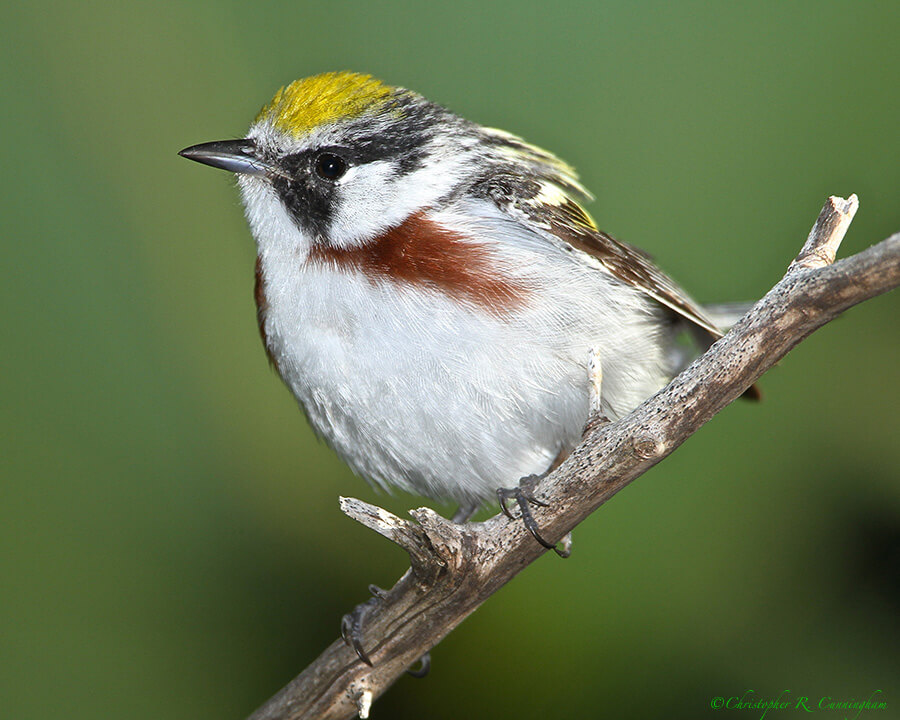
Chestnut-sided Warbler at Lafitte’s Cove, Galveston Island, Texas. High-speed synchronized flash.
I spent most of the first weekend in May at Lafitte’s Cove, Galveston Island. At least one major fallout during that time frame meant exceptional birding. There were times when the vegetation was literally hopping with warblers, vireos, orioles, tanagers, grossbeaks, buntings, flycatchers, hummingbirds, thrashers, and thrushes, among others. Flashes of avian color were all around. The warblers were particularly amazing. I noted Blackburnian, Prothonotary, Yellow, Wilson’s, Blue-winged, Common Yellowthroat, Chesnut-sided, Canada, American Redstart, Magnolia, Tennessee, Nashville, Kentucky, Black and White, Worm-eating, Northern Parula, Palm, Ovenbird, Louisiana Waterthrush, and Hooded Warblers–just a few short of 50% of the 49 warbler species that occur in the U.S. Add to that the seven species seen by other birders (and reported to me in the field) in the same time frame, and well over half of U.S. species were observed within this little patch of trees in just a few days.
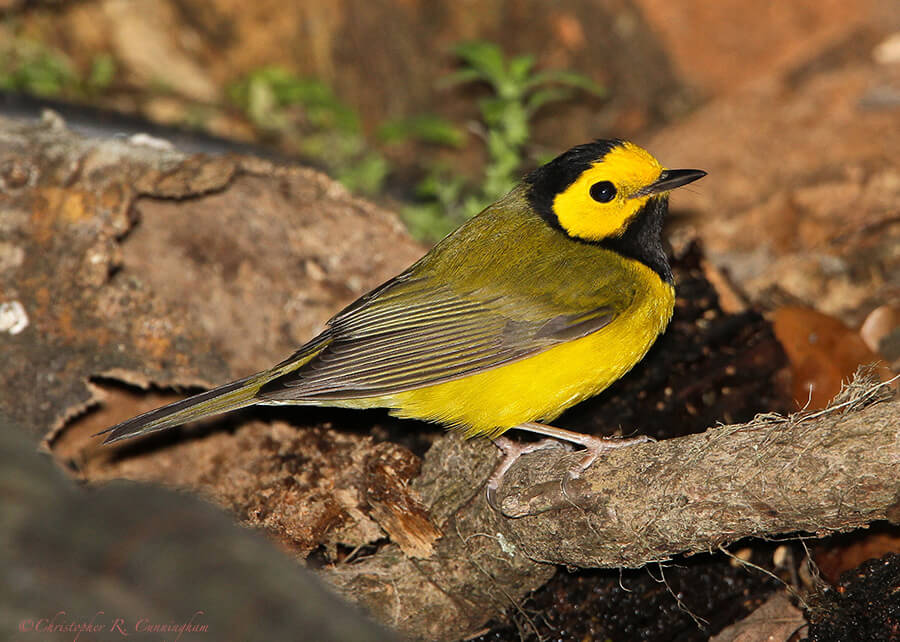
Male Hooded Warbler at Lafitte’s Cove, Galveston Island, Texas. High-speed synchronized flash.
Of all people on this trip during spring migration, I thought of Sir Isaac Newton, ornithologist. Yes, we can add ornithologist to mathematical and physical genius, ruthless enforcer of government policy, and nutty historian and theologian. Sir Isaac was the first to attribute the structural colors of bird feathers to interference and diffraction (physical optics). And he was the first to really understand the seasons as the result of the precession of the earth’s spin axis due to a gravitational torque exerted by the sun and moon–although his equations needed a little tweaking by later workers. So we owe some of our most basic understandings of two of the most important themes in birdwatching, avian color and the seasons, to Sir Isaac Newton.
Now that the spring migration is ending, I’ll have to start getting back into summer mode–primarily going after wader hunting scenes, one of my favorite subjects, but somehow lacking the glory of the migration. Just the thought and awesome spectacle of hundreds of millions of birds chasing the sun and warmth and exploding insect populations north inspires. I can’t wait for next spring!
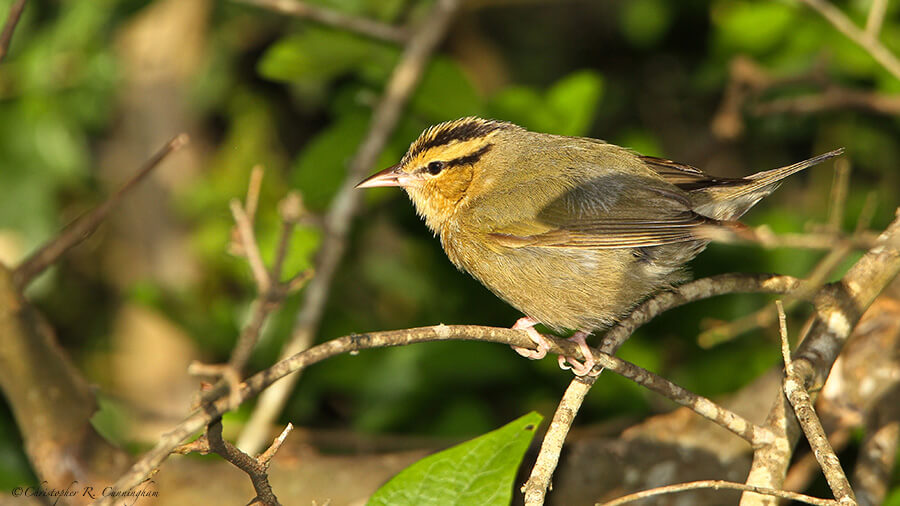
Worm-eating Warbler at Lafitte’s Cove, Galveston Island, Texas. High-speed synchronized fill-flash.
Finally, at 11:07 AM on Sunday, May 5th, the shutter on my beloved Canon EOS 7D gave out. 7Ds are rated for 100,000 shutter actuations, which I think I far exceeded. I wasn’t even upset at the camera that died just as a Common Yellowthroat appeared for a drink of water. The 7D is a marvel of technology and among the best values on the planet. I removed the CF card and retired it to a place of honor on the shelf containing my other obsolete or spent camera bodies. I bought a new 7D on the following Monday.
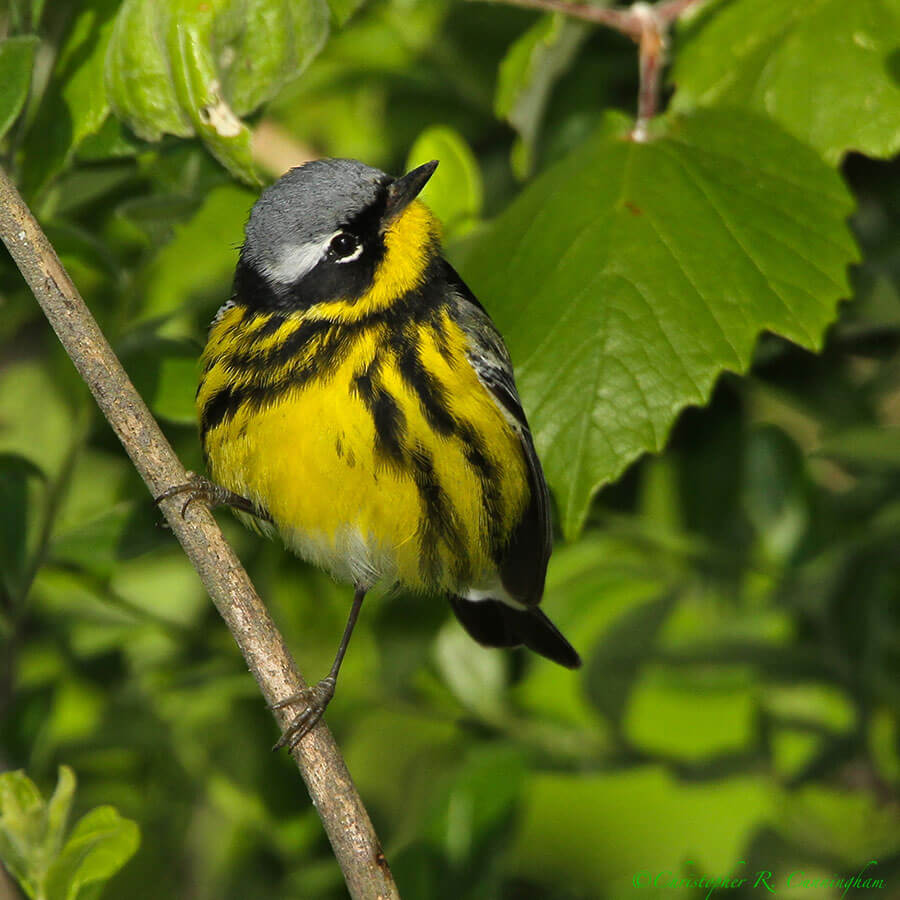
Magnolia Warbler Among the Grape Vines, Lafitte’s Cove, Galveston Island, Texas. Perhaps they’ll be laden with ripe and rotting fruit (attracting tasty bugs!) for the return journey. High-speed synchronized fill-flash.
I would be interested to learn just how dangerous birdwatching is statistically relative to other hobbies–say rail dragster racing, extreme fighting, or chainsaw juggling. But seriously, from time-to-time major dangers do present themselves. I’ve been in the mountains with lightning bolts dancing around me, and large (or venomous) animals have moved in my direction from time to time. The crack of a nearby hunter’s gunfire has also gathered my attention on several occasions.
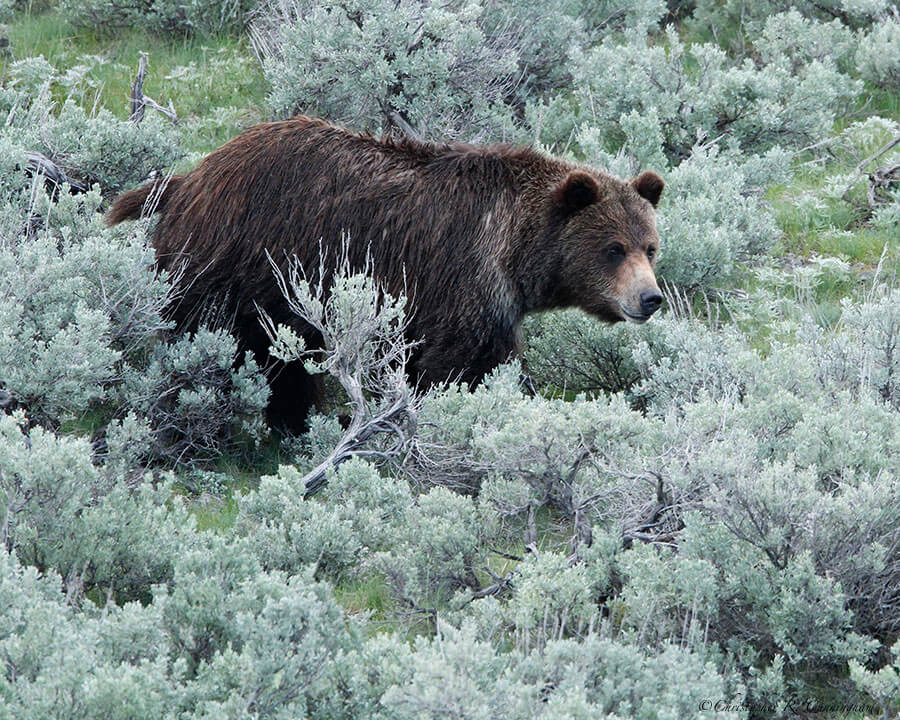
Grizzly Bear in the Lamar Valley Sagebrush Country, Yellowstone National Park, Wyoming. Black bears and Grizzly bears can be surprisingly difficult to tell apart. I think this is a young Grizzly given the small, rounded ears, concave face and slight shoulder hump. Also, five minutes before we saw a classic black Black Bear that looked quite different–although not all Black bears in a given area are necessarily similar. I invite comments from anyone who knows better, however. In any case, one should always bring a change of underwear when photographing bears, black or brown.
On the other hand, a host of less dramatic, but real threats await the birder. Poisonous plants like poison ivy and oak can cause significant misery–as can a cactus thorn through the foot. Biting and stinging arthropods may be a significant aspect of being in the field, depending on location. Africanized “killer” bees, lyme disease-carrying ticks, and West Nile virus-carrying mosquitos are not to be scoffed at.
Animals (except man-eaters, typically injured large felids) seem to know that humans are a menace instinctively and flee or keep a safe distance at the approach of man. When an animal does not flee, or even approaches people (especially during daylight hours), one of two things is usually the case: people have been feeding the animal, or it is sick. Rabies, the most terrifying of the zoonotic diseases with its extreme virulence in mammals, is the worst fear. Even the cure is a nightmare.
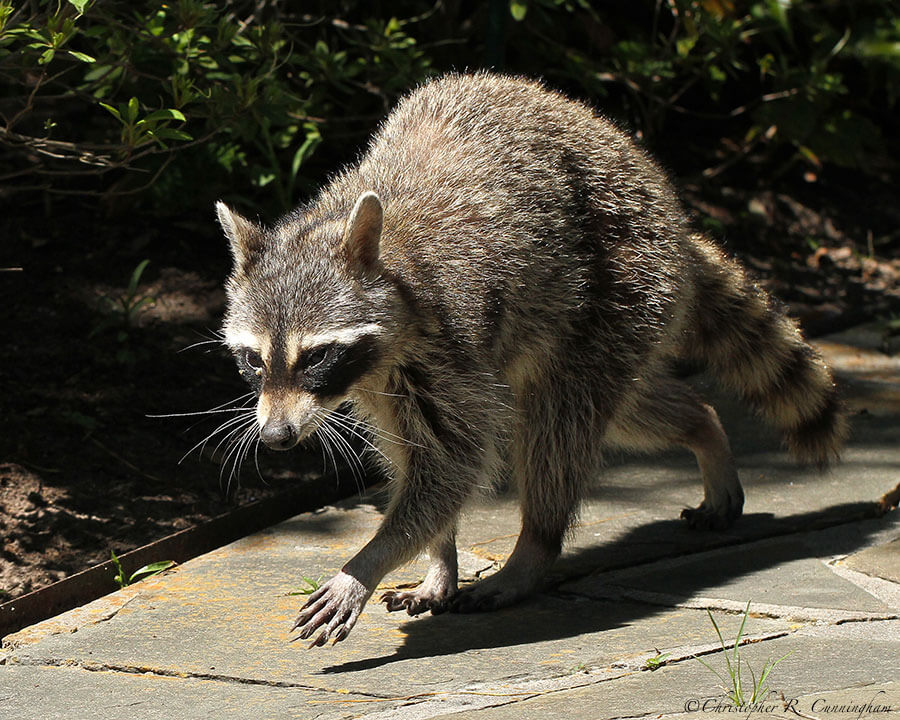
Not cute, MP: This raccoon is sick. It showed no fear of humans and marched right toward person after person. At first I though people had been feeding it, but the dull, lifeless mucous-encrusted eyes suggested illness, probably canine distemper. Elisa called animal control. Photo taken hand-held with Canon EOS 7D/100mm f/2.8L IS USM under natural light.
As fearsome as some animals can be, the most dangerous animal in the woods is almost always man. It is sometimes difficult to assess just how dangerous any particular human is to other people without access to their rap sheet. Thankfully I have not crossed paths with any truly dangerous individuals (that I know of). I have, however, been made extremely nervous a few times by other humans. This nervousness has led me to acquire a set of walkie-talkies so that I can periodically check on Elisa’s safety (and she on mine).
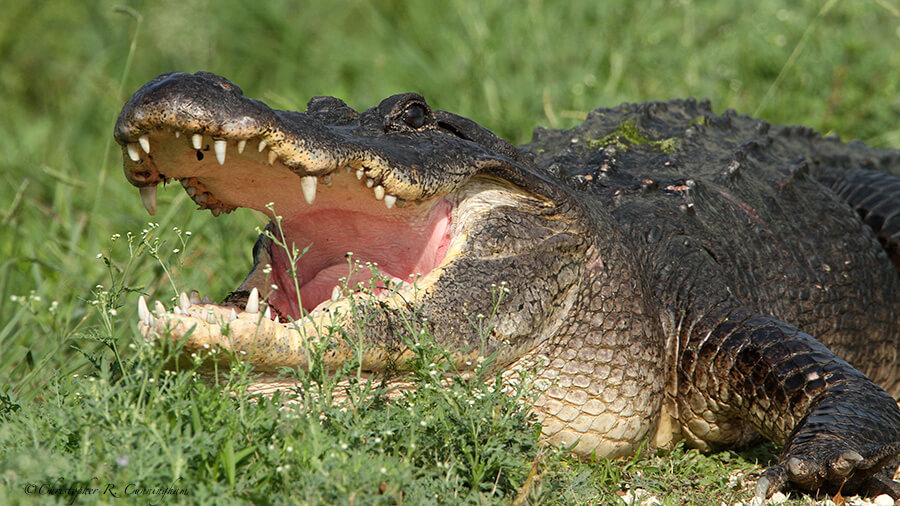
Gaping Gator: no match for a man with a gun. Alligators are dangerous, no question. But, unlike bears and big cats, I do not fear them. Only one has come after me in the field–and it was my fault. I was standing ankle-deep in a patch of water hyacinth, so engrossed in the birds around me that I missed the submarine threat.
Although birdwatching can be dangerous, the benefits (especially health benefits) clearly outweigh the risks. The minute I step into the field I can feel the stress melt away. By the end of the day the little nagging headache is gone, and I can think clearly–no more of the mental fog, the result of daily trials and tribulations. One old-timer I met on a catwalk across a subtropical forest canopy said: “Go birding, you’ll live longer.” Unless I lose my balance, I thought.
In any case, just like the old joke about the really dangerous part of skydiving being the drive to the airport, I am confident that the real danger in birdwatching lies in getting to the park or sanctuary via our Texas highways.
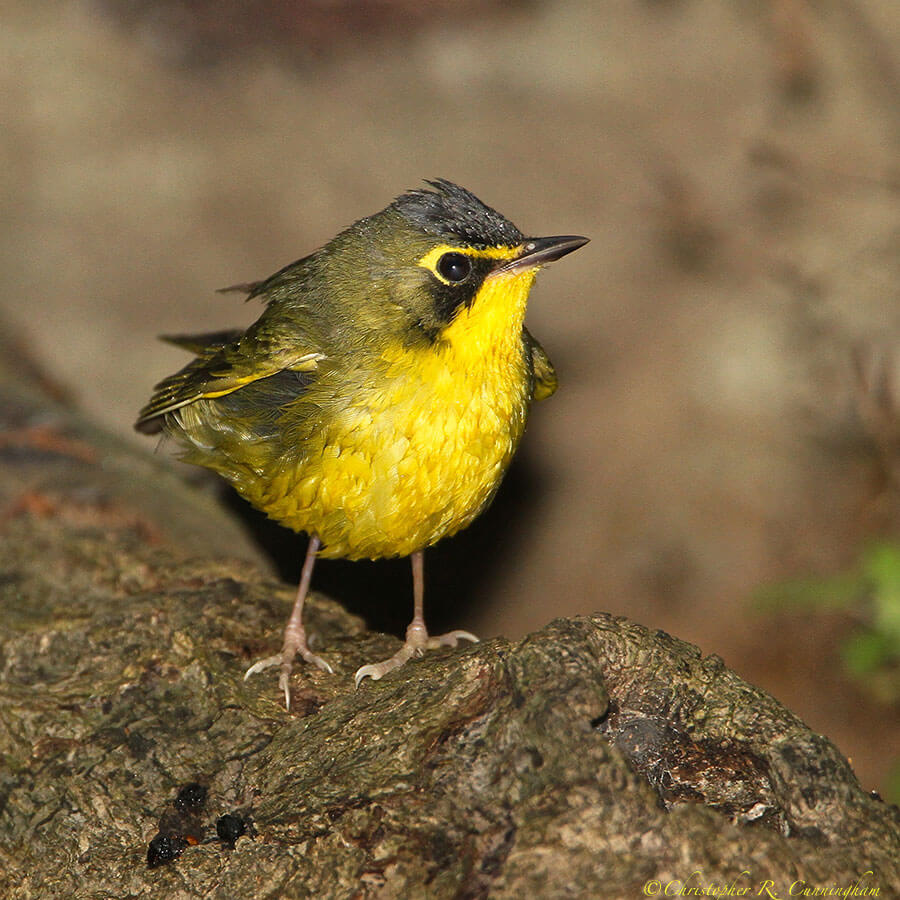
Bathing Kentucky Warbler at Lafitte’s Cove, Galveston Island, Texas. Warblers are not dangerous: approach with confidence. Photo taken in a drizzle on a dank, gloomy morning with high-speed synchronized flash.
Human beings are not the natural prey of tigers, and it is only when tigers have been incapacitated through wounds or old age that, in order to live, they are compelled to take to a diet of human flesh.–Jim Corbett, Man-eaters of Kumaon