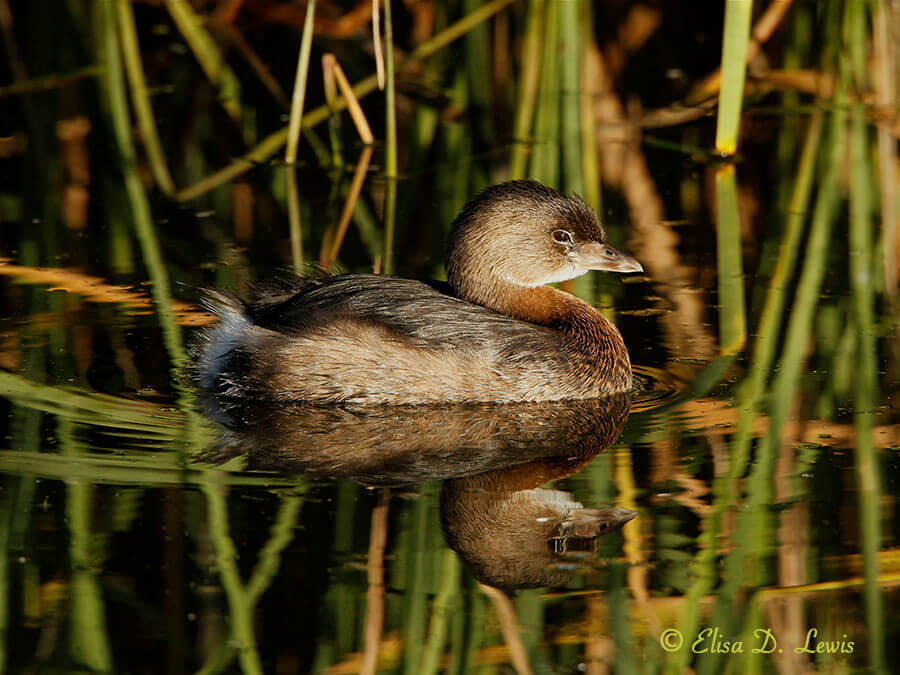
Pied-billed Grebe in Nonbreeding Plumage at South Padre Island Birding Center, Texas. Photo taken in late December under natural light. Canon EOS 7D/500mm f/4L IS (+1.4x TC).
Pied-billed Grebes are fascinating foot-propelled diving birds–submarine hunters that are uncomfortable on land due to their anatomy. These birds are fun to watch as they dive, and then emerge seconds later, sometimes with a struggling fish, frog, or crawfish clamped in their bills. Texas birders are lucky to be able to observe the complete life cycle of the Pied-billed Grebe.
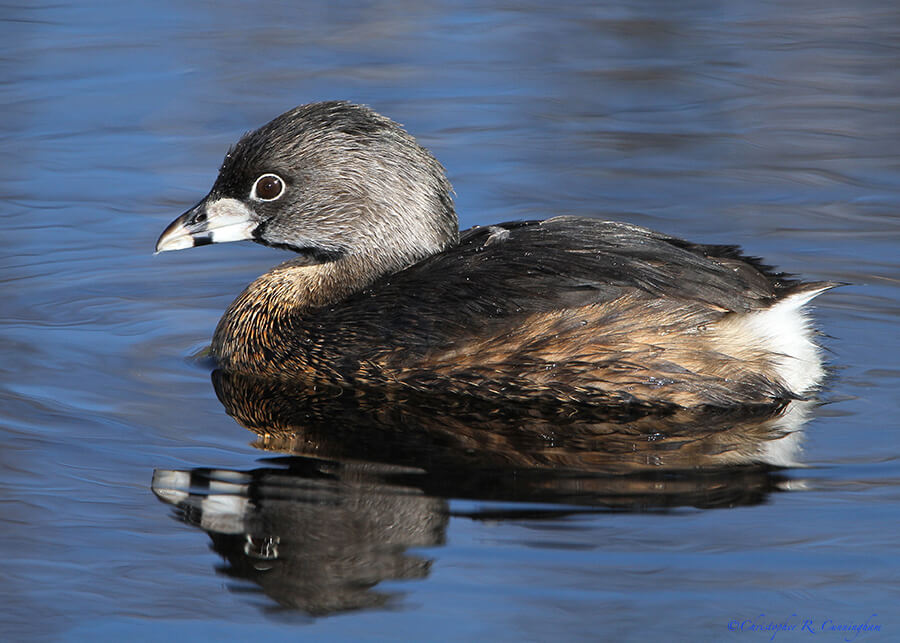
Pied-billed Grebe in Breeding Plumage at Elm Lake, Brazos Bend State Park, Texas. Photo taken in early March. Canon EOS 7D/500mm f/4L IS (+1.4x TC). High-speed synchronized fill-flash.
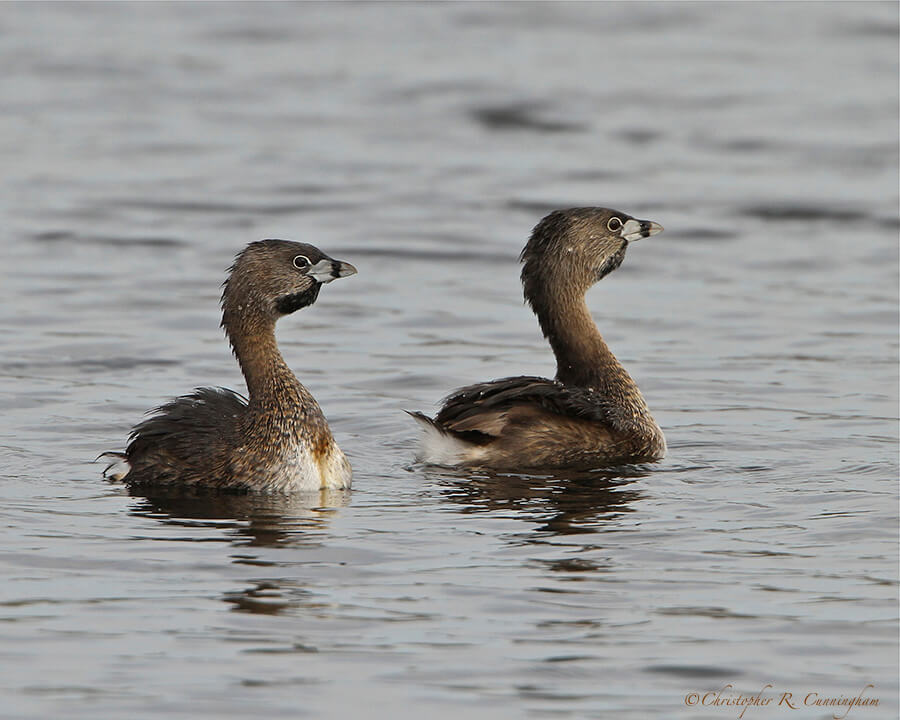
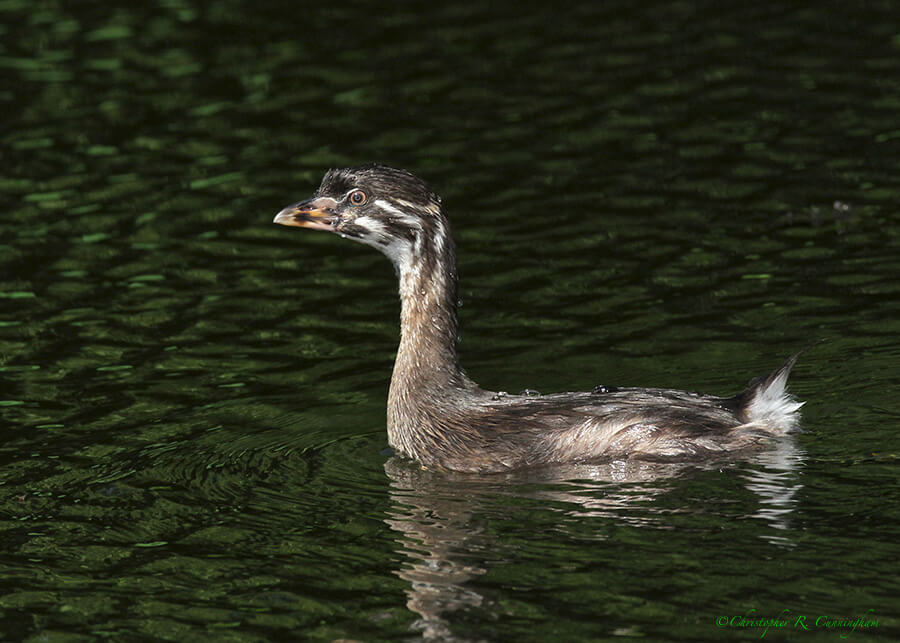
One of the challenging aspects of birding, one that provides a real sense of depth and richness to the hobby, is sorting through the variation in plumage exhibited by many birds as they mature and move through their life cycles. Juvenile Pied-billed Grebes, like many young water birds, are striped. As you can see above, the nonbreeding plumage of the Pied-billed Grebe has a distinctly rufous cast, whereas the breeding plumage is more gray. During the breeding season, Pied-billed Grebes develop black throats and a black stripe on their beaks. There is no sexual dimorphism in coloration.
Mated pair of Pied-billed Grebes at Elm Lake, Brazos Bend State Park, Texas. Photo taken in late February. Note the conspicuous black throats. Canon 7D/500mm f/4L IS (+1.4x TC). Natural light.
Although Pied-billed Grebes are common at Brazos Bend State Park, we have yet to definitely identify nests or nestlings there. Pied-billed Grebes typically build nests on floating vegetation and may produce two broods of highly precocial young from April through October. Grebe chicks can leave the nest in as little as a day, sleep on their parents’ backs, and spend the first few weeks of life outside the nest hiding in vegetation until they learn to swim. The youngster shown below is likely from the first brood of this summer, which means that we may have another chance to observe and photograph Grebe family life this season. At Brazos Bend, we’ll be scanning the water and scrutinizing the vegetation with extra diligence though the early fall until we find Grebe nests and chicks!
Juvenile Pied-billed Grebe at Brazos Bend State Park. Photo taken at Elm Lake in early July. Canon EOS 7D/600mm f/4L IS. High-speed synchronized fill-flash.
“It can be a trap of the photographer to think that his or her best pictures were the ones that were hardest to get.” – Timothy Allen
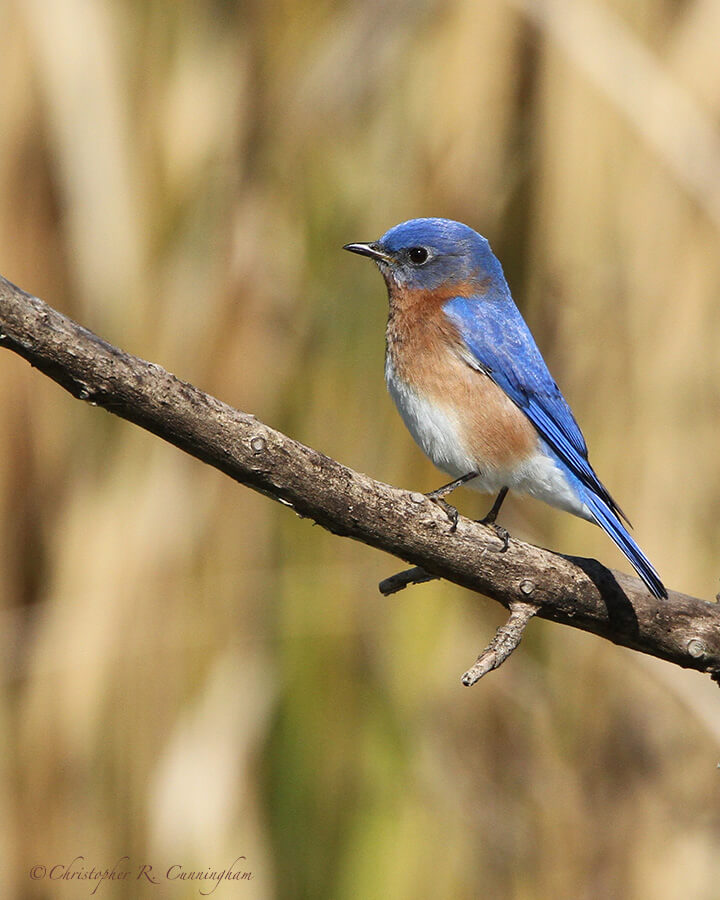
Sapphire: Male Eastern Bluebird. This bird utilized a nest cavity near Pilant Lake, Brazos Bend State Park, during spring of 2013. Eastern Bluebirds are common sights around Elm Lake throughout the summer. Canon EOS 7D/500mm f/4L IS (+1.4x TC). High-speed synchronized fill-flash.
Although the vast majority of brightly-colored songbirds in Texas during the spring migration continue their journeys north, a few species remain to add flashes of color to the post-migration greenery. These include Prothonotary Warblers, Northern Parulas, Eastern Bluebirds, Painted Buntings, and Summer Tanagers.
Of course, one of the things to watch for in the spring and summer is nesting behavior. Early this spring in an area of Brazos Bend State Park much frequented by warblers and other songbirds, I identified a nest cavity being used by a mated pair of Eastern Bluebirds (male shown above). Much later in the spring, the same nest cavity was adopted by Prothonotary Warblers.
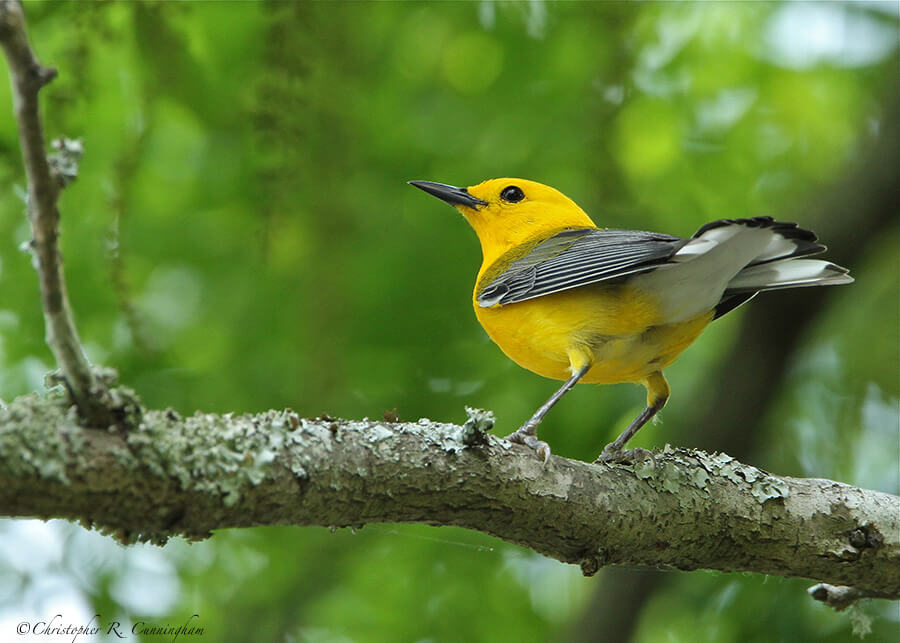
Sadly, about two weeks ago I noticed that the top of the dead tree containing the nest cavity snapped off, taking the cavity with it. Last week, too, I noticed that another nest cavity in this area was gone. The whole dead tree collapsed. This is unfortunate as this little patch of forest and slough has been a reliable spot for nest cavities and songbirds for the past several years. I spotted the male Prothonotary Warbler shown below, for example, in this same area last summer. What a reminder that things humans place no value on, like dead trees, can be vital to the health of an ecosystem.
Citrine: Male Prothonotary Warbler. Golden Swamp Warbler is the original (and so much better) name for this bird. Photo taken near Pilant Lake under natural light in late spring. Canon EOS 7D/500mm f/4L IS (+1.4x TC).
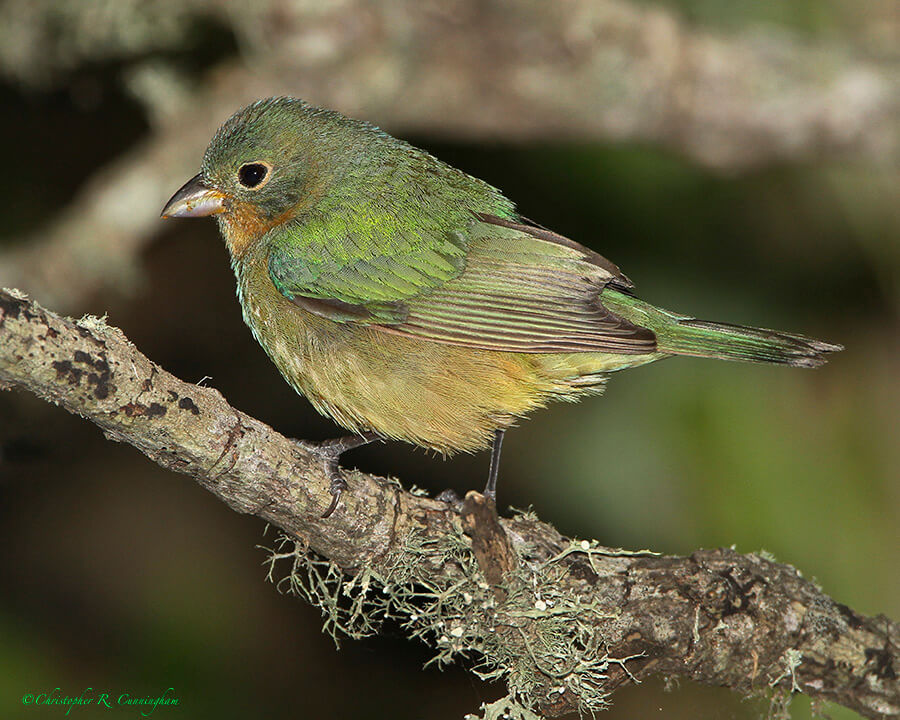
Painted buntings, especially the adult males, are among the most brilliantly-colored songbirds in North America. It’s not uncommon for people to come up to me breathlessly in the field with something like: “We saw this bird, it was . . . .” “Male Painted Bunting,” I interrupt gently.
The best place to find Painted Buntings in summer at Brazos Bend is where there are tall grasses with mature seed-heads adjacent to wooded areas (just in case a quick getaway is required). Painted buntings are so spectacular they, no doubt, will warrant a whole post of their own at some point in the future.
Emerald: Young Male Painted Bunting Showing Brilliant Green Specular Reflection at Lafitte’s Cove, Galveston Island, Texas. Like some minerals, the iridescence and colors of some bird feathers are structural (the result of reflection, diffraction, and interference of light) rather than absorption and reflection due to pigmentation. This fellow it just starting to molt into his multicolored adult plumage. Photo taken during spring migration. Canon EOS 7D/500mm f/4L IS (+1.4x TC) with high-speed synchronized flash.
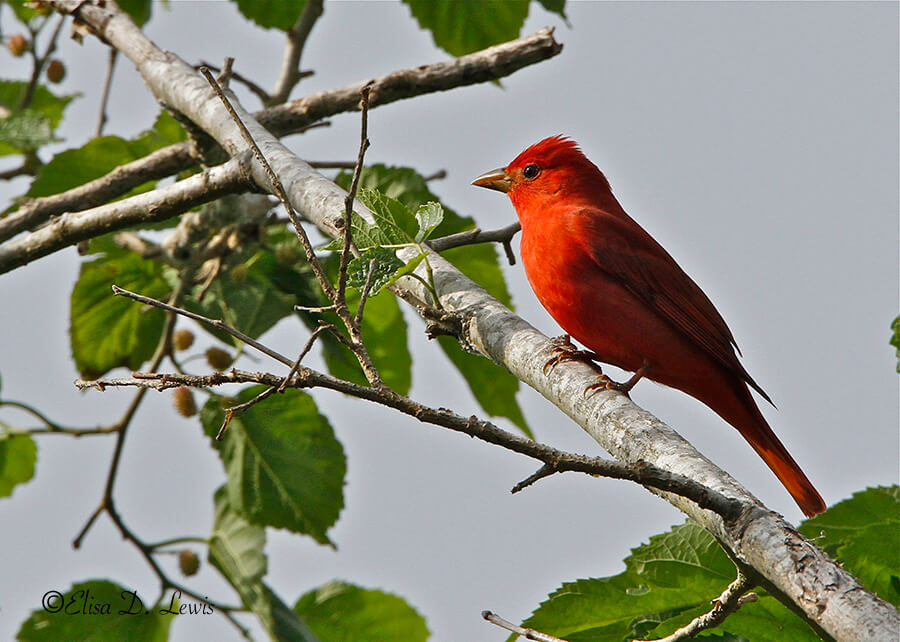
Tanagers are such prized summer sightings along the Texas Gulf Coast that I find myself double-checking every male Northern Cardinal I see. A rule of thumb is helpful when looking for Tanagers: find the fruit (especially mulberries), find the birds. Otherwise, Summer Tanagers are specialist feeders on bees and wasps. A few times I have chased Tanagers through the sweltering underbrush in hopes of getting a shot–usually to no avail. Photographing birds in the fully leafed-out summer forest is tough, and songbirds, coy creatures that they are, are not about to cooperate.
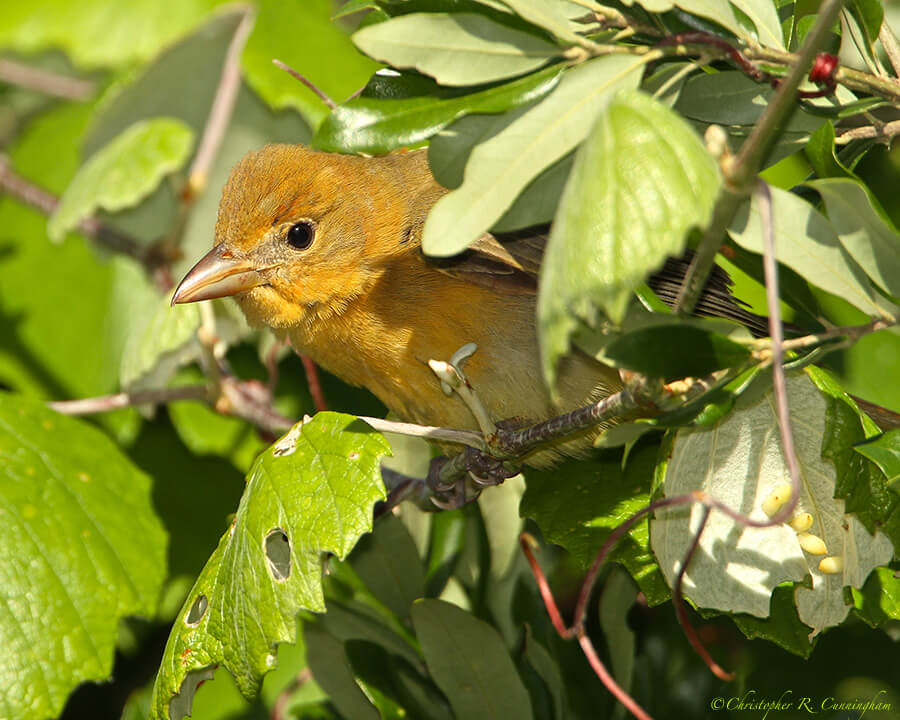
Ruby: Male Summer Tanager in a Mulberry Tree at Sabine Woods, Texas. Elisa captured this image on a hot, muggy, and buggy morning in early April. Natural light. Canon EOS 7D/500mm f/4L IS (+1.4x TC).Peek-a-boo: Female Summer Tanager among the Grape Vines at Lafitte’s Cove, Galveston Island, Texas. No fruit yet: bugs will have to do. Photo taken during spring migration. Perhaps this Summer Tanager stayed in East Texas–some do. Canon EOS 7D/500mm f/4L IS (+1.4x TC) with high-speed synchronized fill-flash.
“What makes photography a strange invention is that its primary raw materials are light and time.”–John Berger
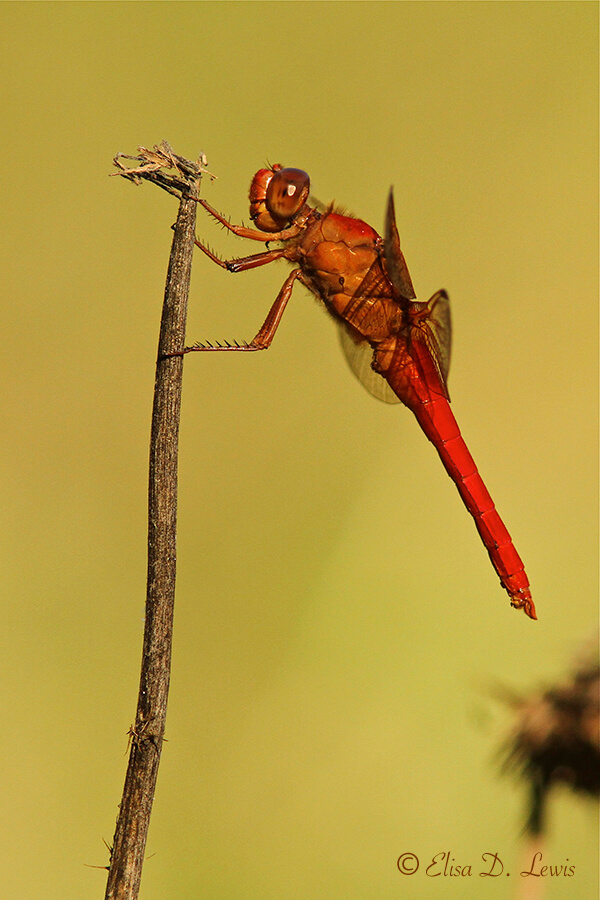
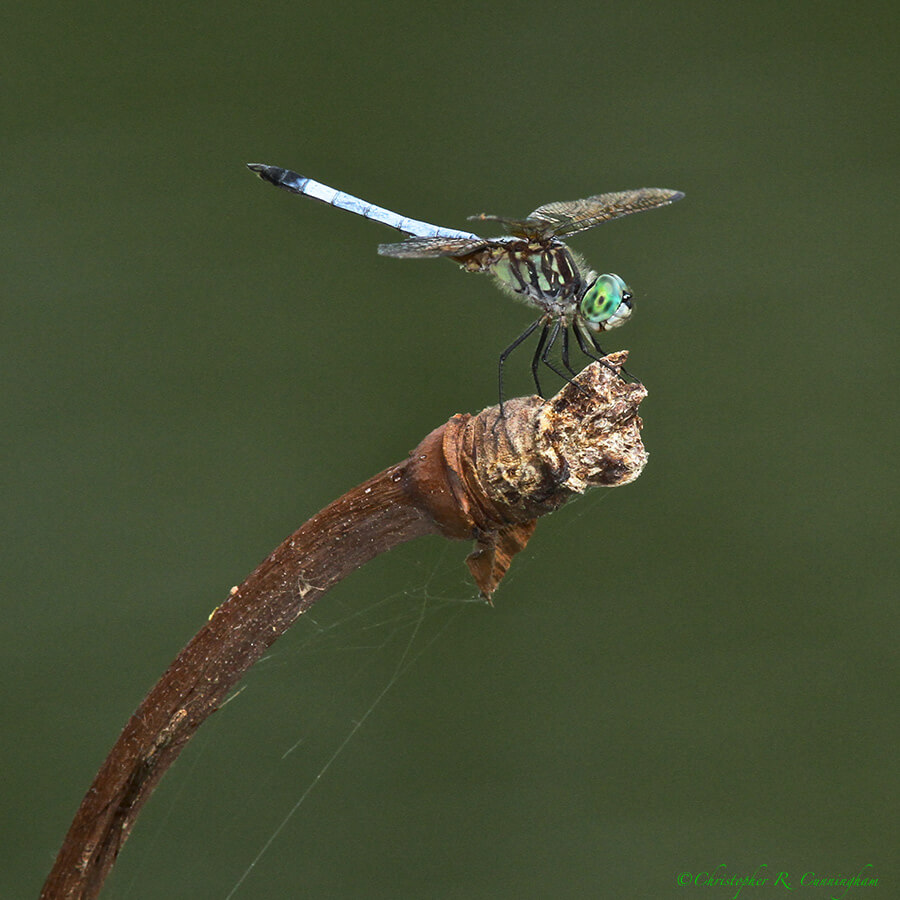
Flame Skimmer Dragonfly(Libellula saturata) at Lost Maples State Natural Area, Central Texas. Elisa got this shot with a Canon EOS 7D/300mm f/4L IS (+1.4x TC)/tripod. According to internet sources, the 300mm f/4 is a popular lens for dragonfly shots. Natural light.
During the summer in Gulf Coast Texas, when bird diversity is relatively low, there are generally lots of insects–especially dragonflies–to draw the photographer’s attention. Clearly dragonflies, although small, cannot be treated like typical macro subjects, at least most of the time. First of all, they are highly aware of their surroundings and sometimes won’t let you get close to them. Second, along the Gulf Coast they are often perched on emergent vegetation in alligator- and water moccasin-infested water, or chigger-infested grass.
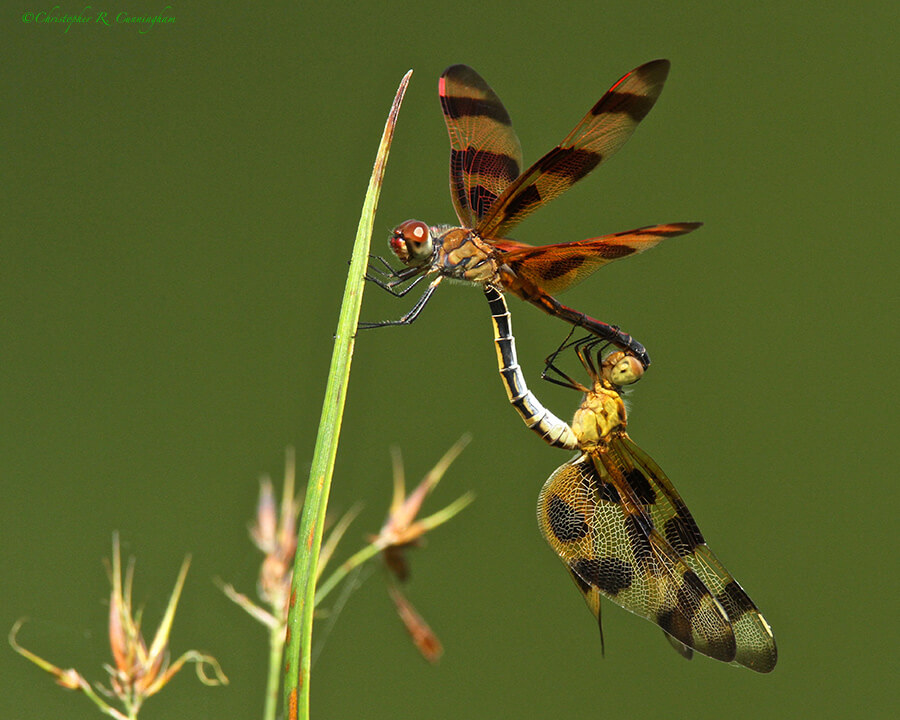
Mating Halloween Pennant Dragonflies (Celithemis eponina) in a Strong Breeze at Brazos Bend State Park, Texas. Photo taken at Elm Lake. This shot was only cropped significantly in the horizontal dimension: In other words, these insects nearly filled the frame vertically with this combination of equipment at the minimum focus distance. Canon EOS 7D/600mm f/4L IS (+1.4x TC)/tripod with high-speed synchronized flash.
So rather than use a lens requiring a close approach (the super sharp 100mm f/2.8L IS macro, for example), the question becomes which super telephoto is the best dragonfly lens? Further, is flash necessary or even best? Should the 1.4x teleconverter be used? What about extension tubes? With this many questions and permutations of possible combinations of equipment (plus field considerations), I’ve come nowhere near a definite conclusion, but at least I have identified some issues–and I’m excited about further experimentation!
Although I know that some photographers use extension tubes in this application, for the moment I’m taking them off the table primarily because these devices (hollow tubes inserted between the camera and lens that decrease the minimum focus distance while retaining most camera functions) significantly decrease the flexibility of the set-up. Extension tubes cost image brightness, slow autofocus (if they allow it to function at all), slightly shift the focal point of the lens, and degrade the ability to focus at a distance. I’m looking for a rig that will allow excellent captures of dragonflies while preserving my options should a bird or other animal suddenly appear at a larger distance.
That said, the different super telephotos I have access to (100-400mm, 300mm, 500mm; 600mm) have different minimum focus distances (MFD) and magnifications. Of these, the 100-400mm is definitely out: It is a versatile lens, but it just isn’t as sharp as the primes (fixed focal length lenses). The 300mm has the closest MFD (4.93 ft), but in my experience that is often irrelevant because the bug won’t let you get anywhere near that close.
On the other end of the scale, dragonflies will almost always let you get to the MFD for the 600mm (18.04 ft), but that’s pretty far away for such a small animal. Teleconverters do not affect MFD, but they soak up a little light and degrade sharpness (only slightly for 1.4x on a prime). So far, I have liked some shots taken with the 600mm (+1.4x TC). This is probably because of the number of opportunities I’ve been able to take with such a large MFD–I don’t risk trying to get too close and chase the subject away.
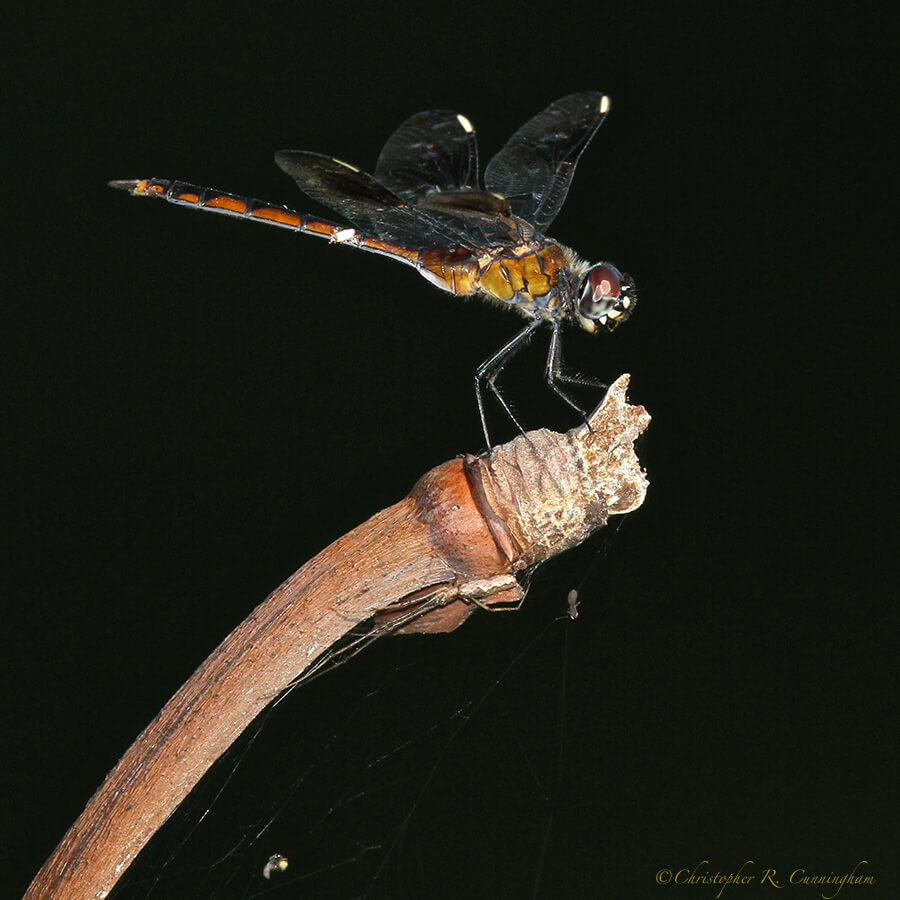
Female Four-spotted Pennant Dragonfly (Brachymesia gravida) at Brazos Bend State Park, Texas. Canon EOS 7D/600mm f/4L IS/tripod. High-speed synchronized flash.
Of the three primes (with teleconverters attached) being discussed here, the 600mm should give the worst results on theoretical grounds. The ratio of focal length (the longer, the better) to MFD (the smaller, the better), is a way to think about this issue. The larger this ratio, the better because it expresses how much focal length “firepower” you have per separation distance. For the 300mm (+1.4x TC), the focal length/MFD ratio = 85 mm/ft. For the 600mm (+1.4x TC), focal length/MFD ratio = 47 mm/ft. The ratio for the 500mm has a value of 48 mm/ft, nearly the same as the 600mm. So if you could get close, the 300mm should be best–but often you can’t get that close. Compromise strikes again!
As far as flash is concerned, it seems to be primarily a matter of taste. Natural light, of course, looks more natural. The flash reveals fine details, especially in the shadows, sometimes not visible in natural light. Flash can sometimes create a magical, almost surreal effect as in the case of the Halloween Pennants above. One clear problem with the flash is the same as in the case of birds: the flash adds an extra catchlight in the eyes. Because dragonflies have large compound eyes, the effect can be pronounced.
Swift Long-winged Skimmer Dragonfly(Pachydiplax longipennis) at Elm Lake, Brazos Bend State park, Texas. Canon EOS 7D/600mm f/4L IS/tripod. Natural light.
So . . . what to do? For now, keep working, trying new combinations, and see if a clear choice emerges that preserves options and image quality. Finally, all this thought about dragonflies has clearly benefitted my bird photography in one way. I can now easily recognize all the common dragonflies around the places I normally shoot, and thus can put a technical name on some of the meals my beloved waders are enjoying!
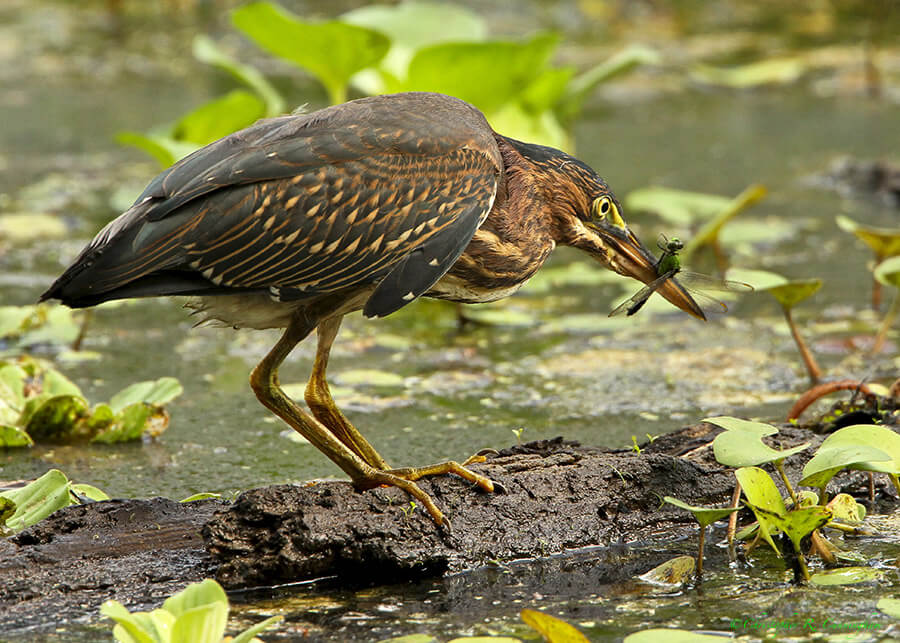
Green Heron with Green Clearwing (Erythemis simplicicollis) at Brazos Bend State Park, Texas. This is my favorite type of dragonfly photography. Canon EOS 7D/500mm f/4L IS (+1.4x TC)/tripod. Natural light.
“Your first 10,000 photographs are your worst.” ― Henri Cartier-Bresson
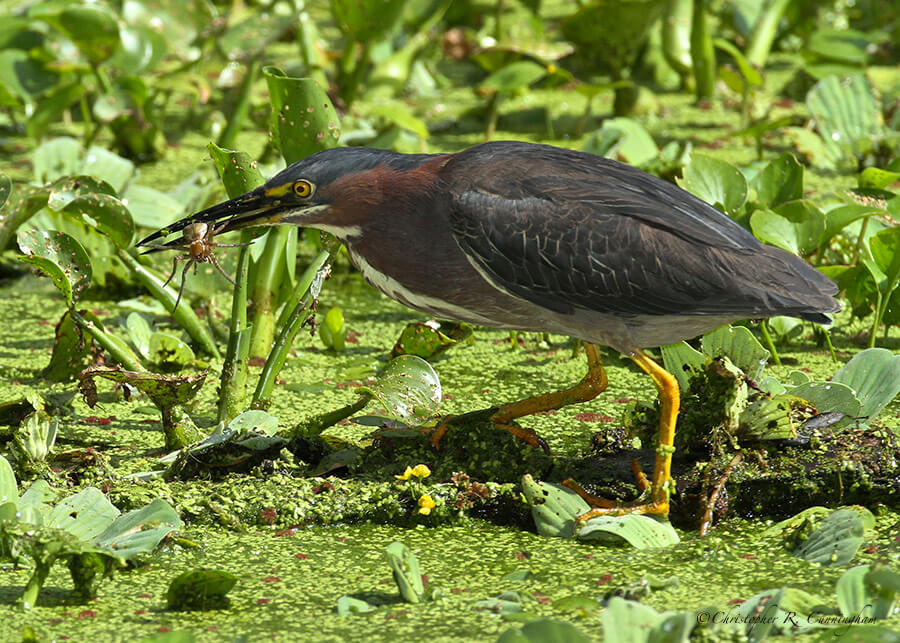
Green Heron with Six-spotted Fishing Spider(Dolomedes triton) at Brazos Bend State Park. Photo taken near Pilant Slough. Canon EOS 7D/600mm f/4L IS (+1.4x TC). High-speed synchronized flash.
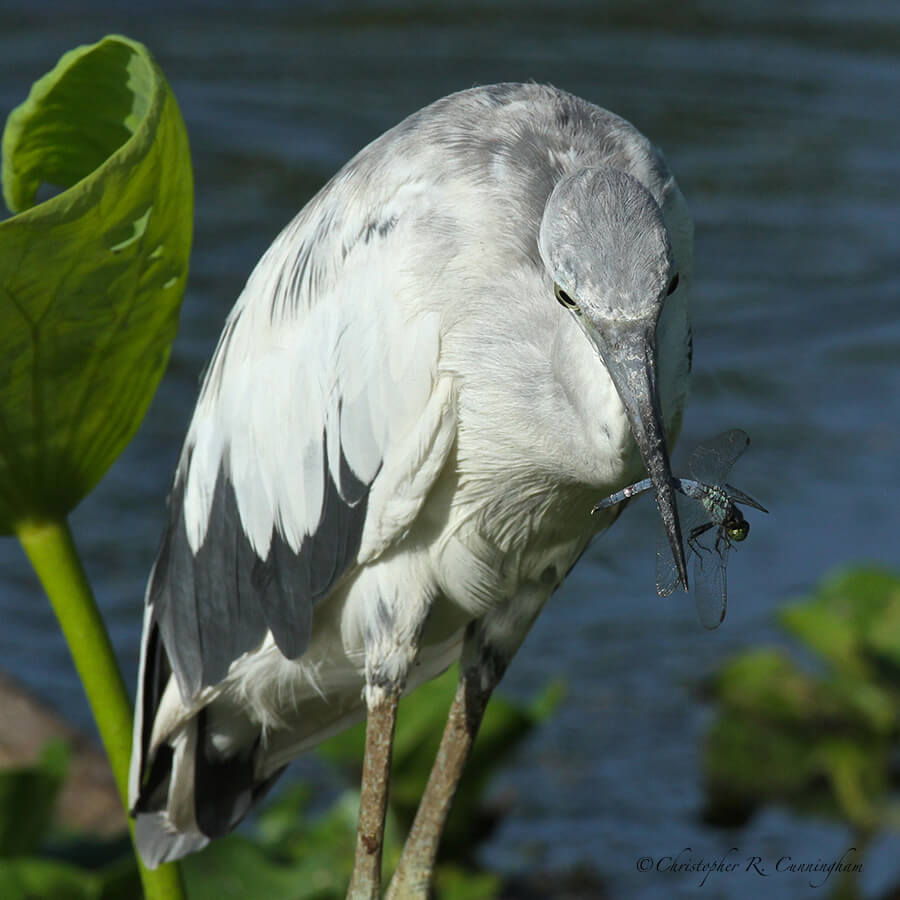
There has been a bumper crop of fishing spiders this year at Brazos Bend State Park, and I have seen Little Blue Herons and Green Herons eat them, sometimes one spider right after another. Some years it seems as though wader diets consist of a fairly uniform mix of aquatic vertebrates and invertebrates, especially crawfish. This year, rather than crawfish, waders seem to be relying more heavily on smaller invertebrate prey items than in recent years. Lots of aquatic insect larvae, dragonflies, adult aquatic bugs and beetles, and spiders are being consumed along with the occasional small fish, frog, or tadpole.
Juvenile Little Blue Heron with Swift Long-winged Skimmer Dragonfly (Pachydiplax longipennis) at 40-Acre Lake, Brazos Bend State Park, Texas. Juvenile Little Blue Herons are fun to stalk: they are prolific hunters but, being young, they still have a level of naiveté toward humans allowing a close approach. Canon EOS 7D/600mm f/4L IS. High-speed synchronized fill-flash.
Invertebrates are highly sensitive to environmental conditions of temperature, humidity, and rainfall. This year’s unusually cool, dry spring may have led to a different mix of potential prey for waders. The Upper Texas Gulf Coast is already behind in rainfall for the summer and water levels already appear low, perhaps impacting aquatic vertebrate numbers as well.
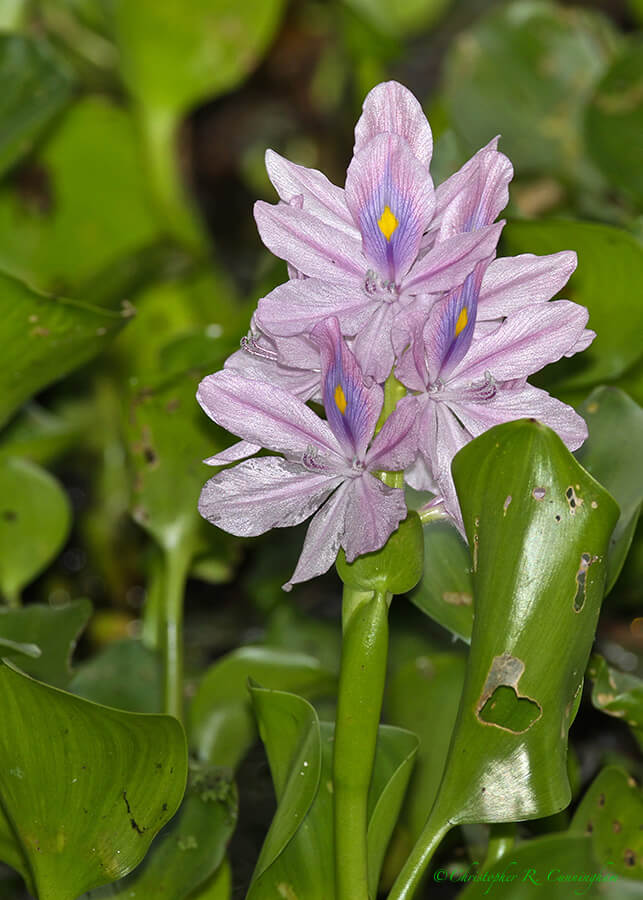
Many of the invertebrates (spiders especially) I see waders take are living among the Water Hyacinth that is growing profusely in some areas of the park. Water Hyacinth is native to the Amazon Basin, but has been imported to many areas of the world where it has become a major nuisance by crowding out and shading native plants and choking waterways.
Beautiful Invasive: Common Water Hyacinth(Eichhornia crassipes) at Brazos Bend State Park. Water Hyacinth is costly and troublesome for land managers. Mechanical, chemical, and biological mechanisms for its control have been devised and employed worldwide.
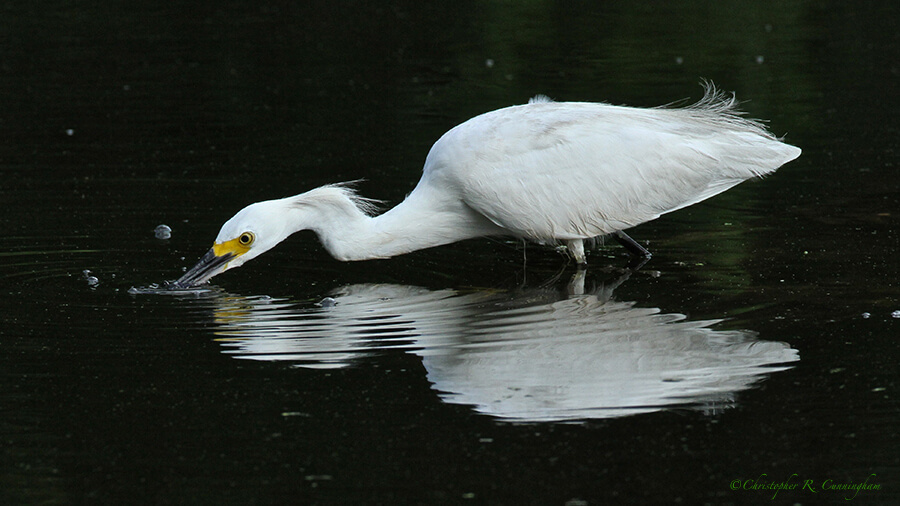
Besides keeping an eye (and a lens) out for interesting wader predator-prey relationships, I am always on the look-out for hunting techniques. For example, Snowy Egrets are known for shuffling their bright yellow feet in the shallows to flush out prey. Several times over the past weeks I have seen a Snowy Egret (I think it was the same bird) employing a bubble-blowing technique on Elm Lake. This bird was (presumably) blowing bubbles to attract prey. Perhaps the bubbling simulates a small struggling animal, attractive to fish and other aquatic predators. Between bouts of bubbling, this bird also opened and closed its beak, a fishing technique I have seen employed by Black-crowned Night-Herons and Great Egrets, and one that also sends ripples out into the water. One time during this process this Snowy Egret grabbed a small aquatic invertebrate–it was down the hatch too fast to tell for sure what it was, although it was about the right size and shape for a water tiger (larval predaceous diving beetle). On another occasion, the egret was clearly catching small fish with this technique. Time will tell if anything bigger can be attracted by blowing bubbles!
Snowy Egret Blowing Bubbles at Brazos Bend State Park, Texas. Photo taken at Elm Lake. Canon EOS 7D/600mm f/4L IS. High-speed synchronized flash.