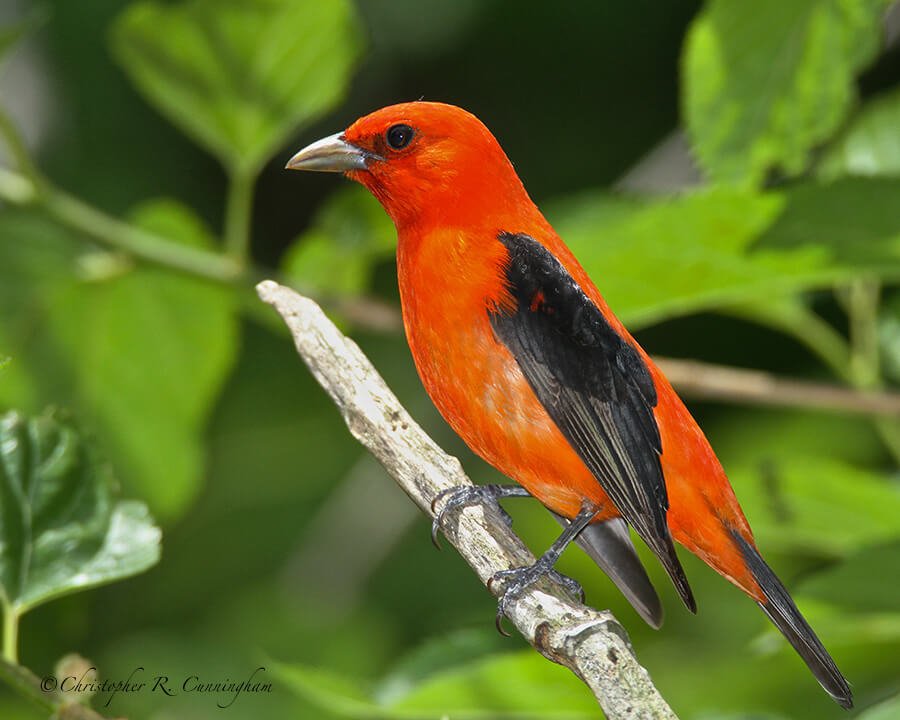
Male Scarlet Tanager in Breeding Color at Pelican Island, Texas. This dandy was feasting on bees and mulberries. Canon EOS 7D/600mm f/4L IS (+1.4x TC). High-speed synchronized fill-flash.
We recently stumbled upon a new strategy for birding the the Upper Texas Coast during spring migration: short road trips south from High Island across the Bolivar Peninsula to Galveston Island. After spending the evening birding High Island and the night in Winnie, Texas, an early morning jaunt down Highway 87 brings the birder past numerous outstanding locales. A copy of Finding birds on the Great Texas Coastal Birding Trail by Ted Lee Eubanks et al. is an excellent resource to use for planning purposes or to have at hand on the road.
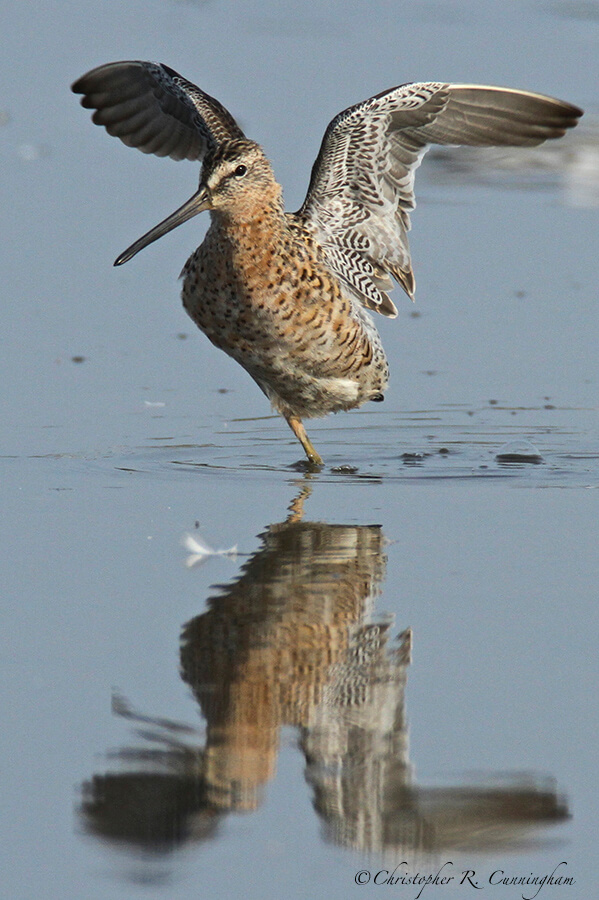
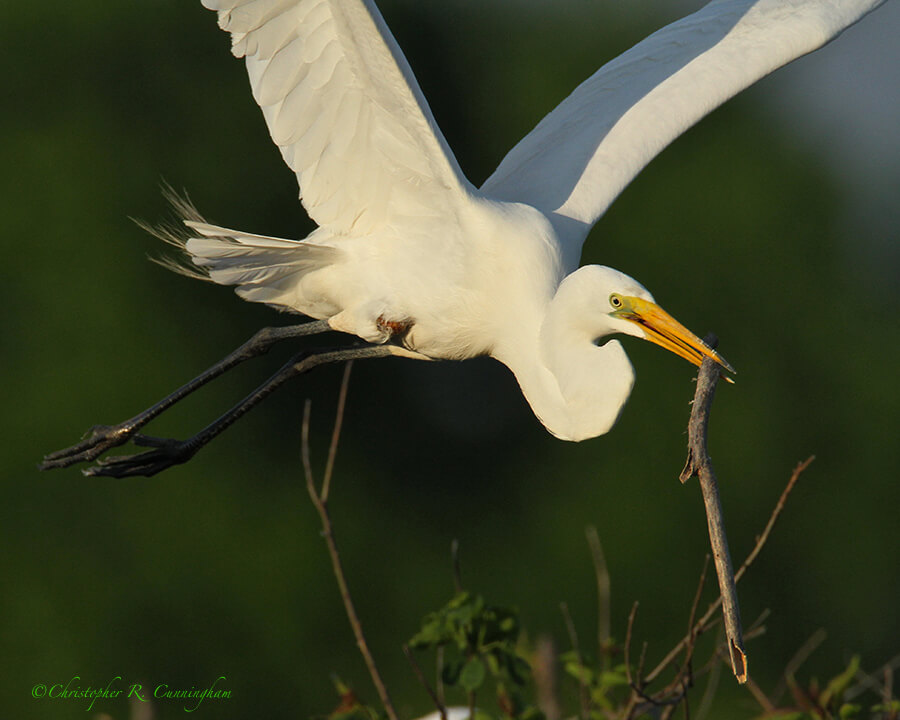
Takeoff: Long-billed Dowitcher at Frenchtown Road, Bolivar Peninsula, Texas. Canon EOS 7D/600mm f/4L IS (+1.4x TC). Hand-held, from car. Natural Light.Great Egret with Stick at Smith Oaks Rookery, High Island, Texas. Birders can currently observe Roseate Spoonbills, Great Egrets, Neotropic Cormorants, and Snowy Egrets fussing with nesting materials at Smith Oaks. Canon EOS 7D/600mm f/4L IS (+1.4x TC). Natural light.
The power of this approach to birding lies in the amazing diversity of coastal habitats and their avian inhabitants one encounters along this route, from oak motte migrant trap to beach to salt marsh to tidal lagoon. On such journeys one can truly appreciate how special this stretch of coast is, and how lucky we are to still be able to observe the incredible flow of biodiversity from the Neotropics (as well as our resident birds).
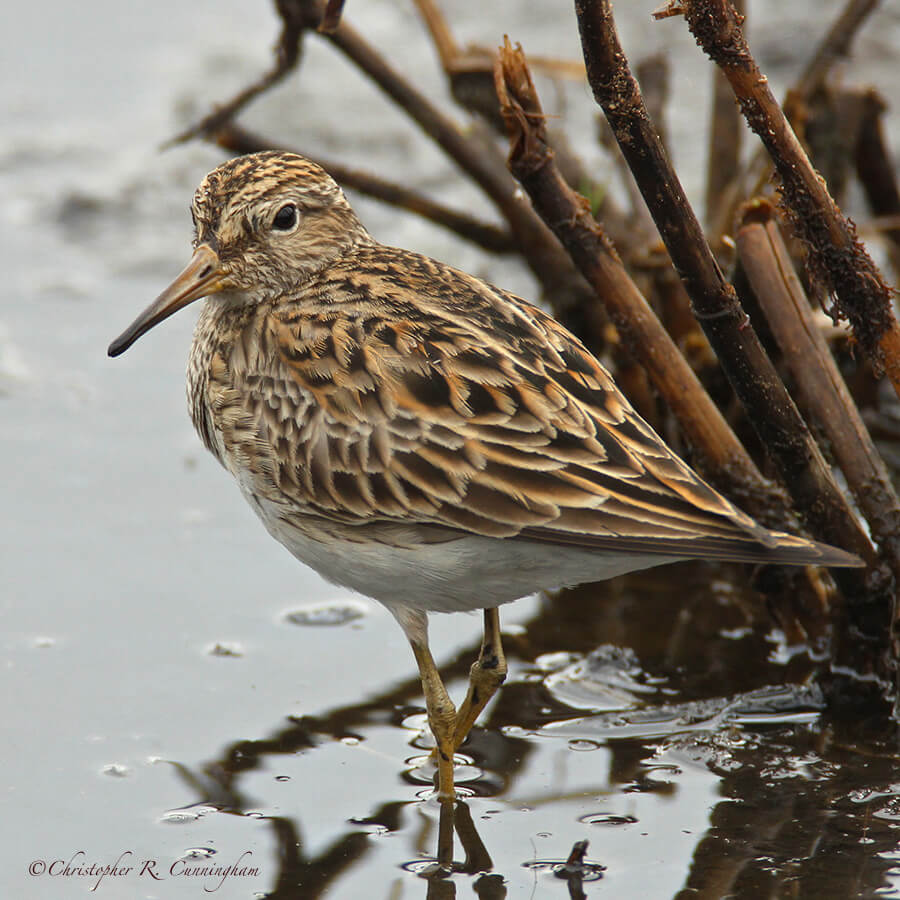
Pectoral Sandpiper at the south pond, Lafitte’s Cove, Galveston Island, Texas. This bird is en route from the Pampas of southern South America to the High Arctic. Canon EOS 7D/600mm f/4L IS (+1.4x TC). Natural light.
Travel becomes a strategy for accumulating photographs.—Susan Sontag
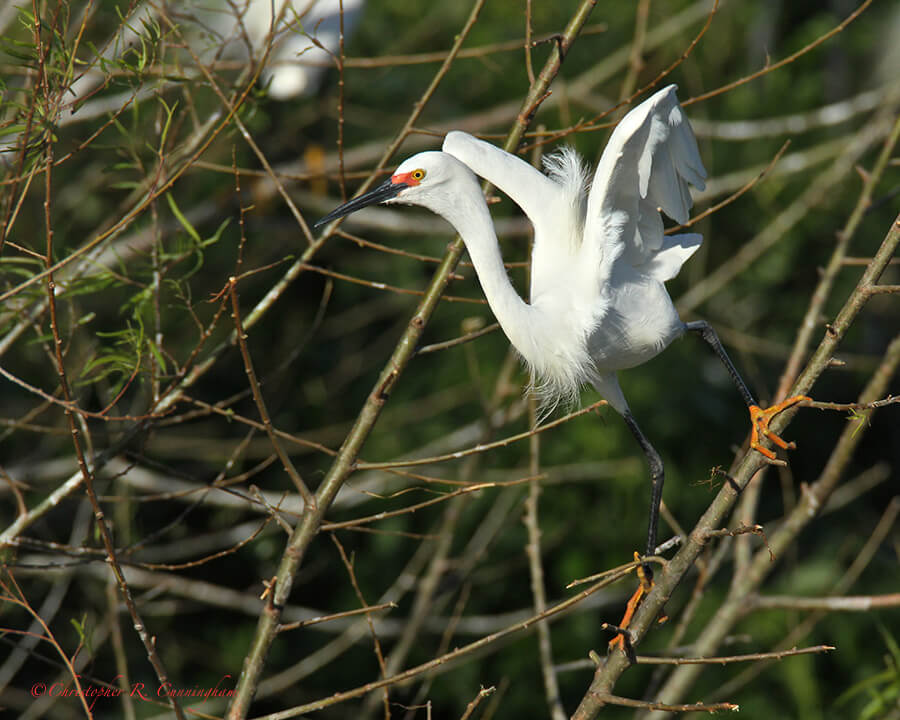
Snowy Egret in High Breeding Color at Smith Oaks Rookery, High Island, Texas. All images Canon EOS 7D/600mm f/4L IS (+1.4x TC).
Over the past week we’ve been visiting our favorite springtime haunts and hotspots. The Smith Oaks Rookery on High Island was an explosion of color dominated by Snowy Egrets (some in breeding, some in high breeding colors), Great Egrets, Roseate Spoonbills and Neotropic Cormorants. At Lafitte’s Cove the Hooded Warbler invasion continued, accompanied by a new invasion of Orchard Orioles and Indigo Buntings. Tennessee Warblers and White-eyed Vireos were common, too.
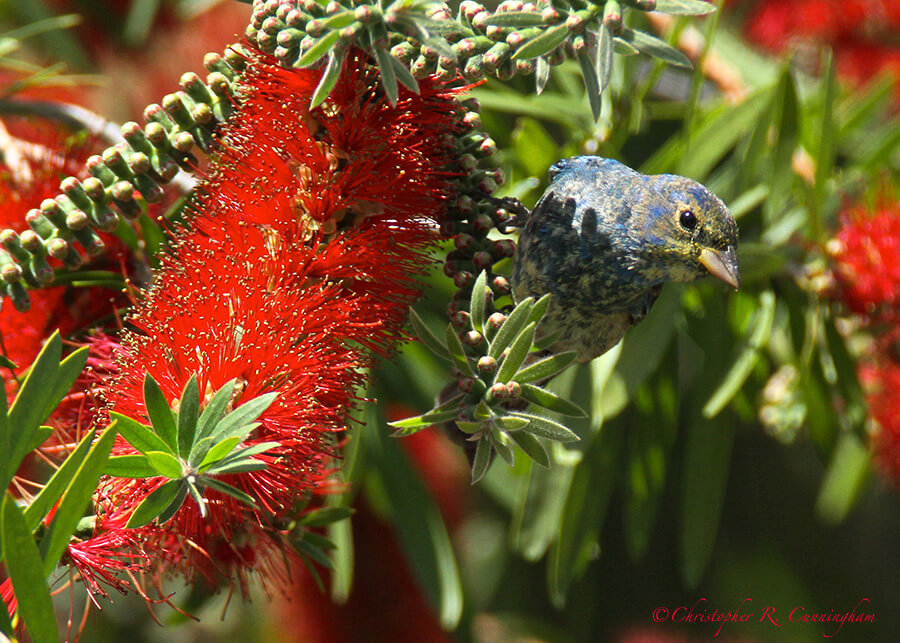
First Spring Male Indigo Bunting on Bottlebrush(Callistemon sp.) at Lafitte’s Cove, Galveston Island, Texas. Bottlebrush is native to Australia and is used as an ornamental in many places around the world. Stamens constitute the bulk of the visible part of flowers, which are highly attractive to insects and birds alike. Visiting birds usually come away dusted with pollen like this fellow. Indigo Buntings winter from Panama to South Texas and summer in the eastern U.S.
Lafitte’s Cove is wonderful because in one small preserve one can explore oak motte, marsh, and prairie habitat. The motte, of course, is famous for migrating songbirds, but the marshes and ponds, too, are almost always productive during migrations. This time, at the pond south of the trail we saw Solitary Sandpipers and Long-billed Dowitchers, both firsts for us at this locale. Explorations continuing . . . .
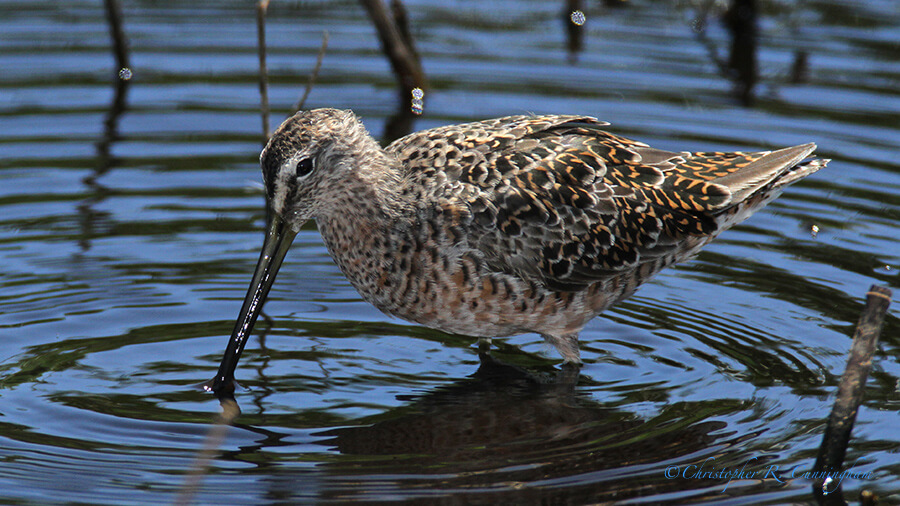
Long-billed Dowitcher at the south pond, Lafitte’s Cove, Galveston Island, Texas. This bird is fattening up for a trip to the High Arctic.
For an occurrence to become an adventure, it is necessary and sufficient for one to recount it.—Jean-Paul Sartre
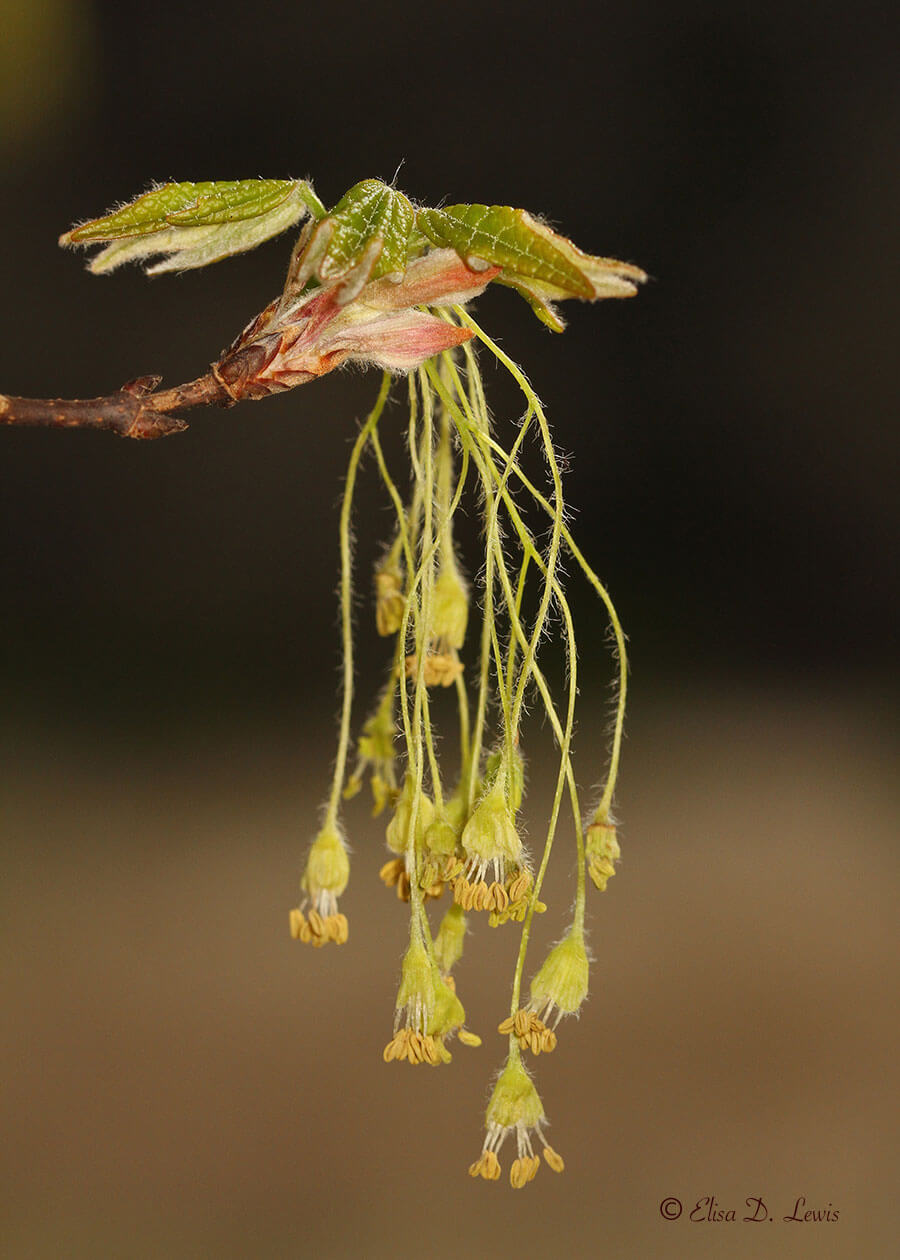
Although Bigtooth Maple flowers attract the attention of bees and flies alike, they depend on the wind for pollination. The flowers, which bloom alongside emerging leaves in spring, are unisexual. Can you tell if these flowers are male or female? (Answer: The prominent stamens with the large yellow anthers full of pollen indicate that these are male flowers.) Canon EOS 7D/100mm f/2.8L Macro IS. Hand-held. High-speed synchronized fill-flash.
They say that timing is everything. For birders whose getaways are tied to school holidays, the timing of spring break is usually too early for spring migration. Not this year! With the deciduous trees just starting to put out new growth, Spring Break 2014 was timed perfectly for birding Lost Maples State Natural Area on the Edward’s Plateau of Central Texas.
Our goal was to see and photograph male Golden-cheeked Warblers (which typically arrive in Central Texas around March 10th) singing in the treetops before the trees were completely leafed-out. We heard many Golden-cheeked Warblers, but got only a few ID shots. The trip was a success for other reasons, however, in part due to the generosity of Richard Redmond of the Texas Ornithological Society who spent a day with us and shared his vast knowledge of Hill Country birds and birding techniques, especially tracking target birds by their songs . . .
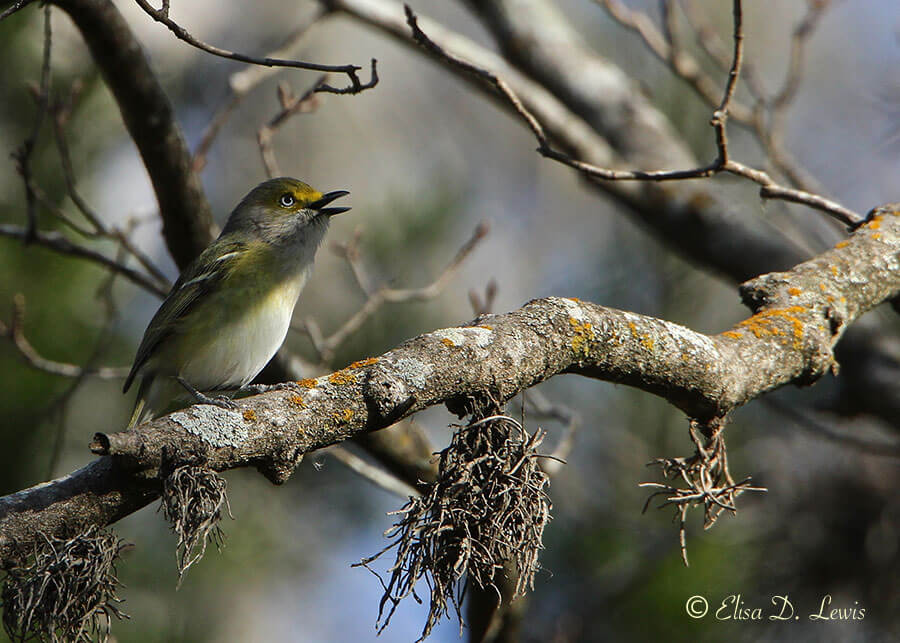
Singing in the Shadows: White-eyed Vireo at Lost Maples SNA, Texas. Canon EOS 7D/500mm f/4L IS (+1.4x TC). Natural light.
Two Trips in One
When we go birding together, we often end up birding apart. Different things catch our eyes and ears, and so we end up with unique take-aways on the same get-away. In this spirit, we decided to share our Lost Maples birding experience “he said, she said” style.
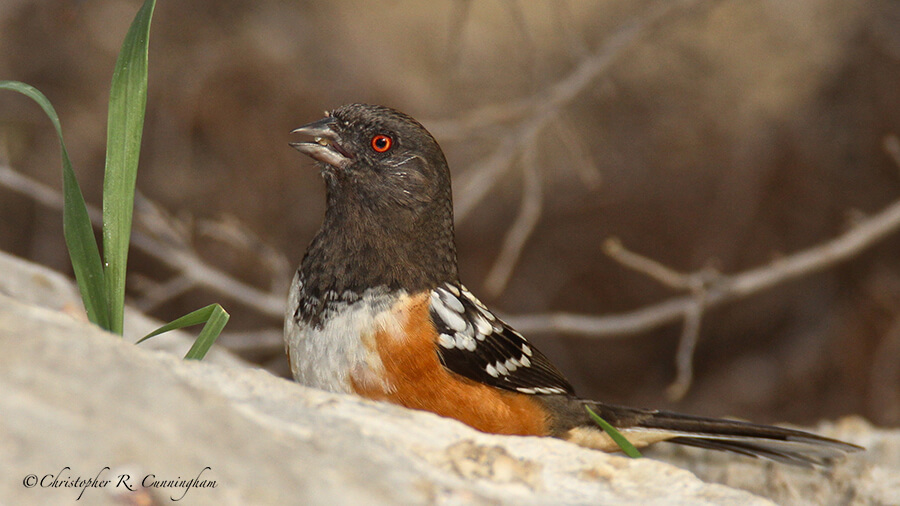
Female Spotted Towhee at Lost Maples SNA, Texas. This colorful bird spends much of her day in the brush pile near the observation blind. Lost Maples is in the winter range of this species. Canon EOS 7D/600mm f/4L IS (+1.4x TC). High-speed synchronized fill-flash.
Chris’s Field Notes
The most abundant species observed were Chipping and Rufous-crowned Sparrows, Black-crested Titmice, and Black-chinned Hummingbirds, but I also saw White-eyed and Yellow-throated Vireos (and also caught the merest glimpse of a Hutton’s Vireo), Black and White, Orange-crowned, Louisiana Waterthrush, and Yellow-throated Warblers. Other highlights included a male Scott’s Oriole, a pair of Canyon Wrens, and a nest-sitting Great Horned Owl and Red-tailed Hawk. Wildflowers were on the sparse side, but Agarita and Bigtooth Maple were in bloom . . . . My couch-potato Houston Flatlander lifestyle didn’t help tackling those canyon trails hauling 30lbs of photographic equipment, but I came back invigorated and looking forward to the next trip.
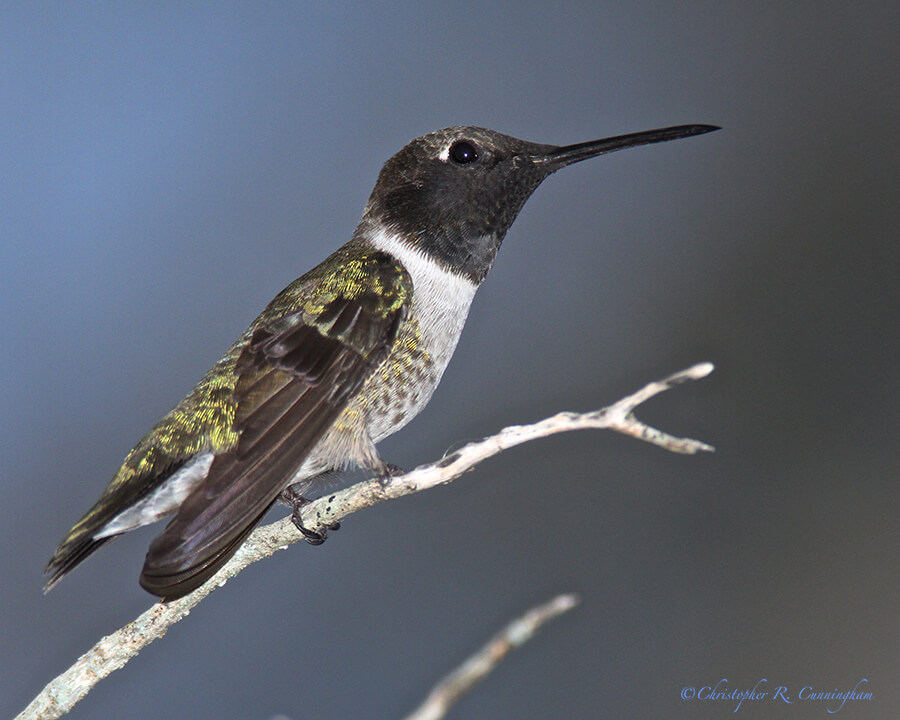
Male Black-chinned Hummingbird at Lost Maples SNA, Texas showing specular reflection and structural color. Black-chinned Hummingbirds were thick around the feeders near the observation blind. Canon EOS 7D/600mm f/4L IS (+1.4x TC). High-speed synchronized flash.
Elisa’s Field Notes
If it weren’t for our chance encounter with Richard and his experienced ear, I would likely never have seen half the species I observed — many of which were firsts for me including the Golden-cheeked Warbler, the Yellow-throated Vireo, and a far-off-in-the-distance Hutton’s Vireo. This trip, more than any other, clearly illustrated the need to know more birds by ear. Springtime is a great time to study bird songs and, wouldn’t-cha know, there’s an app for that. The bird identification mobile app that I use provides representative vocalizations, but most birds sing more than one tune. After a quick search, I downloaded BirdTunes and found it to be an encyclopedic resource of songs, calls, and scolding vocalizations, with regional variations for most species.
As a visual learner, birding by ear has always been daunting, and I quickly forget which bird sings which song when I don’t see and hear them regularly. On this trip, I developed a strategy that I think will work for the long-term. I characterize the song in a way that I can associate with the bird’s name or identifying feature. For example, the song of the Canyon Wren reminds me of a horse whinny which I associate with canyons and the West. Now when I hear that cascading whinny, I think “canyon” then “Canyon Wren” and look to the rocks to find it.
I was lucky to photograph two species singing on this trip — the vireo near the top of the post and the titmouse included in this spring’s “Image of the Season” sidebar. It bears mentioning that I used the bird song app as a pre-birding and post-birding tool for review and study, and not in the field to attract the birds. If you use recordings in the field, please do so responsibly. Check out the American Birding Association’s Code of Ethics section 1(b) for guidance.
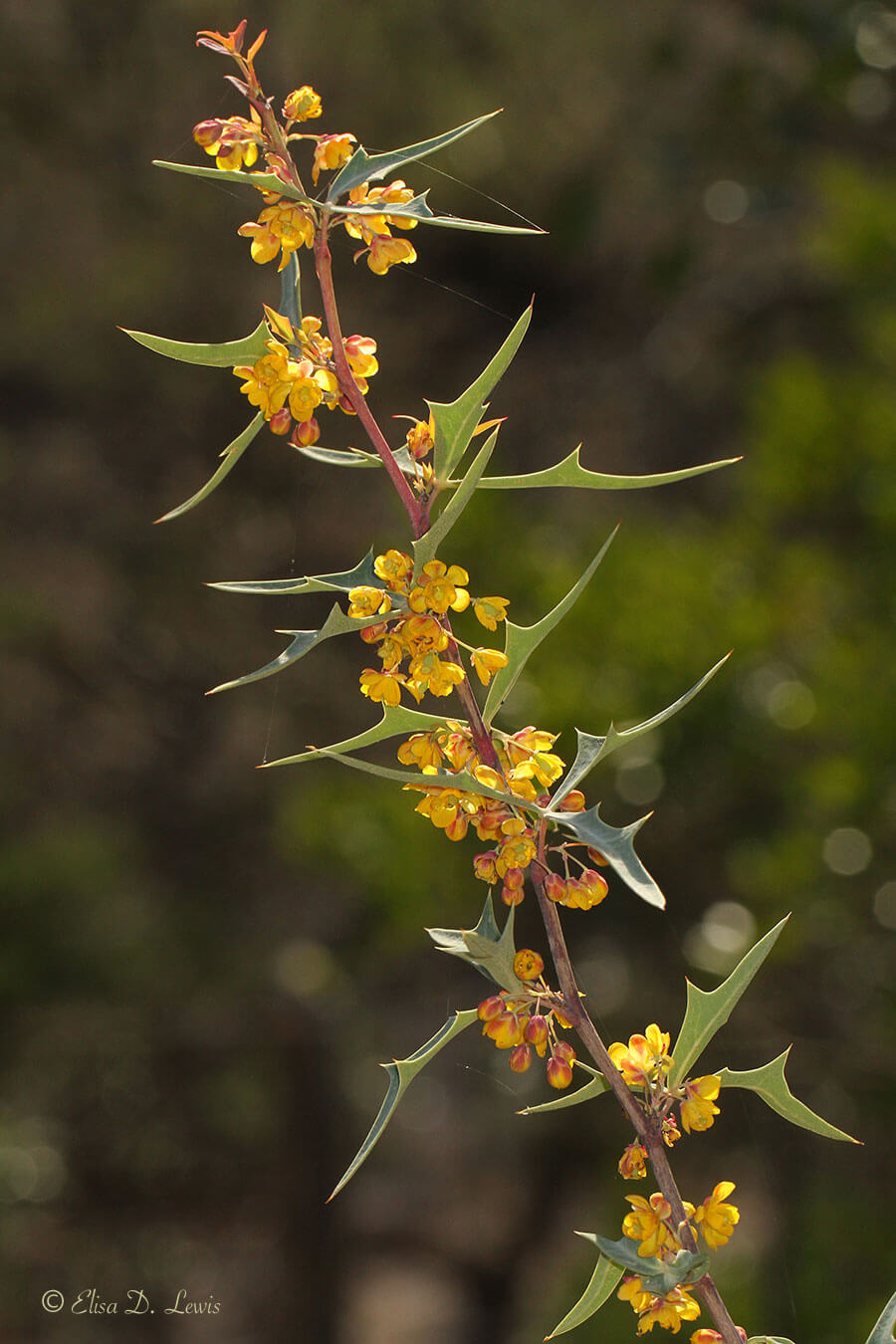
Agarita (Mahonia trifoliolata) is the quintessential hill country plant to me. It’s one of the first plants I was able to reliably identify when learning the flora of Central Texas. After the cheery yellow flowers fade, bright red berries develop among the prickly evergreen leaves. (In case you’re wondering: these flowers are bisexual – each flower has stamens and pistils.) Canon EOS 7D/100mm f/2.8L Macro IS USM. Hand-held. High-speed synchronized fill-flash.
To be interested in the changing seasons is a happier state of mind than to be hopelessly in love with spring.—George Santayana
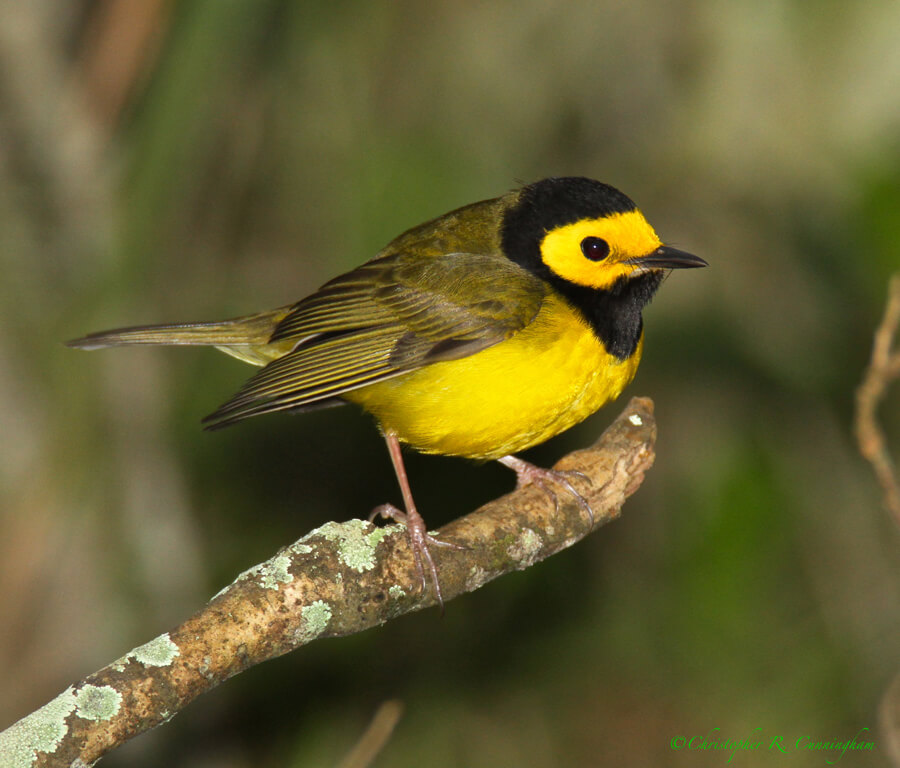
Adult Male Hooded Warbler at Lafitte’s Cove, Galveston Island, Texas. Canon EOS 7D/600mm f/4L IS (+1.4x TC). High-speed synchronized flash.
Last weekend evidence of spring was all around Galveston and environs. The big news at Lafitte’s Cove was the Hooded Warbler invasion. With the exception of Yellow-rumped Warblers (Myrtle Race—still waiting for Audubon’s), Hooded Warblers probably outnumbered all other warbler species combined. Black and White, Louisiana Waterthrush, Common Yellowthroat, Northern Parula, and Prothonotary Warblers were also in attendance. White-eyed Vireos were profuse at Dos Vacas Muertas and Lafitte’s Cove.
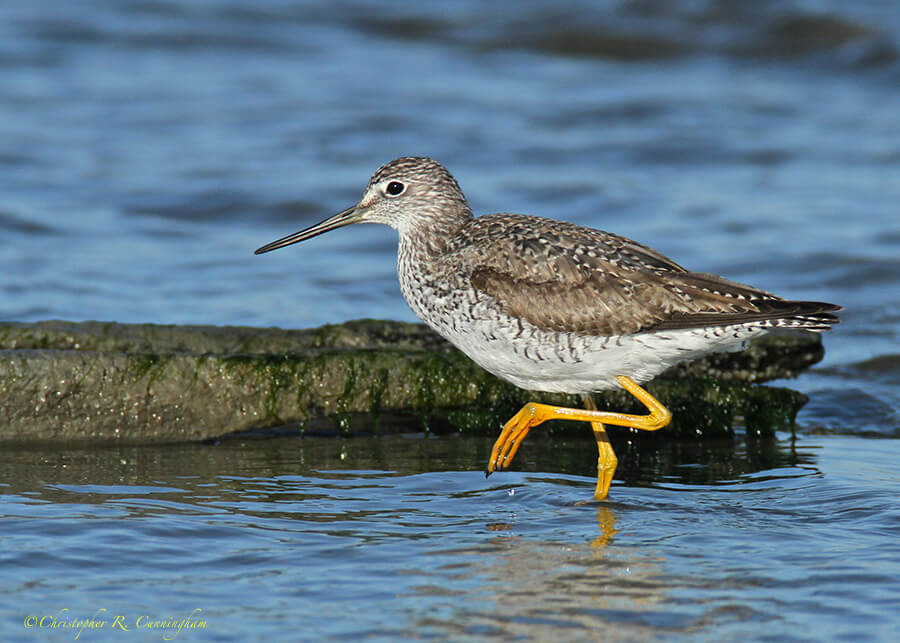
Lesser Yellowlegs at East Beach, Galveston Island, Texas. Canon EOS 7D 600mm f/4L IS (+1.4x TC). High-speed synchronized fill-flash.
There was a notable uptick of numbers of birds that winter on the Gulf Coast, but have significant parts of their ranges to the south–Lesser Yellowlegs, Ruby-crowned Kinglets, and Blue-gray Gnatcatchers, for example. Lesser Yellowlegs winter on the southern parts of the Atlantic and Pacific U.S. Coasts, as well as the Gulf Coast, but range all the way down to Tierra del Fuego. Technically, I suppose, it’s impossible to tell if individual birds have moved far, but seeing Lesser Yellowlegs at Lafitte’s Cove and East Beach suggest to me that they are part of a big wave from the south.
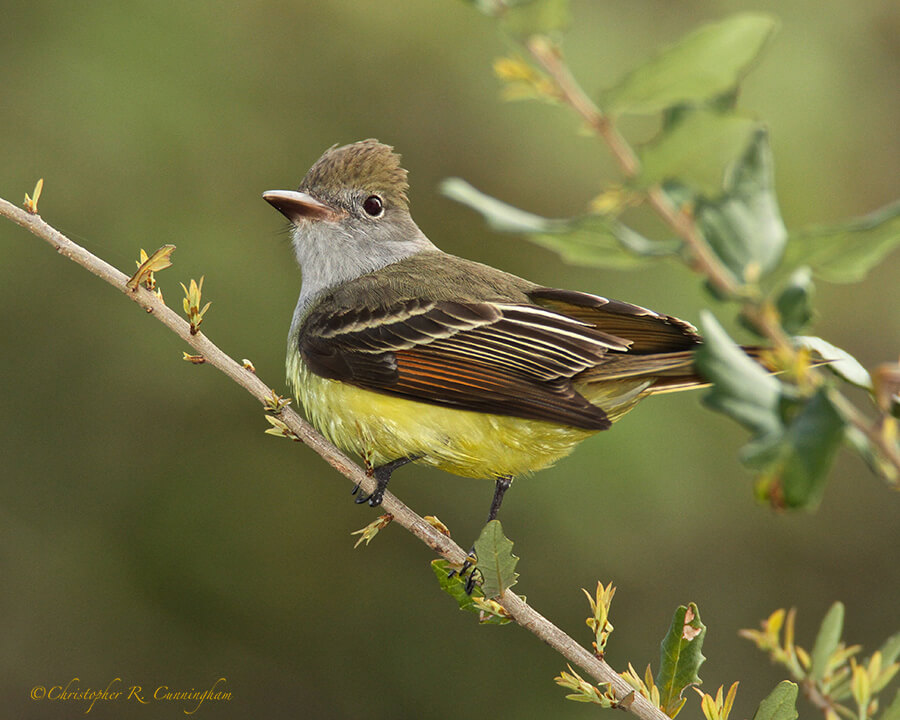
On the flycatcher front: In a week or so, the trees of Lafitte’s Cove will be hopping with Great-crested, Least, and Yellow-bellied Flycatchers—but last weekend I only saw Great-crested Flycatchers. Observations are continuing . . . .
Great-crested Flycatcher at Lafitte’s Cove, Galveston Island, Texas. Canon EOS 7D/600mm f/4L IS (+1.4x TC). High-speed synchronized fill-flash.
Now this is not the end. It is not even the beginning of the end. But it is, perhaps, the end of the beginning.—Winston Churchill