Marbled Godwits in the Texas Springtime

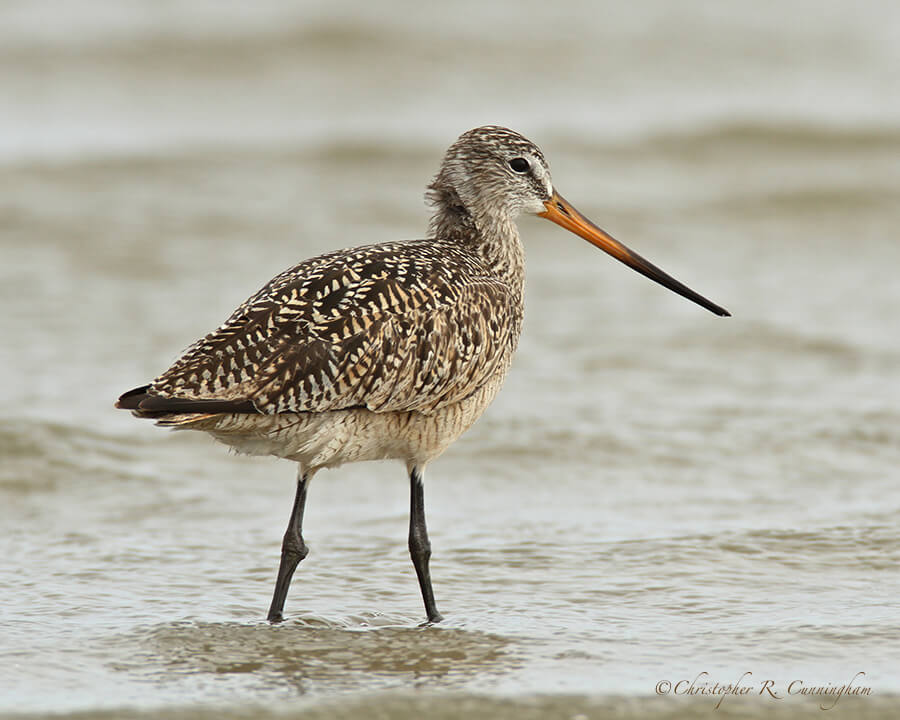
Marbled Godwit in breeding colors with orange bill, April, East Beach, Galveston Island, Texas
Marbled Godwit in High Breeding Colors (with orange-based bill), first week in April, East Beach, Galveston Island, Texas. Canon EOS 7D/600mm f/4L IS (+1.4x TC). Natural light.

Having read a report of a sighting of a Hudsonian Godwit on Galveston several weeks ago, I recently kept an eye out for them among the flocks of Marbled Godwits on East Beach. For a few minutes I thought I had a Hudsonian Godwit in the viewfinder: The bird above has a bright orange bill base, and the back appears quite dark. The colors and barring on the underside of the bird, however, really seem to indicate that this is a Marbled Godwit. The vast majority (all but one it turns out!) of Marbled Godwits I have ever seen have had pink bill bases—even all the other Marbled Godwits I saw in the same flock on the same morning in early April (next two images) had pink-based bills. So what gives? Could this be sexual dimorphism? Breeding color? A little reading was in order.
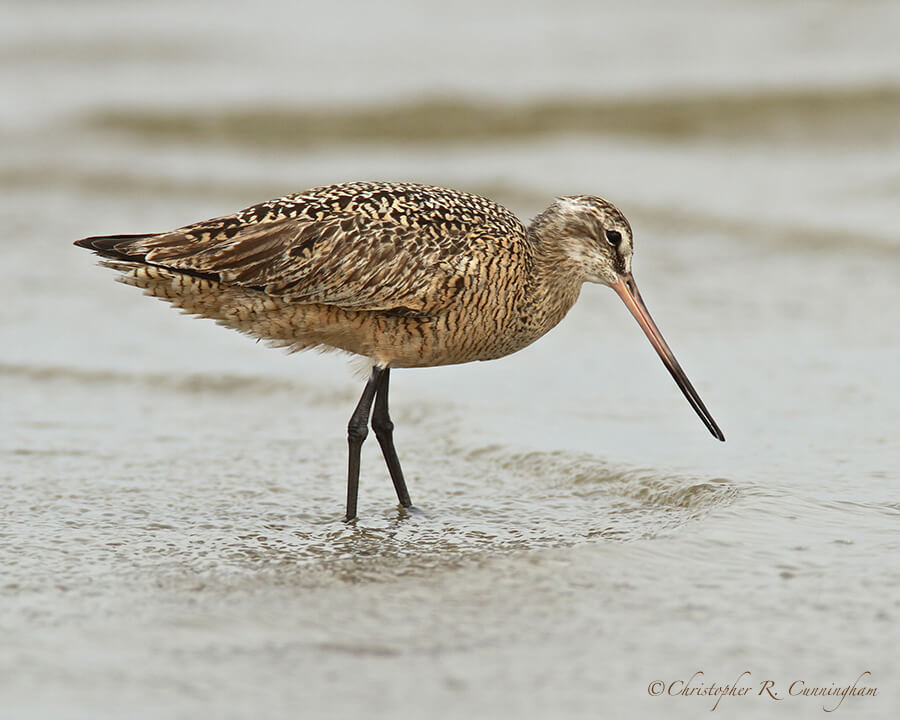
Marbled Godwit in breeding colors, April, East Beach, Galveston Island, Texas
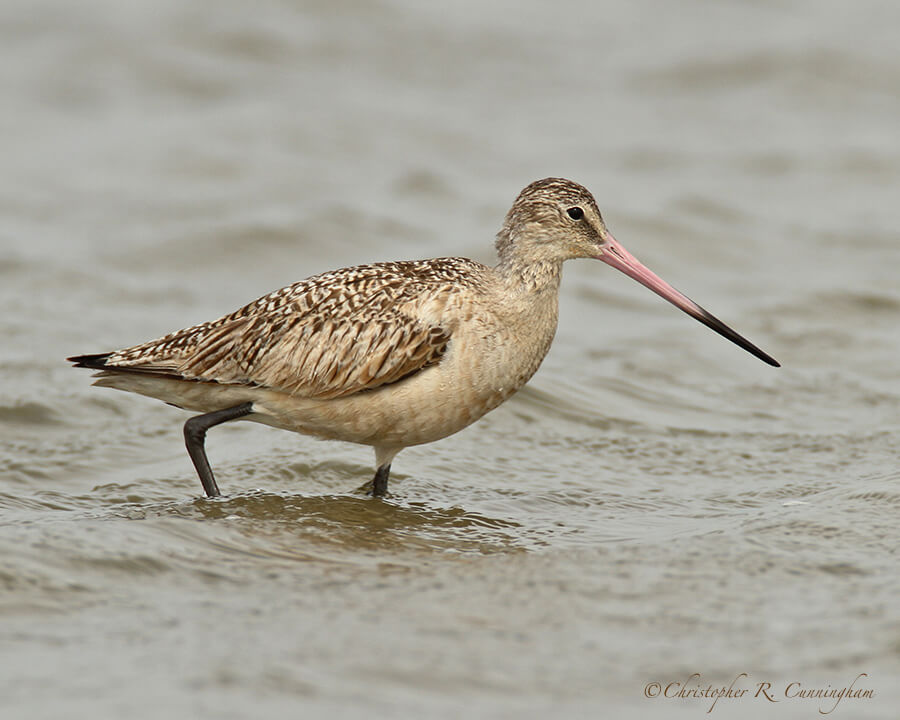
Marbled Godwit in Breeding Colors (with pink bill base), first week in April, East Beach, Galveston Island, Texas. Note the barring on the breast and underside. Canon EOS 7D/600mm f/4L IS (+1.4x TC). Natural light.

As far as field marks are concerned, Marbled Godwits show only a hint of sexual dimorphism, females being slightly larger (by millimeters on average) than males (Ayala-Pérez et al., 2013), but no reported obvious color differences—so no help here. In Arthur Morris’ Shorebirds: Beautiful Beachcombers (1996), however, he explained that the orange-based bill in Marbled Godwits is a result of hormone level—during a time of “full breeding plumage.” I suppose that this is similar to the case of the Snowy Egret. The lores and feet are yellow in “breeding” and pinkish red in “high breeding.” I have seen Snowy Egrets sitting on nests in both breeding and high breeding color, though, so I’m not clear if there are any behavioral differences tied to these color differences, or what specific event in the reproductive cycle, if any, is tied to the appearance of high breeding color. More research and observation on my part are clearly required.
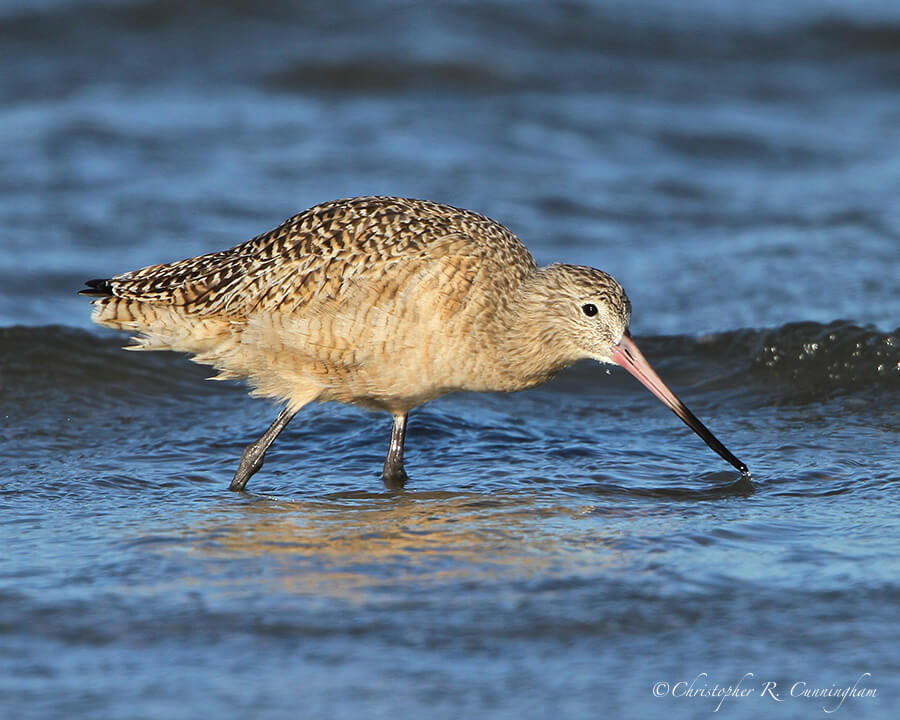
Marbled Godwit in nonbreeding colors, April, East Beach, Galveston Island, Texas
Marbled Godwit in Nonbreeding Colors (with pink bill base), first week in April, East Beach, Galveston Island, Texas. Canon EOS 7D/600mm f/4L IS (+1.4x TC). Natural light.

In spring on the Texas Coast, Marbled Godwits appear in a variety of color schemes before they depart for their breeding grounds in the Upper Midwest, Canada, and Alaska. When they return in the fall, they show up in faded breeding colors, but will be sporting (you guessed it!) pink bill bases. Given that Marbled Godwits winter along the Gulf Coast, this is probably how most Texas birders see them—but it’s fun to see them in other colors.
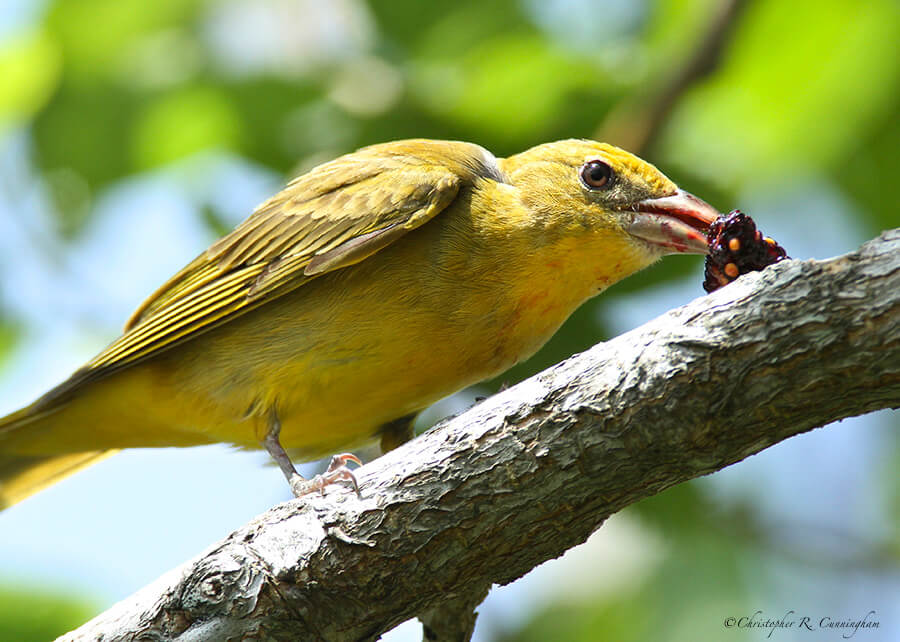
Marbled Godwit in postbreeding colors on wintering grounds, East Beach, Galveston Island, Texas
Marbled Godwit in Faded Breeding Colors on Wintering Grounds (with pink-based bill), late October, East Beach, Galveston Island, Texas. Canon EOS 7D/600mm f/4L IS (+1.4x TC). Natural light (the second, lower catchlight is from the sun’s reflection off the surface of the water).

References

Ayala-Pérez, V., Carmona, R., Baker, A.J., Farmer, A.H., Uraga, and Arce, N. 2013. Phenotypic Sexing of Marbled Godwits (Limosa fedoa): A Molecular Validation. Waterbirds 36(4): 418-425.

Morris, A. 1996. Shorebirds: Beautiful Beachcombers (Northword Wildlife Series). Econo-Clad Books. 160p.

To see what is in front of one’s nose needs a constant struggle.—George Orwell

©2015 Christopher R. Cunningham. All rights reserved. No text or images may be duplicated or distributed without permission.
Spring Migration: Chasing the Sun

Let me recommend the best medicine in the world: a long journey, at a mild season, through a pleasant country, in easy stages.—James Madison

Female Summer Tanager with mulberry, Pelican Island, Texas
Female Summer Tanager with Mulberry, Pelican Island, Texas. Tanagers love mulberries. Unfortunately a major Texas A&M building project on Pelican Island has restricted access to most of the mulberry trees that were a reliable place to see migrant tanagers, orioles, buntings, Dickcissel, and others. Canon EOS 7D/600mm f/4L IS (+1.4x TC). Natural light.

This is the time of year for visiting migrant songbird traps! In these special places it’s easy to see what migration is all about—chasing the warming rays of the sun north as they bring their bounty of flowers, nectar, pollen, fruit, and succulent bugs!

Although it will probably have to wait for retirement, I dream of an April road trip, drifting slowly down the Gulf Coast from Dauphin Island, Alabama to Grand Isle, Louisiana to Sabine Woods, High Island, Pelican Island, Lafitte’s Cove, Quintana, perhaps ending at Paradise Pond, Mustang Island, Texas.

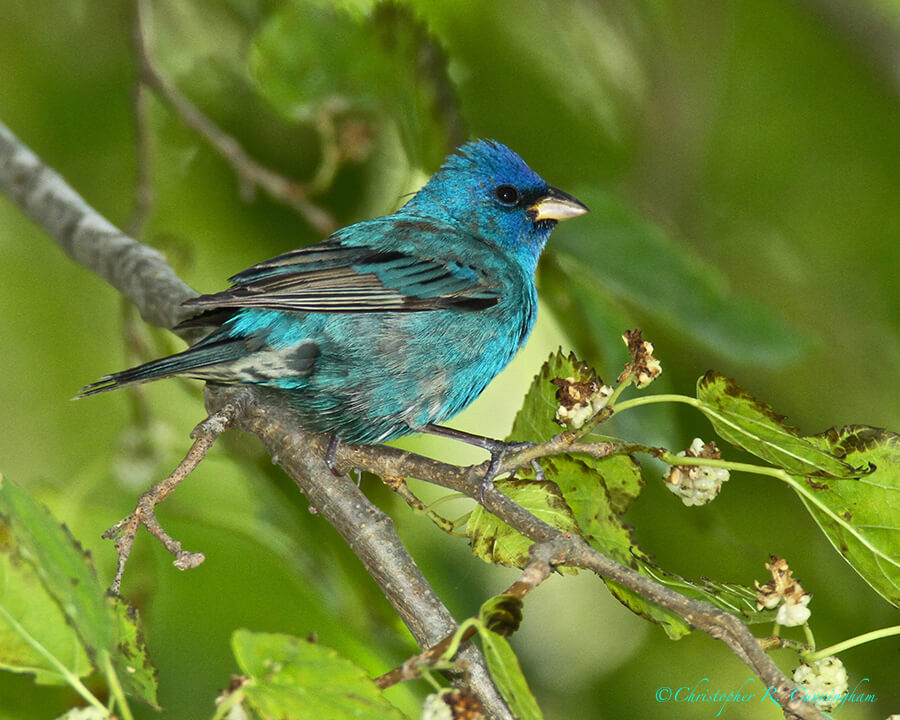
Male Indigo Bunting in Breeding Colors, Pelican Island, Texas
Male Indigo Bunting in Breeding Colors on Mulberry Tree, Pelican Island, Texas. Indigo buntings are generalist feeders and eat buds, seeds, fruit, and insects. Canon EOS 7D/600mm f/4L IS (+1.4x TC). High-speed synchronized fill-flash.
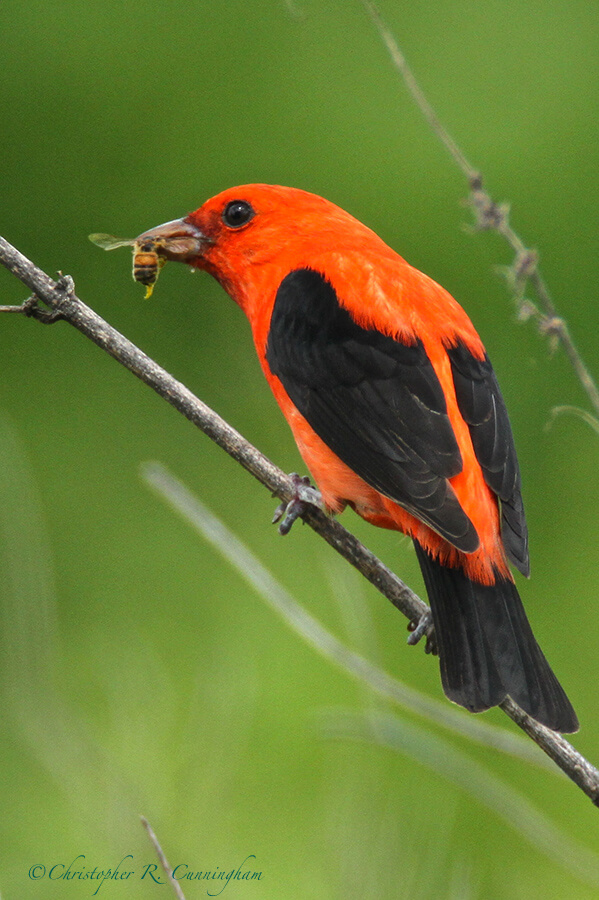
Male Scarlet Tanager with bee, Pelican Island, Texas
Male Scarlet Tanager with Bee, Pelican Island, Texas. Scarlet Tanagers are generalist feeders, but prefer bees, when available. Canon EOS 7D/600mm f/4L IS (+1.4x TC). Natural light.

Many of these classic migrant traps are oak mottes, slightly elevated patches of woods, on the very edge of the land and provide desperately needed food, water, and shelter after an exhausting flight across the Gulf of Mexico. One of the most exciting parts of being out in these migrant traps during spring is observing and photographing Neotropical migrants hunting and gorging on fruits and other botanical goodies.

In the oak mottes, birds are often covered in pollen as they poke around flowers. Sometimes novice birders, field guides clutched in hand, are puzzled by a bird that looks somehow familiar—but it has a yellow face! There’s usually an old-timer around, though, who explains kindly how the birds are sometimes painted with pollen at this magical and all-too-short time of the year.

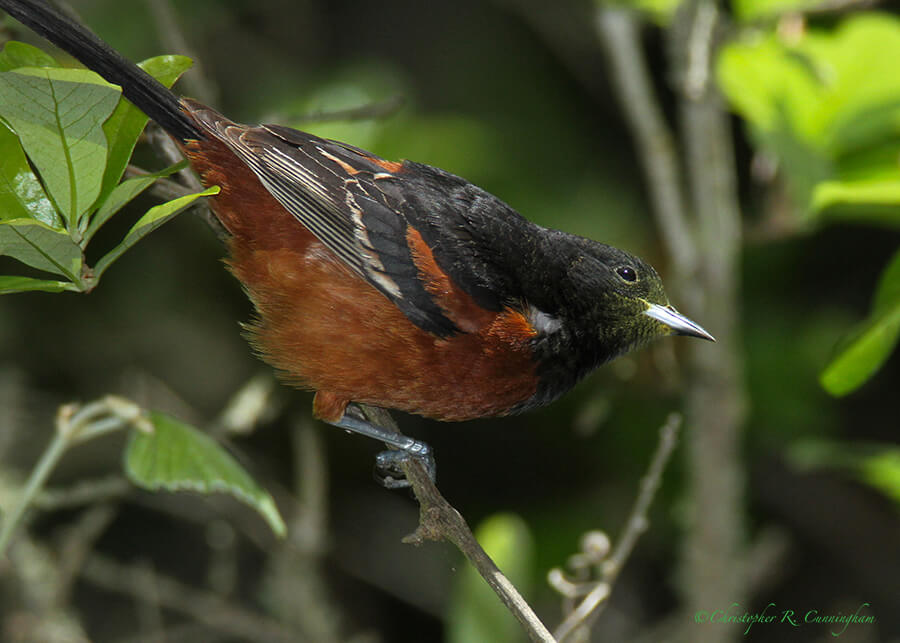
Male Orchard Oriole with Pollen on Face, Lafitte's Cove, Galveston Island, Texas
Male Orchard Oriole with Pollen on His Face, Lafitte’s Cove, Galveston Island, Texas. Orchard Orioles eat primarily insects during the breeding season, but will supplement their diets with seeds, fruits, pollen, and nectar. Canon EOS 7D/600mm f/4L IS (+1.4x TC). High-speed synchronized fill-flash.

©2015 Christopher R. Cunningham. All rights reserved. No text or images may be duplicated or distributed without permission.
Those Ridiculously Good-looking Terns

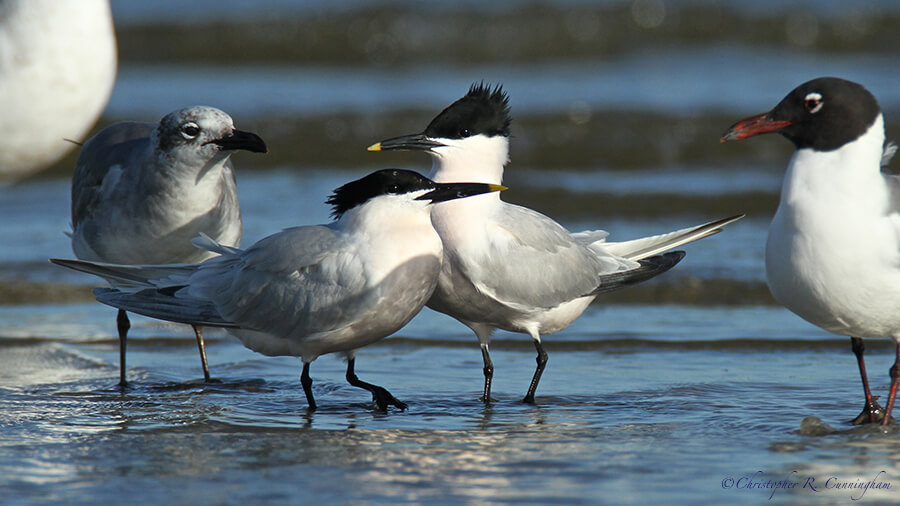
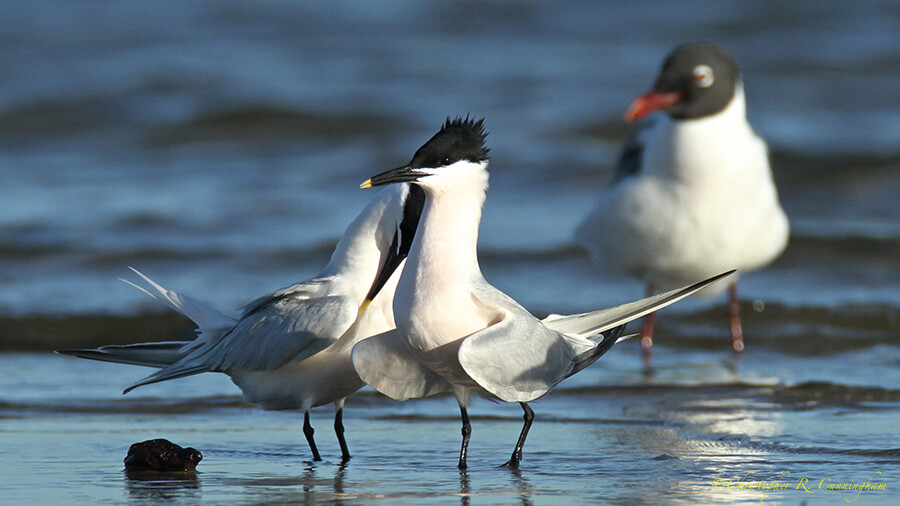
Mated Pair Sandwich Terns, East Beach, Galveston Island, Texas.
Sandwich Tern Mated Pair 1, East Beach, Galveston Island, Texas. It’s easy to imagine that the gulls are looking on jealously at this drop-dead gorgeous pair. Photo taken in early April. Canon EOS 7D/600mm f/4L IS (+1.4x TC). High-speed synchronized fill-flash.

East Beach, Galveston Island, Texas is one of my favorite birding spots—especially in cool weather. Flying birds will often follow the strand line predictably from the north allowing flight shots of gulls, pelicans, skimmers, plovers, sandpipers, terns, and others. At low tide, exceptional, text-book sedimentary structures are visible over wide areas. But of all the natural wonders observable at East Beach, terns are my favorites. Caspian, Royal, Sandwich, and Forster’s are especially common, but careful searches of U’s will occasionally turn up Least, Common, or Gull-billed Terns. I continue to hold out hope for rarer species.

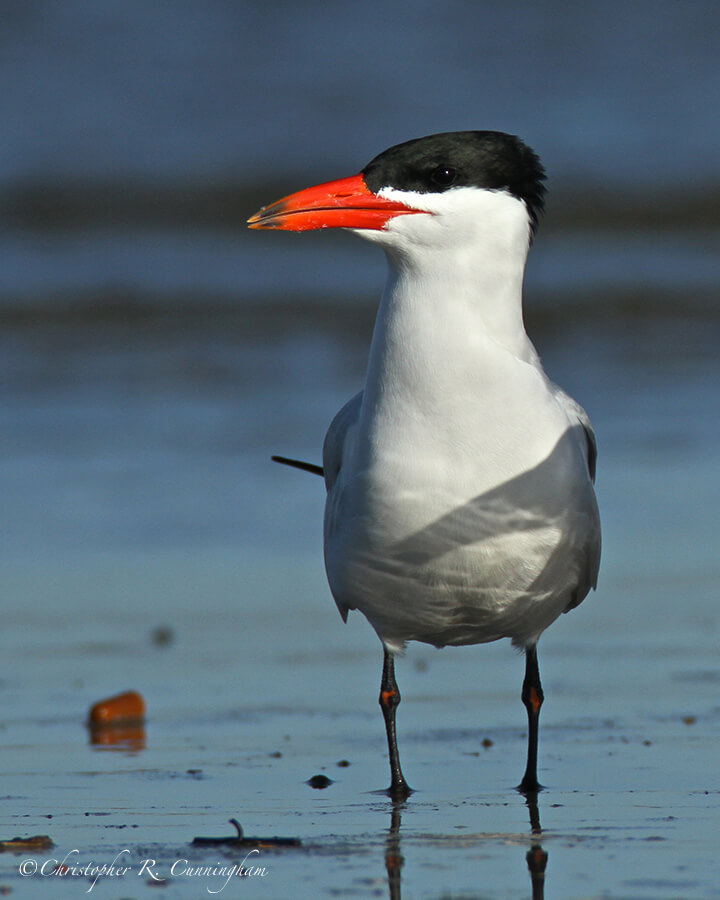
Caspian Tern, East Beach, Galveston Island, Texas
Caspian Tern, East Beach, Galveston Island, Texas. Caspian Terns are the largest terns in the world and have a nearly worldwide distribution. Photo taken in early April. Canon EOS 7D/600mm f/4L IS (+1.4x TC). High-speed synchronized fill-flash.

Another alluring aspect of East Beach is the fact that you often have the entire area to yourself, especially in cold weather. After a blue norther, there may be no one else at all around. This being said, rare encounters with yahoos can occur at East Beach, as they can anywhere. They are just much less probable here than at places like Brazos Bend or Lafitte’s Cove, even during nice, warm weather.

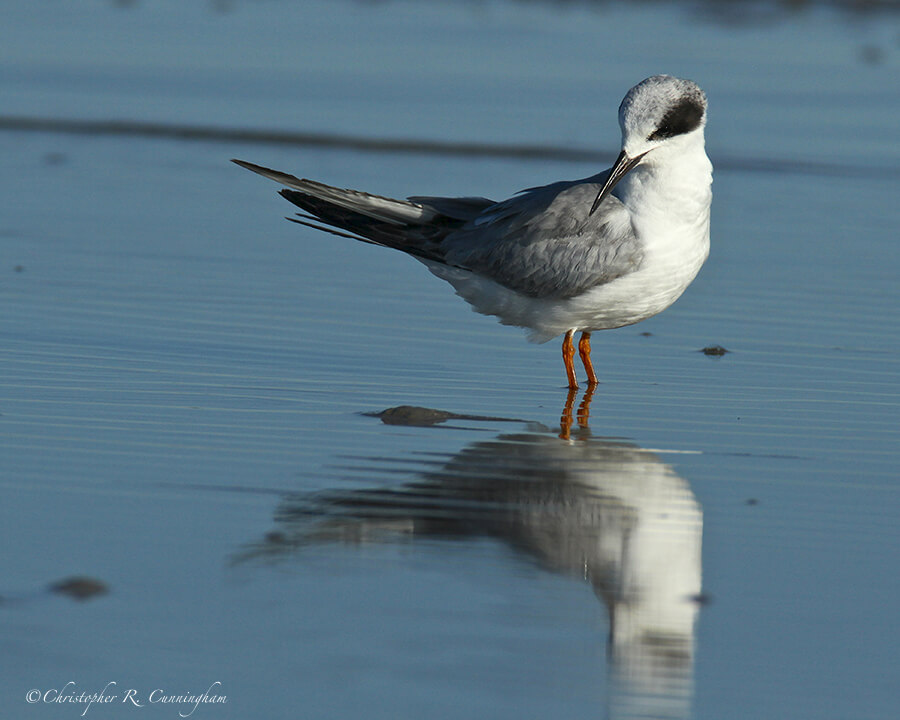
Forster's Tern, East Beach, Galveston Island, Texas
Avian Narcissus: Forster’s Tern, East Beach, Galveston Island, Texas. Photo taken in early November. Canon EOS 7D/600mm f/4L IS (+1.4x TC). Natural light.

Terns have a wide variety of interesting behaviors to observe and (at least attempt) to document photographically. These include spectacular dives for fish, courtship-feeding (the male bribes the female with a small fish, a “nuptial gift,” prior to copulation), and elegant dances and promenades involving mated pairs, as below in the case of Sandwich Terns. Sandwich Terns minuet with shaggy crown feathers and necks erect, pointing beaks skyward or nodding occasionally, wing-tips directed parallel to the ground or slightly upward. And, because terns are doting parents, it’s worth watching for adults feeding “chicks” as large as themselves well after the nesting season.

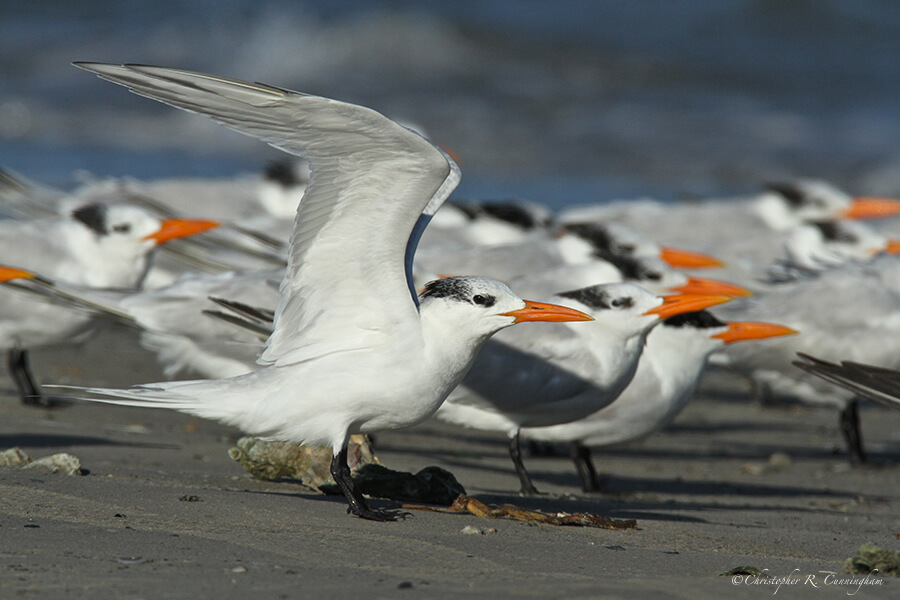
Royal Terns, East Beach, Galveston Island, Texas
A U of Royal Terns, East Beach, Galveston Island, Texas. Photo taken in early November. Canon EOS 7D/600mm f/4L IS (+1.4x TC). Natural light.

Every time I review my images from East Beach, I get excited about the prospect of returning. Now especially, during the Season of the Runny Nose, the prospect of fresh sea air mercifully free of pollen is indeed attractive.

Sandwich Tern Mated Pair 2, East Beach, Galveston Island, Texas
A Nod to My Love: Sandwich Tern Mated Pair 2, East Beach, Galveston Island, Texas. Note the bitterly resentful gull in the background. Photo taken in early April. Canon EOS 7D/600mm f/4L IS (+1.4x TC). High-speed synchronized fill-flash.

 There is pleasure in the pathless woods, there is rapture in the lonely shore, there is society where none intrudes, by the deep sea, and music in its roar; I love not Man the less, but Nature more.—Lord Byron

©2015 Christopher R. Cunningham. All rights reserved. No text or images may be duplicated or distributed without permission.
American Bittern: A Song in Still Frames

The ghostly winter silence had given way to the great spring murmur of awakening life.—Jack London, The Call of the Wild

Last weekend we took advantage of the spectacular weather and visited a number of our favorite birding haunts, including East Beach, Lafitte’s Cove (both Galveston Island, Texas), Pelican Island, and Brazos Bend State Park (BBSP). We visited the coastal sites with an eye toward seeing migrants, but alas there were no surprises, only the usual customers for this time of year both on the beach and in the motte.

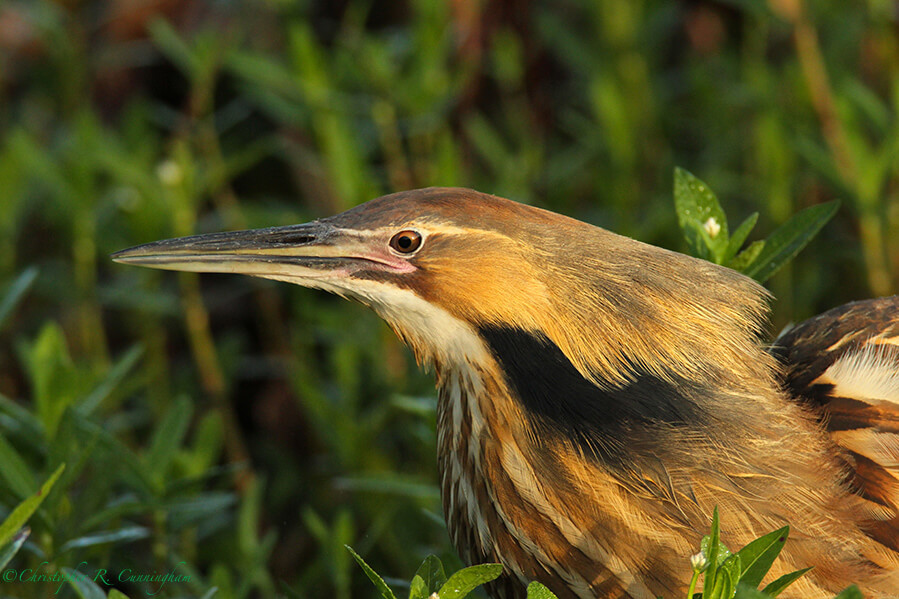
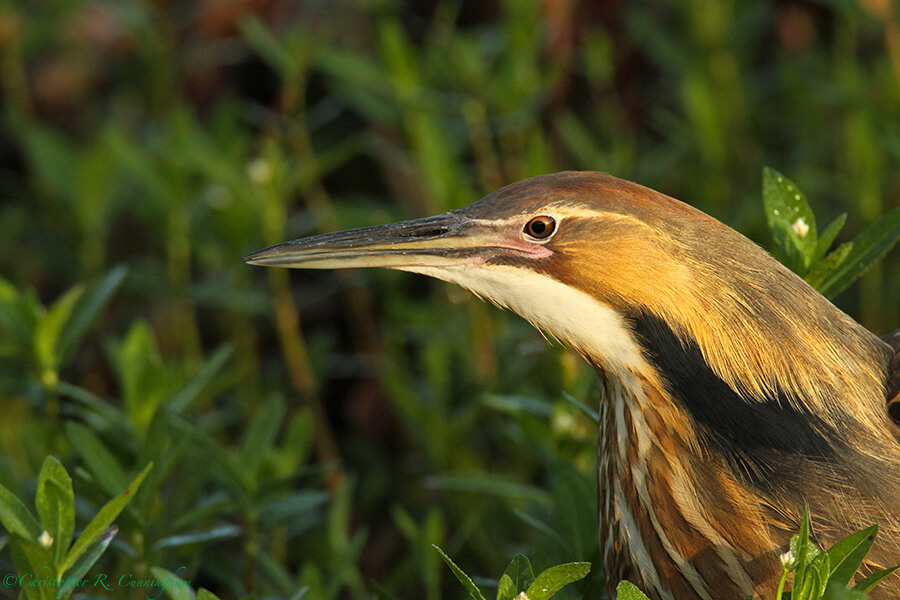
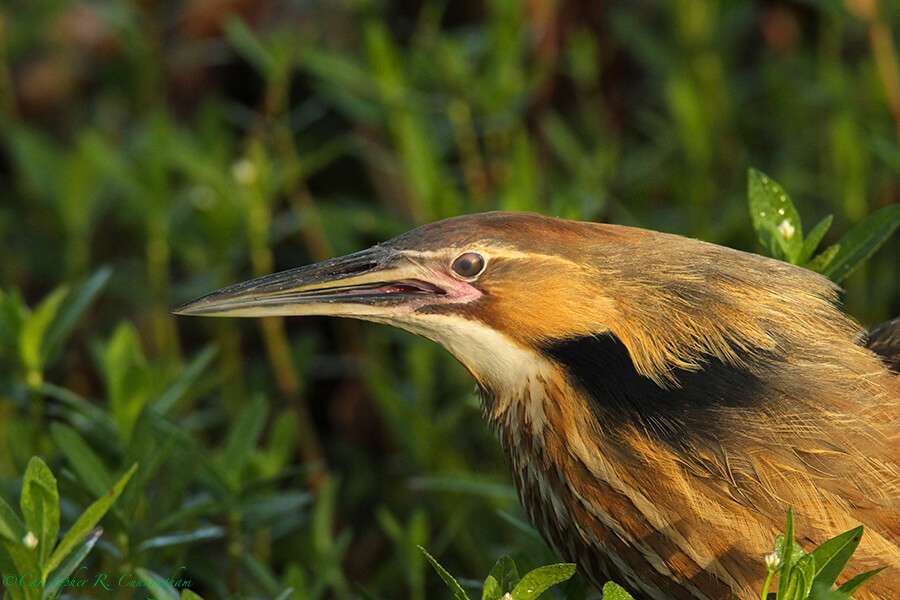
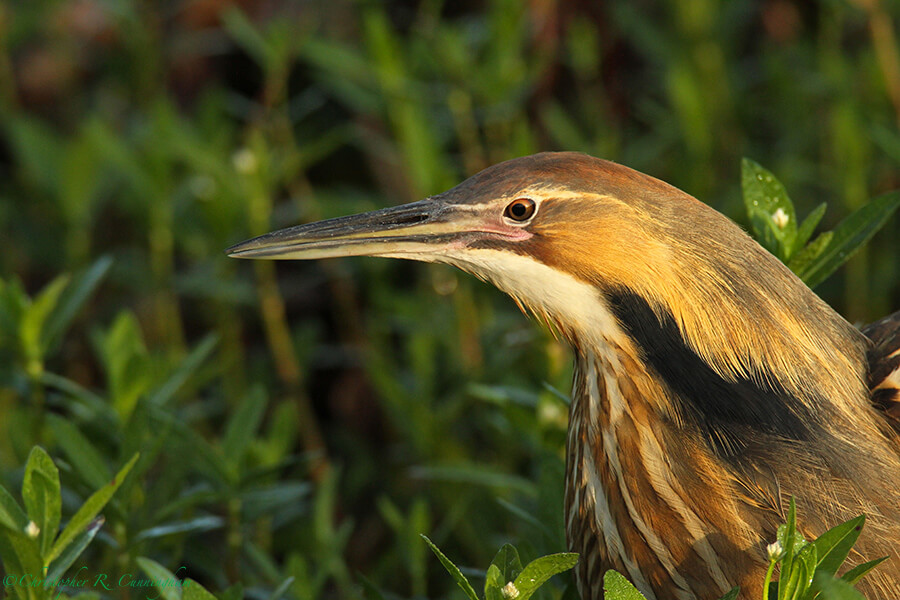
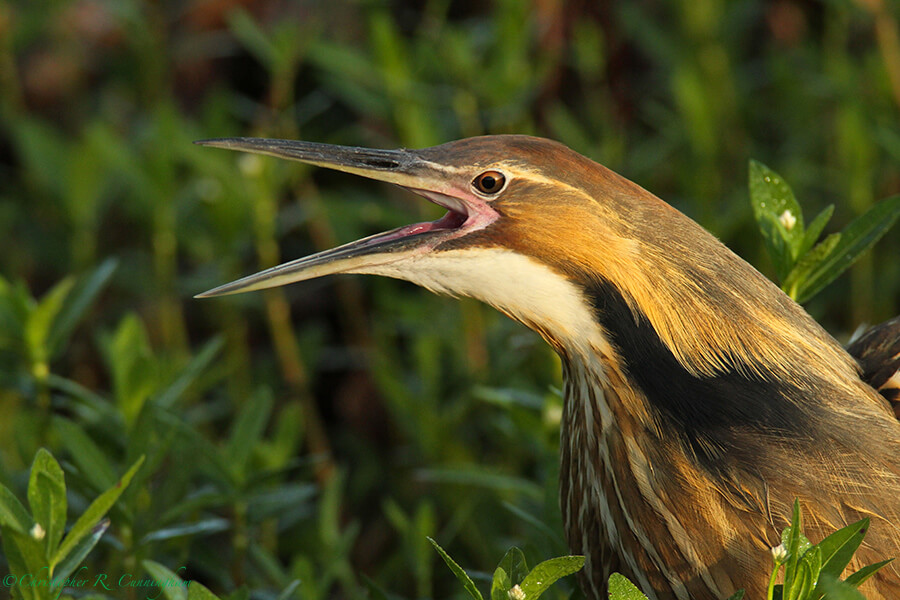
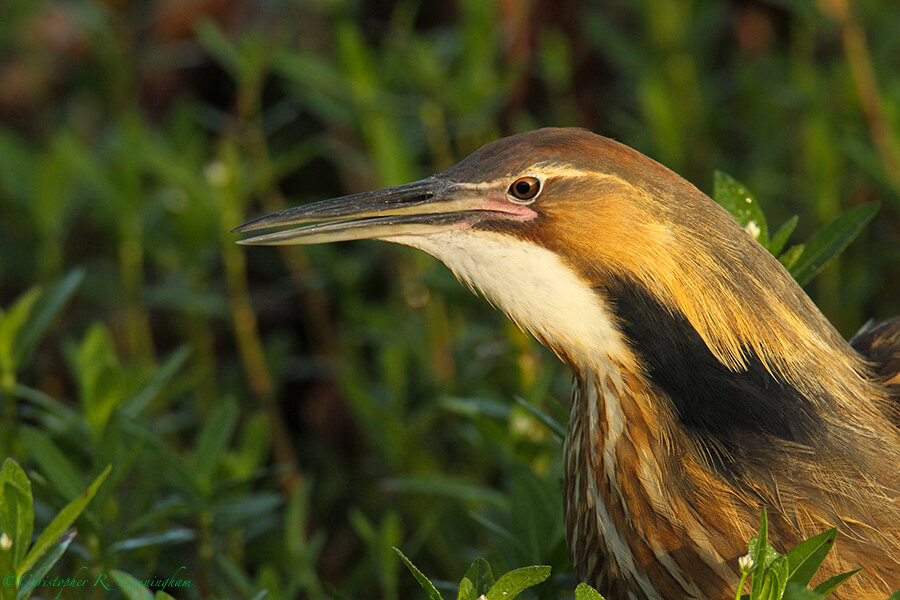
At Brazos Bend State Park, Pilant Lake was again hopping with American Bitterns. They were busy hunting, singing, and displaying. On this visit, I caught one bird singing right out in the open in beautiful morning light around 7:45 am.

The song of the American Bittern, expressed onomatopoetically as oonk-a-loonk, is sometimes described as territorial and likely has a significant infrasonic component, below the threshold of human hearing. The singing is accompanied by a labored-looking performance in which the feathers of the head, neck, and shoulders (white shoulder plumes) are repeatedly roused and flattened. The beak is snapped shut producing a click that is apparently part of the song.

A bittern’s song is clearly aimed at other bitterns in the marsh as they answer each others’ calls. What exactly is being communicated is in question as these birds are on their way to breeding grounds far north of coastal Texas, and they are not likely carving out territories at BBSP. Perhaps they are merely exercising and practicing for the important performances to come on actual breeding grounds.

The series of six images below records one song, a wavelength, if you will, within a performance that may contain many repetitions of the same. All images were taken with a Canon EOS 7D + 600mm f/4L IS (+1.4x TC) under natural light, and are uncropped. Something approximating 0.5 seconds separates each frame.

American Bittern Calling: Image 1
Singing American Bittern 1, Pilant Lake, BBSP, Texas.
American Bittern Call: Image 2
Singing American Bittern 2, Pilant Lake, BBSP, Texas.
American Bittern Call: Image 3
Singing American Bittern 3, Pilant Lake, BBSP, Texas. Note the nictitating membrane.
American Bittern Call: Image 4
Singing American Bittern 4, Pilant Lake, BBSP, Texas.
American Bittern Call: Image 5
Singing American Bittern 5, Pilant Lake, BBSP, Texas.
American Bittern Call: Image 6
Singing American Bittern 6, Pilant Lake, BBSP, Texas.

©2015 Christopher R. Cunningham. All rights reserved. No text or images may be duplicated or distributed without permission.