When an early autumn walks the land and chills the breeze
And touches with her hand the summer trees . . . . “Early Autumn,” Lyrics by Johnny Mercer
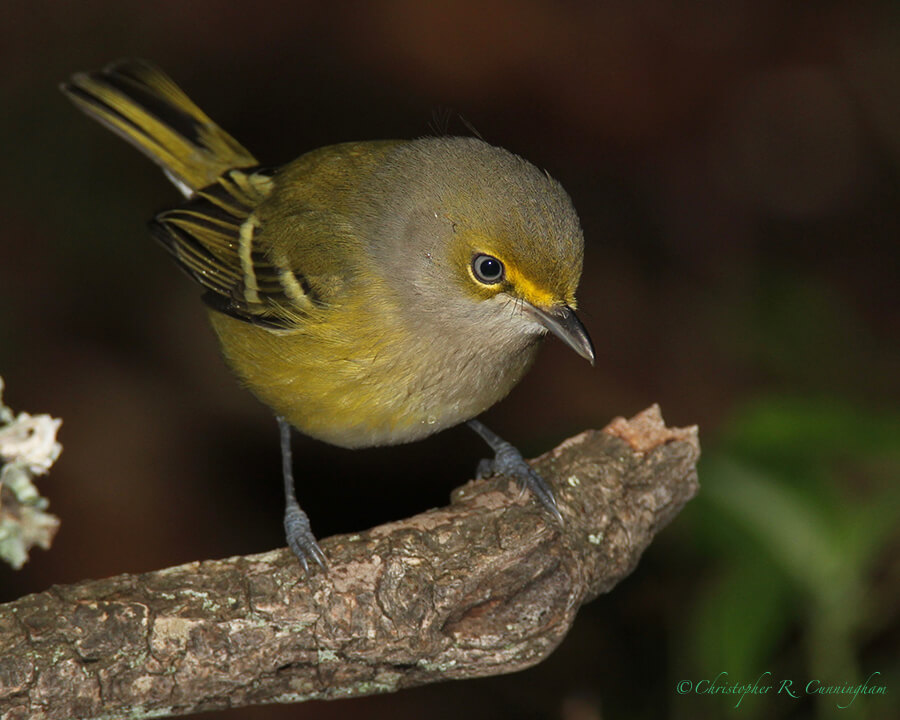
White-eyed Vireo, Lafitte’s Cove, Galveston Island, Texas. White-eyed Vireos summer across the eastern U.S. south to the Atlantic slope of Mexico, but populations generally retreat south for the winter across their range. Canon EOD 7D/600mm f/4L IS (+1.4x TC). High-speed synchronized fill-flash.
This week the sun passed the equator at high noon yielding a day with nearly equal darkness and light. But the important part: the days keep getting shorter. Birds are riding a blue train to the tropics in the hundreds of millions. We stand at the brink of the best of times, the longest stretch of cool, beautiful weather on the Texas calendar.
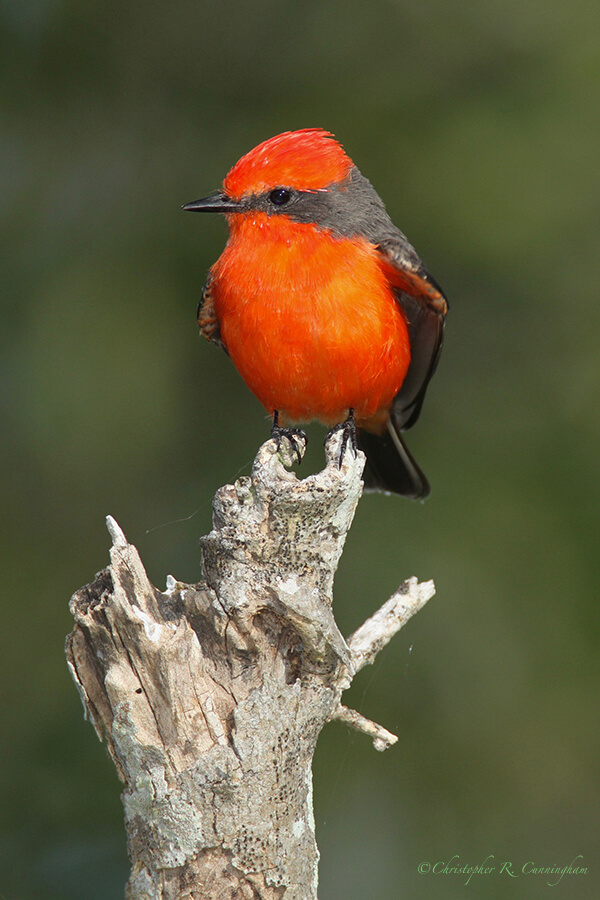
Perched Male Vermilion Flycatcher, Anahuac National Wildlife Refuge, Texas. Vermilion Flycatchers that winter on the Texas Gulf Coast have generally migrated east from breeding grounds in Mexico and the Southwest. Canon EOS 7D/600mm f/4L IS (+1.4x TC). High-speed synchronized fill-flash.
At least for now, the summer wind will be blowin’ in from across the sea–bringing patches of stormy weather. These atmospheric obstacles to avian movements will eventually cease as glaciers of cool breeze eventually bulldoze the sticky Gulf Coast air out to sea. On these frosty days the Gulf Coast, especially Galveston and the Coastal Bend, are a kind of Shangri-La. Can’t wait!
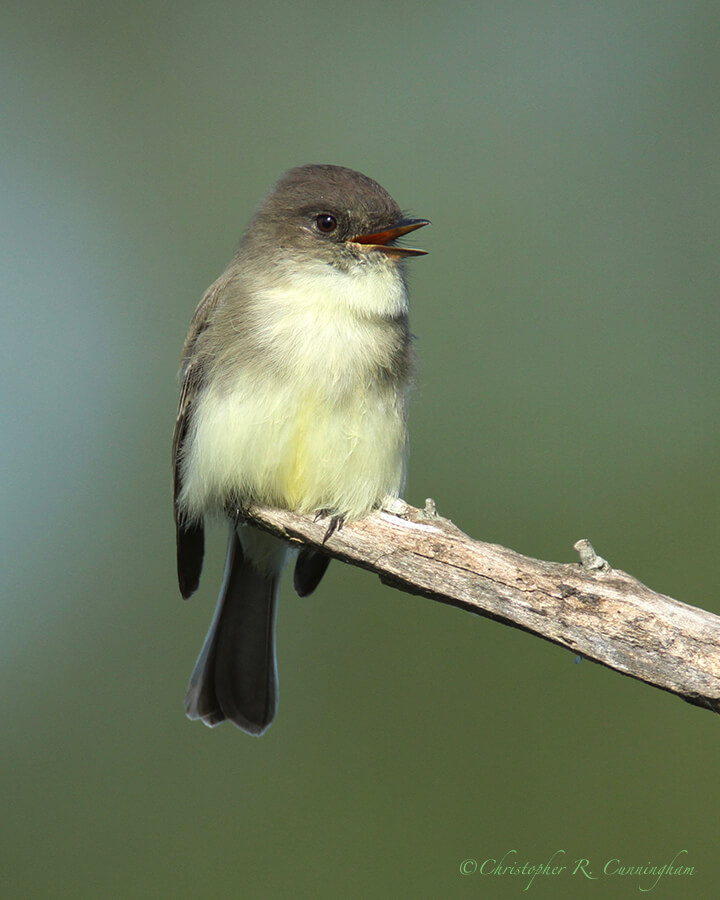
Fee-bee! Calling Eastern Phoebe, Anahuac National Wildlife Refuge, Texas. These flycatchers are a common sight on the Texas Gulf Coast in winter. But the “bee” sounds a bit worried from time to time. Canon EOS 7D/600mm f/4L IS (+1.4x TC). Natural light.
When I go to a party, nobody says hello. But when I leave, everybody says goodbye. –George Gobel
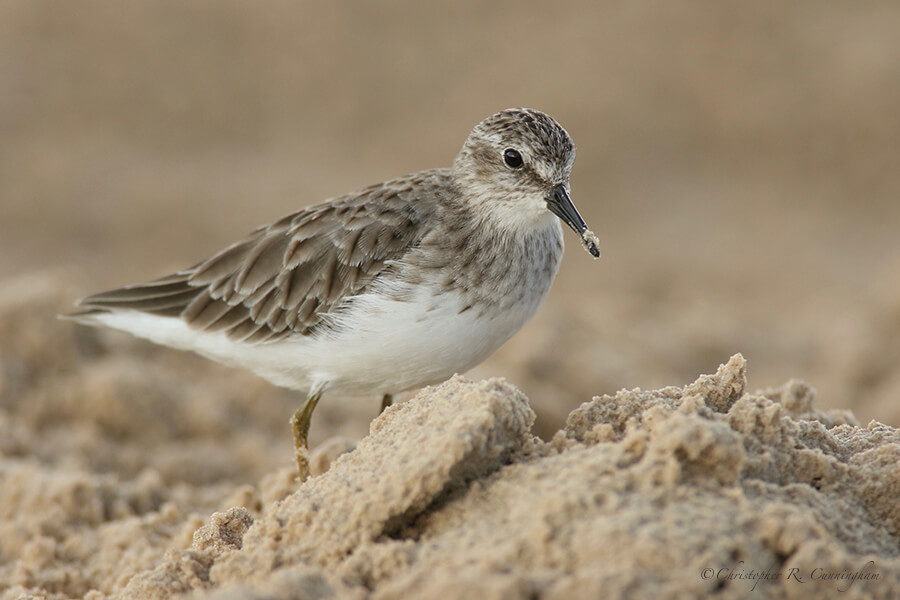
Last Shot of the Swelter: Hunting Least Sandpiper, lagoon behind Bryan Beach, Texas. It was a real trick keeping trash out of images this day. As far as I can tell, Texas beaches have never been filthier than this summer. Canon EOS 7DII/600mm f/4L IS (+1.4x TC). Natural light.
Last weekend we were on our knees on a hot, humid mudflat getting chewed up by sandflies photographing Least Sandpipers as they plucked insect larvae from the sand–when it started to pour warm rain. I looked up to see blue skies overhead. Noting the trajectory of the rain drops, I noticed that they were being blown at about a 45 degree angle from a small gray cloud coming up behind us from the Gulf. Geez. One good thing: We’re likely not far enough south to contract leishmaniasis from the fly bites!
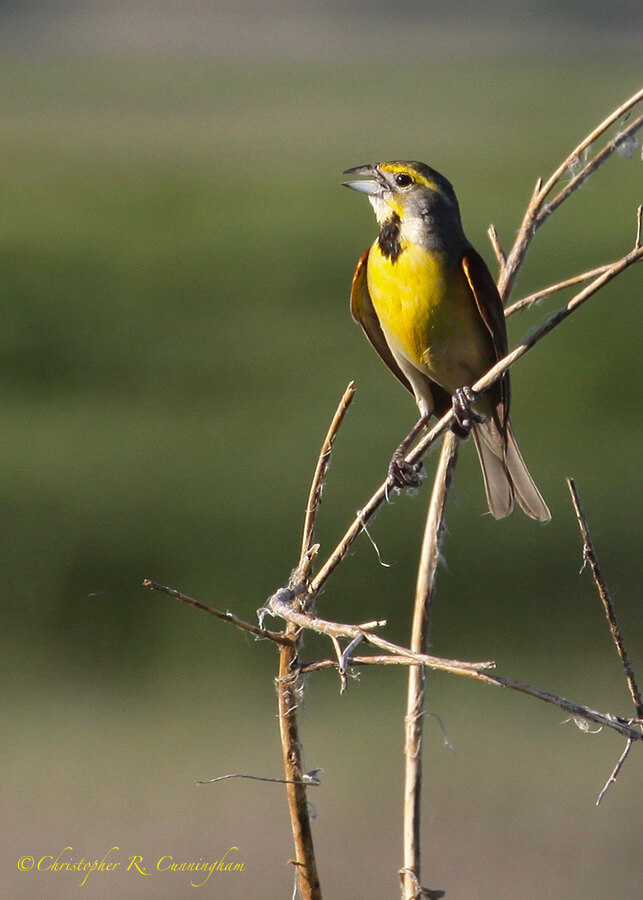
Summer Songster: Singing Dickcissel, Cheyenne Bottoms, Kansas. Birdsong is one of the true joys of summer. Canon EOS 50D/100-400mm f/4.5-5.6L IS. Hand-held. Natural light.
Elisa beat me back to the truck. Once I got there, we mopped off the equipment with my handkerchief. We sat there, in silence, grimy and soggy with rain and sweat. And then, suddenly, I announced that I was finally done for the summer . . . . I will return to the field only after the the first blue norther, maybe in a week or two (or three).
Summer has many wonders: singing, nesting, and baby birds, flowers, and zillions of cool insects. But enough is enough. Texas, you finally beat me.
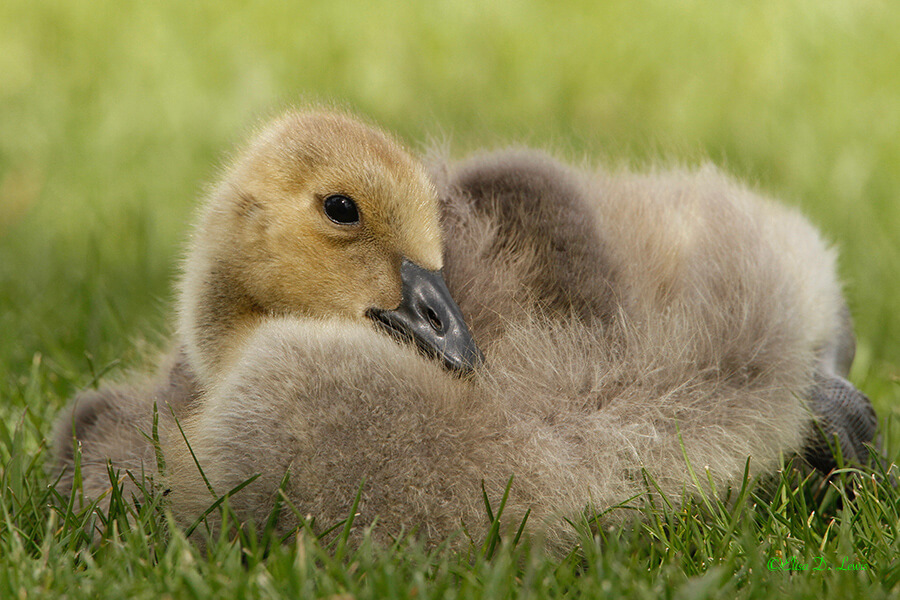
Canada Gosling, Jackson, Wyoming. Wyoming is paradise in summer. Canon EOS 7D/500mm f/4L IS (1.4x TC). Natural light.
A friend who has long since retired and moved from Houston to the hills of Tennessee explained why September is the most trying month in Texas. He found it tough looking at the news and seeing the cooling temperatures and changing colors of the leaves up north—when it is still 95 degrees in the shade here. Houston summers, though, give a great excuse for travel!
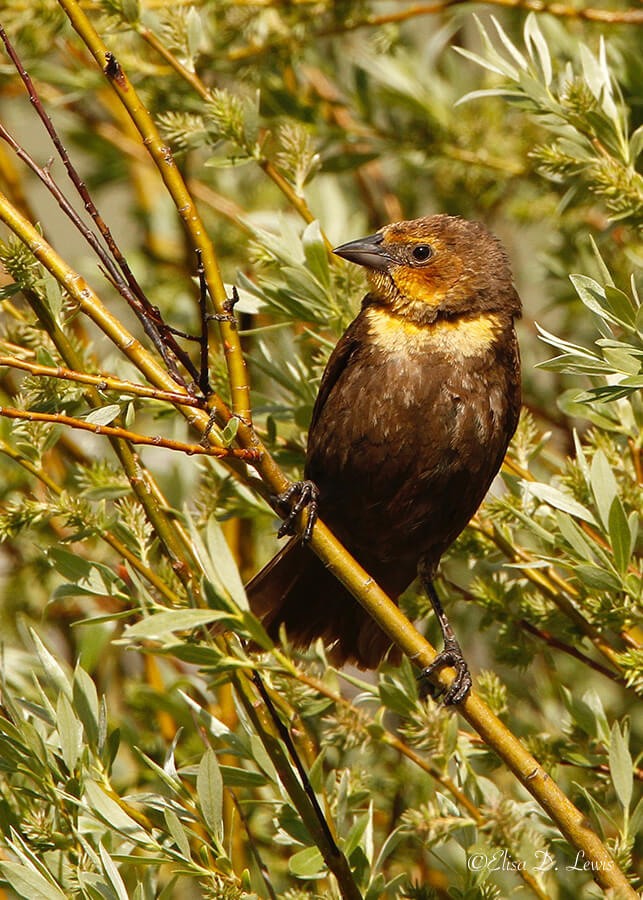
Female Yellow-headed Blackbird, Jackson, Wyoming. In summer, the marshes of cool temperate North America come to life. Canon EOS 7D/500mm f/4L IS (+1.4x TC). Natural light.
In about a month, there will be a few nice days per week. In two months, it will be nice almost all the time. In three months . . . I will be in love with Texas again.
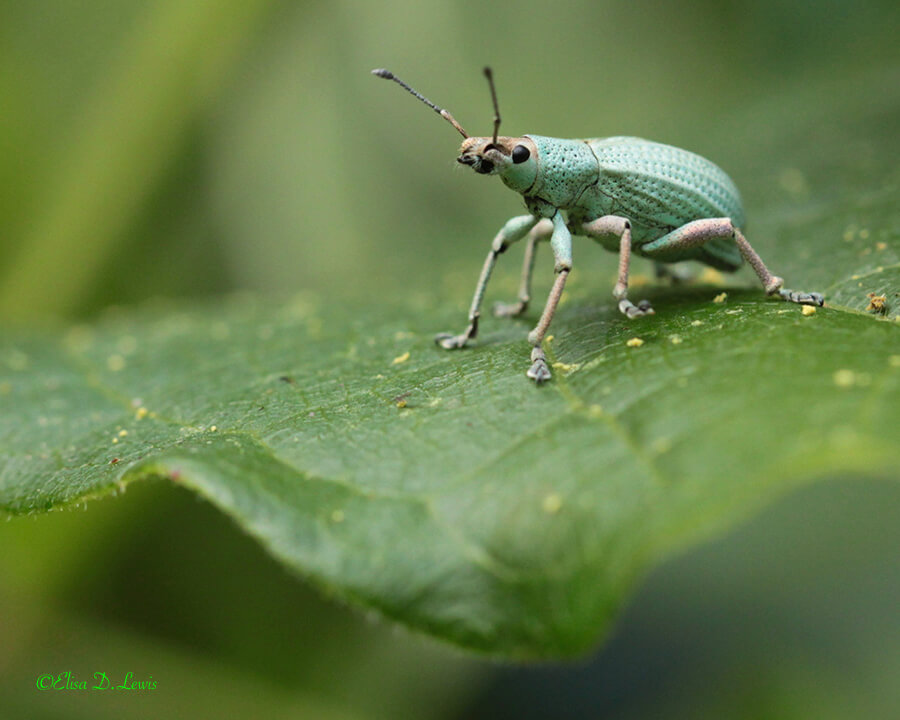
Jack Frost Says Your Days Are Numbered: Blue Green Citrus Root Weevil (Pachaeus litus), Lake Livingston State Park, East Texas. Elisa captured the above image of this weird little character. Charming, but . . . these guys are pests. Canon EOS 7D/100mm f/2.8 L IS Macro. Natural light.
Remembrance of things past is not necessarily the remembrance of things as they were.―Marcel Proust
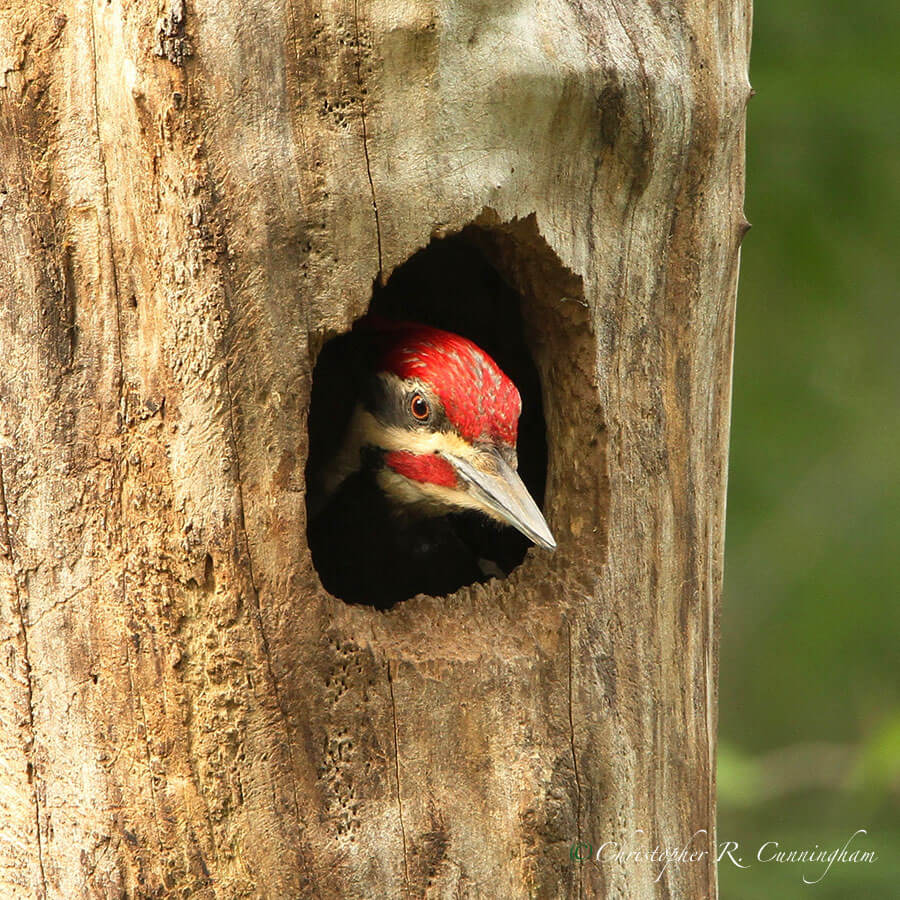
Pileated Woodpecker in Nest Cavity, Pilant Slough, Brazos Bend State Park, Texas. In a pinch, with a little imagination and a suspension of disbelief, the Pileated Woodpecker could pass for the extinct Ivory-billed Woodpecker . . . Canon EOS 7D/500mm f/4L IS (+1.4x TC). Natural light.
The world is old. The world is new . . . .
Over the past few weeks we’ve made a few tepid efforts to get back into the field, mostly binocular birding. After an hour or so, I was dragging along on my heels, round-shouldered, and dripping with sweat. But the first hint that fall might arrive someday is in the air in the early, early morning hours. The sky and clouds may have just a hint more peach and pink. It’s not quite so broiling, at least for a few of these early hours.
Down at Bryan Beach we did see a few things of note. Horned Larks were hunting insects among the beach flotsam. A Ruddy Turnstone was engaged in a life-and-death battle with a large buprestid beetle. This year’s crop of young Wilson’s Plovers were everywhere. In a previous post I remarked about how much this area reminded me of the the great Western Interior Sea of the Cretaceous Period . . . .
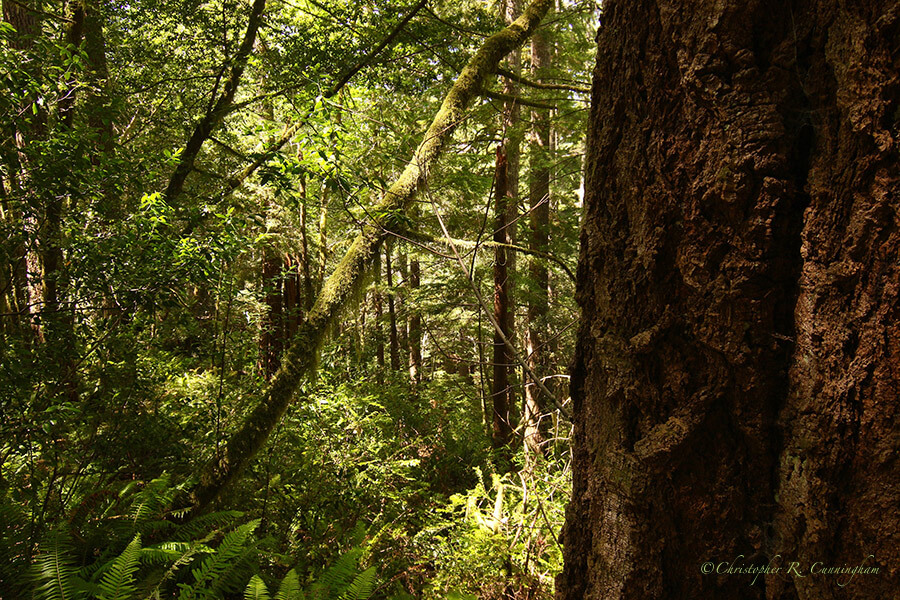
Redwood Forest, Oregon Redwoods Trail, Siskiyou National Forest, southwest Oregon. This could be a scene from the Jurassic Period. The understory is mostly ferns, and the trees are conifers, Coastal Redwoods (Sequoia sempervirens) and Douglas fir. Sequoia conifers date back to the Late Jurassic Epoch. Mosses and ferns are far more ancient. The dark giant shapes slipping through the trees are sauropods. Canon EOS 7DII/Tokina 11-16mm f/2.8. Natural light.
Like Billy Pilgrim, I sometimes find myself free of the confines of a particular time. Growing up on a land shaped by glaciers–moraines, eskers, and potholes–and half the year covered in drifting snow, whipped up into sparkling wisps, it was easy for a kid to stare squinting into a world that dissolved into Clovis hunters in fox and ermine parkas, perhaps, like Eskimos, sporting stylish ivory sunglasses, pursuing herds of mammoths and musk oxen across the ice-pack.
From time to time, I find myself in haunted places that make such time travel easy.
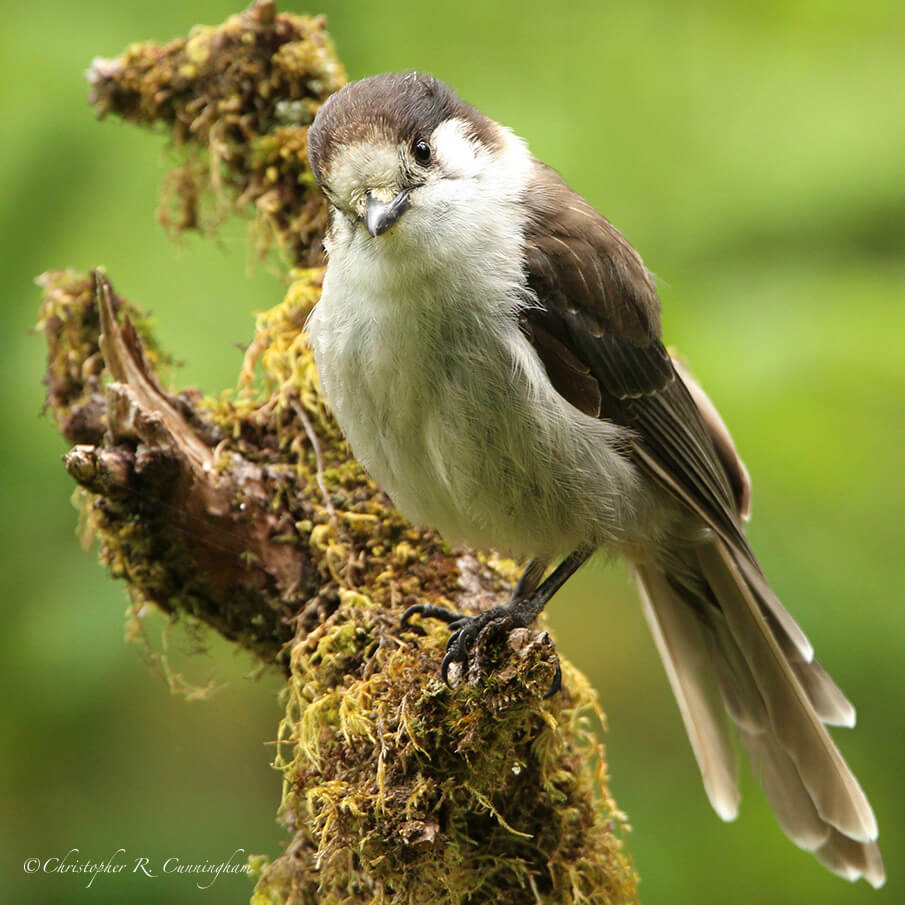
Spirit Guide: A Friendly Gray Jay, Hoh Rainforest, Olympic National Park, Washington. Canon EOS 7D/500mm f/4L IS (+1.4x TC). Natural light.
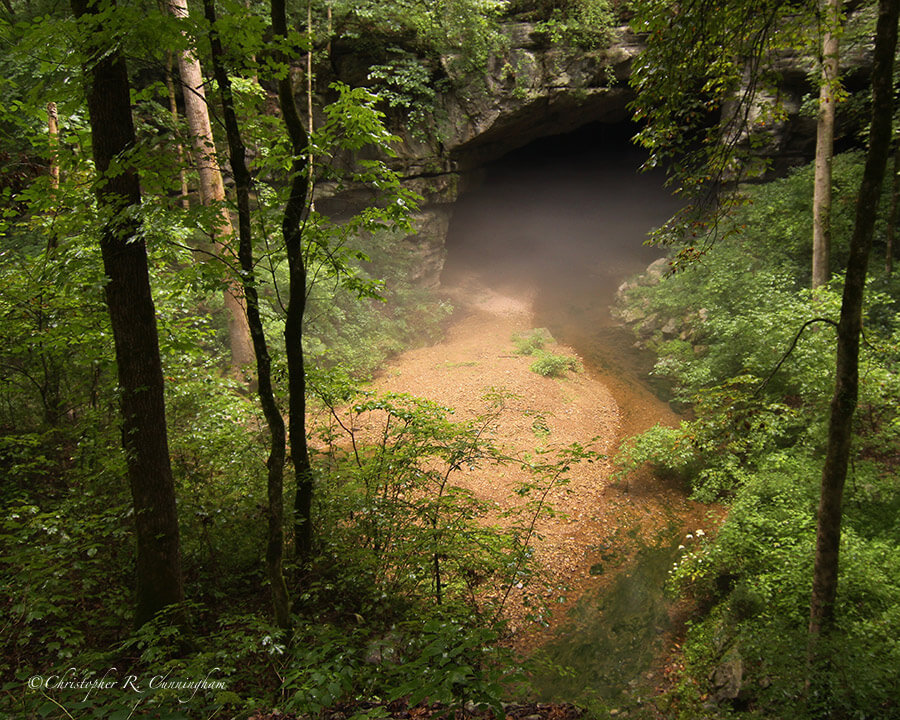
The Hoh Rainforest of the Olympic Peninsula is one such place. Russell Cave is another. The Hoh Rainforest is a misty woods, its mightly conifers draped in moss, and the forest floor covered in ferns. In such forests 150 million years ago the proto-birder could likely have heard the squawking of Archaeopteryx or Microraptor in the canopy as they waited for a stegosaur to lumber past. But steer clear of the giant bison hunters of Russell Cave. They’re a rough lot.
Russell Cave National Monument, Alabama. Human habitation began in Russell Cave during the Archaic Period, around 10,000 years ago. Archaeologists think these Native Americans occupied the cave mostly during winter. Canon EOS 7D/Tokina 11-16mm f/2.8. Natural light.
For a minor creative project I’m working on, we took a trip to Mercer Arboretum and Botanical Garden. I was interested in taking a few images of primitive plants in the Prehistoric Garden. In the garden are a number of types of plants representing groups that date back to the Mesozoic Era, and in a few cases even the Paleozoic Era. We saw the maidenhair tree (Gingko biloba), ferns, tree ferns, cycads, dawn redwood (Metasequoia glyptostroboides), and several strangely wonderful Araucaria conifers (including the Moreton Bay pine, A. cunninghami, and the bunya-bunya, A. bidwillii).
Spinkled throughout the gardens we saw other plants of nearly equal antiquity. Magnolia and sycamore, for example, date back to the Early Cretaceous Epoch. On this trip we even saw a tyrannosaur eat a guy! I swear!
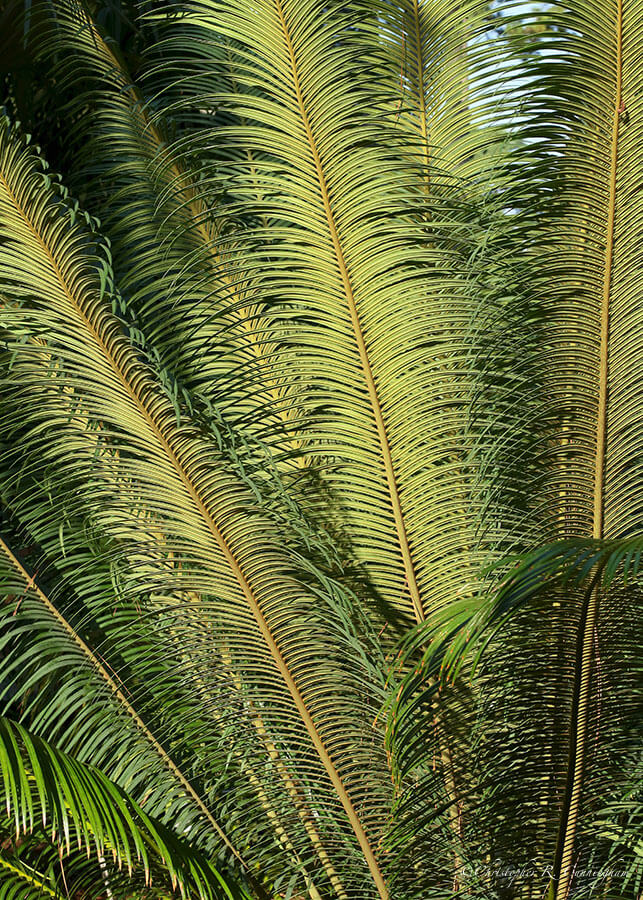
Cycad Fronds, Prehistoric Garden, Mercer Botanical Garden, Humble, Texas. Stare into a cycad understory today with impunity. Were it the Jurassic or Cretaceous Period, you might not like what was staring back! Canon EOS 7DII/50mm f/1.4. Natural light.
Sorry folks, park’s closed. Moose out front shoulda told ya.—Lasky, Walleyworld guard (from National Lampoon’s Vacation)
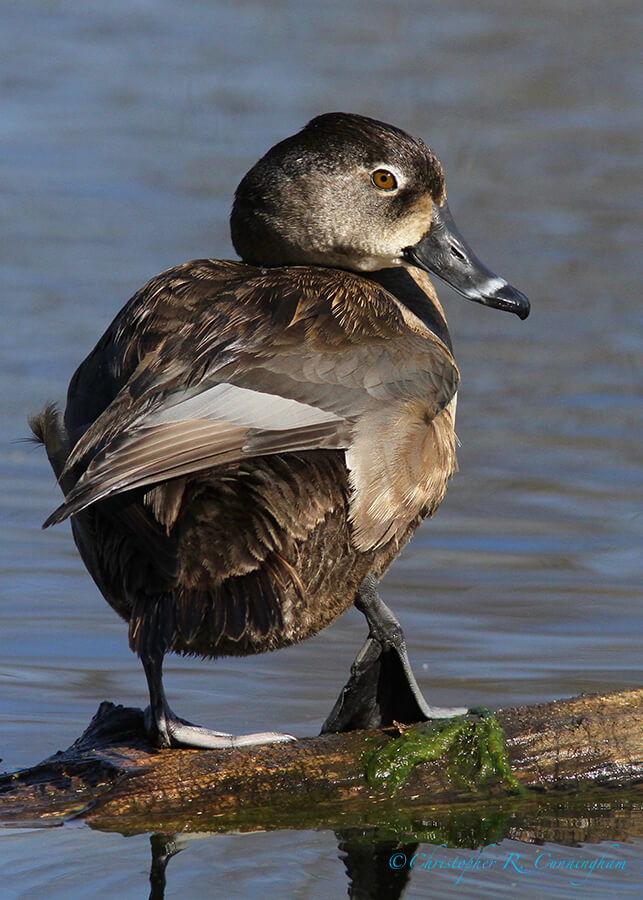
Over the Shoulder: Ring-necked Hen, Pilant Lake, Brazos Bend State Park, Texas. Canon EOS 7D/600mm f/4L IS (+1.4x TC). High-speed synchronized fill-flash.
The dog days of summer have us down! Chris’s return to work, illness (minor), and endless bad weather have cut the wind out of our sails. We’re takin’ a break! And we’re counting the days until the first blue norther arrives and brings with it the cold weather species that winter here—like ducks! See you soon!
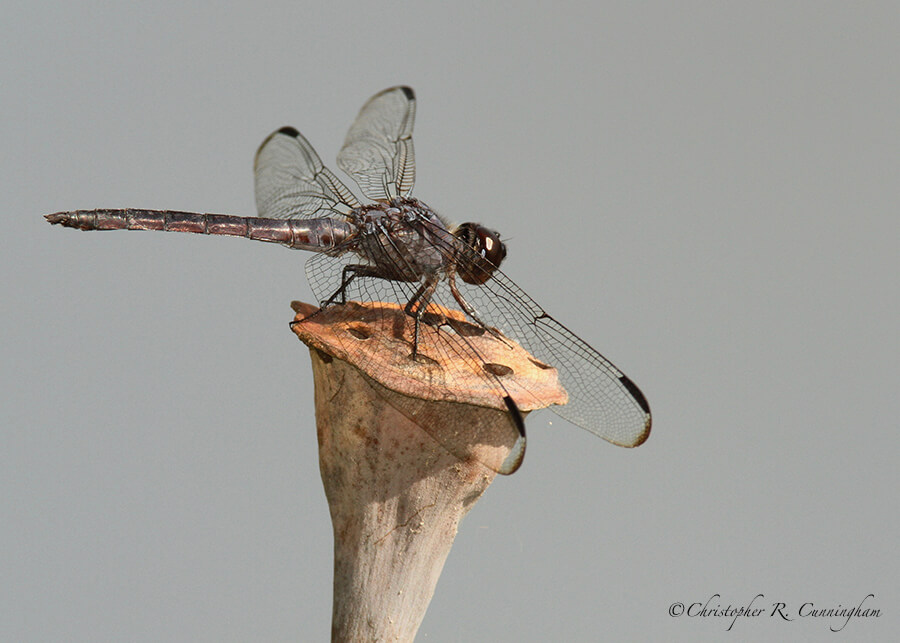
Slaty Skimmer Dragonfly (Libellula incesta) on American Lotus (Nelumbo lutea) Seed Pod, Elm Lake, Brazos Bend State Park, Texas. Canon EOS 7D/600mm f/4L IS (+1.4x TC). High-speed synchronized fill-flash.