A light exists in spring
Not present on the year
At any other period.
When March is scarcely here . . . .
—Emily Dickinson, A Light Exists in Spring
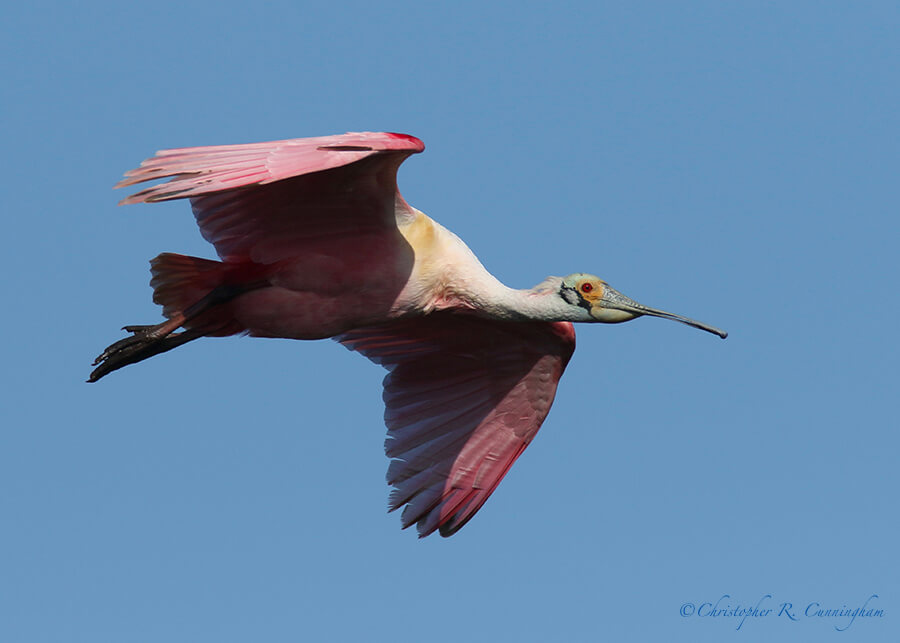
Roseate Spoonbill in Flight, Smith Oaks Rookery, High Island, Texas. Canon EOS 7DII/600mm f/4L IS (+1.4x TC). Natural light.
In our travels last week, we stopped by Smith Oaks on High Island, Texas, one of the most famous birding sites on the Texas Gulf Coast. Although we saw no early migrant songbirds in the surrounding woods, the rookery was hopping with activity—the drive toward life.
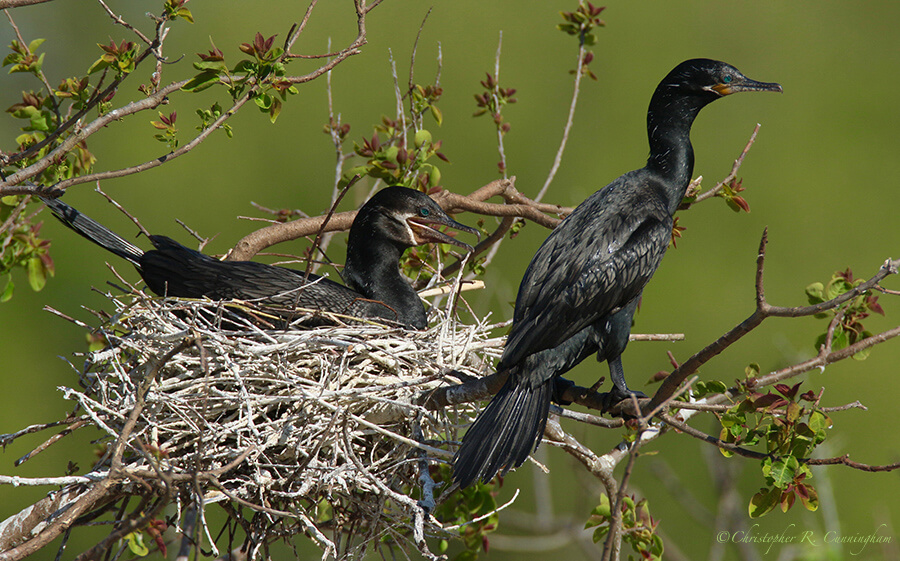
Nest-sitting Neotropic Cormorants, Smith Oaks Rookery, High Island, Texas. Note that the nest is stained white with guano. Canon EOS 7DII/600mm f/4L IS (+1.4x TC). Natural light.
Spoonbills, egrets, and cormorants filled the air. Great Egrets and Neotropic Cormorants shuttled back and forth with nest-building materials. Double-crested Cormorants fished in the water surrounding the rookery. Some Great Egret pairs were building nests, sitting on eggs, or rearing chicks. Neotropic Cormorants were nest-sitting, but no chicks were to be seen. A few energetic Tricolored Herons swooped past but gave no indication of intentions. Spoonbills squabbled with each other: Nesting can’t be far behind!
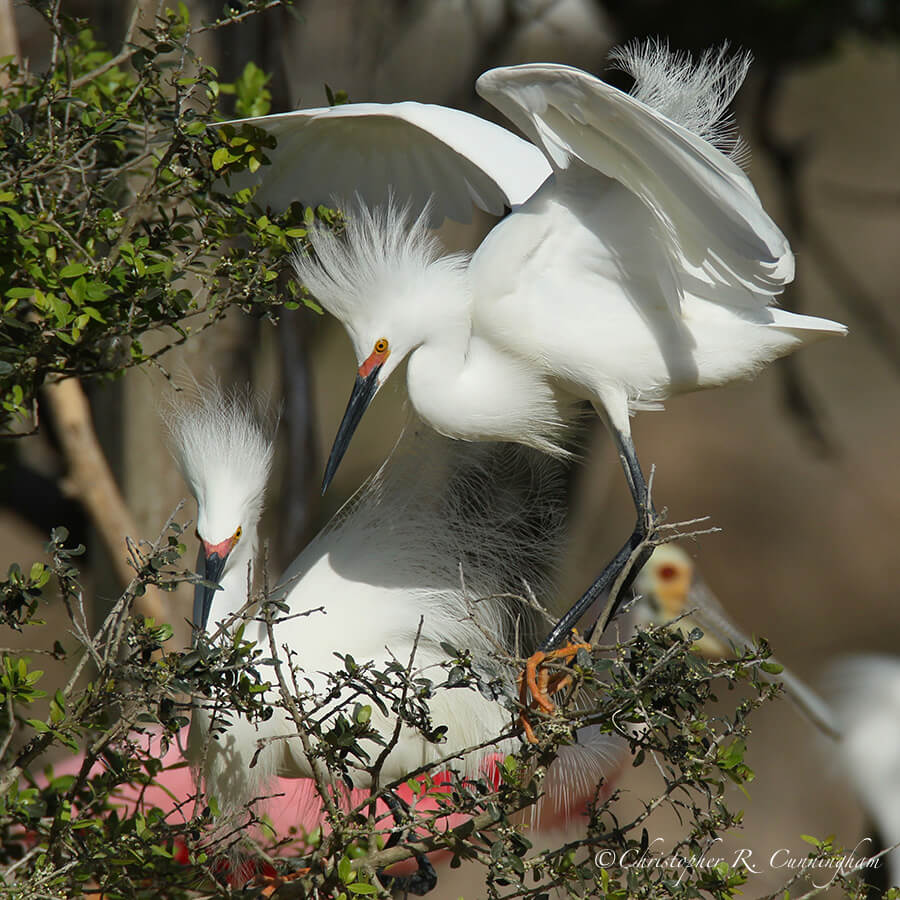
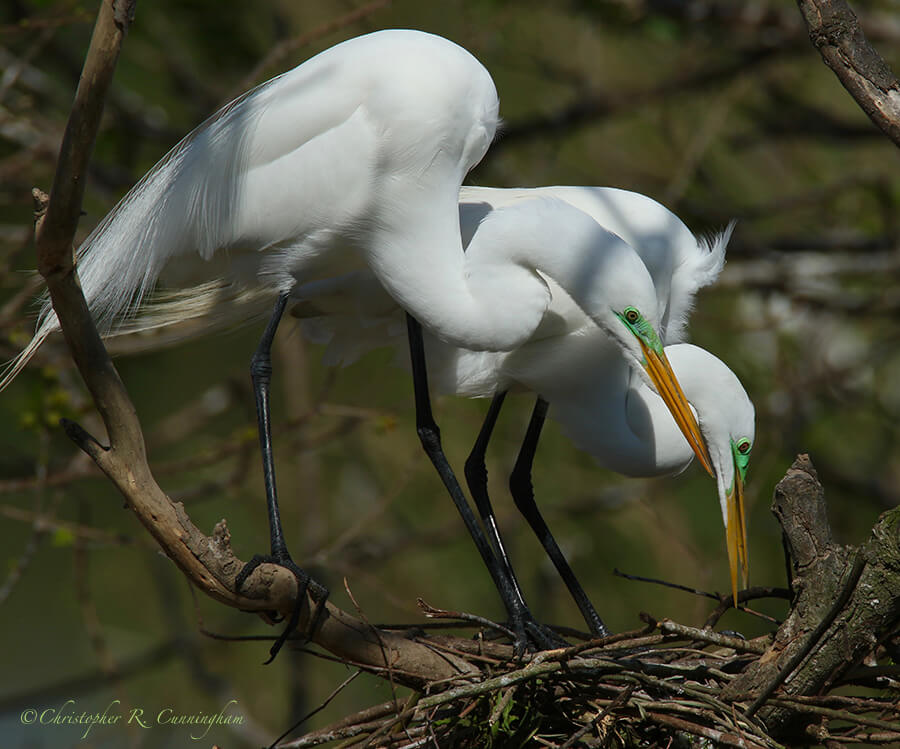
Snowy Egrets in High Breeding, Smith Oaks Rookery, High Island, Texas. In high breeding color, Snowy Egrets have pink lores and feet. Canon EOS 7DII/600mm f/4 L IS (+1.4x TC). Natural light.Nest-building Great Egrets, Smith Oaks Rookery, High Island, Texas. Nest building is a team effort for Great Egrets. Note the fluorescent green lores of high breeding color. Canon EOS 7DII/600mm f/4L IS (+1.4x TC). Natural light.
Great and Snowy Egrets in glorious breeding plumes (that almost doomed these species to extinction in the Gilded Age) with lores ablaze in electric colors were everywhere and revved up on hormones. Soon, the later-breeding species, Cattle Egrets, Tricolored Herons, and Roseate Spoonbills, will join the frenzy. By that time, the trees will be filled with brilliant flashes of Neotropical migrant songbird plumage and the picture of spring will be complete . . . .
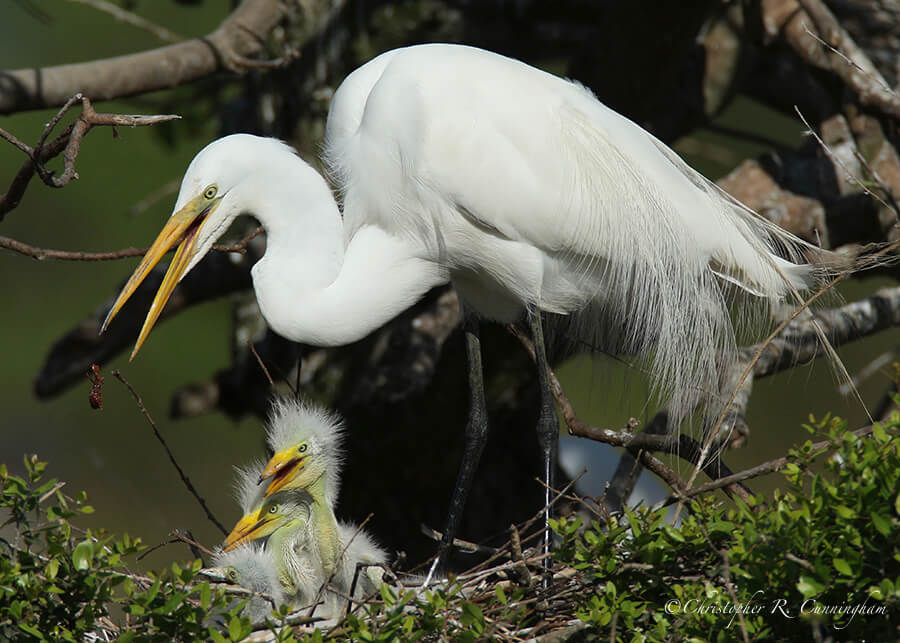
Great Egret Feeding Young, Smith Oaks Rookery, High Island, Texas. A regurgitated crawfish is being presented to the nestlings. Three nestlings are visible in this image, but a fourth smaller one is also present. Canon EOS 7DII/600mm f/4L IS (+1.4x TC). Natural light.
But, as always, predators lurk in the dark water below waiting for larger nestlings to oust smaller, weaker ones, or for birds of any age to simply make a mistake . . . .
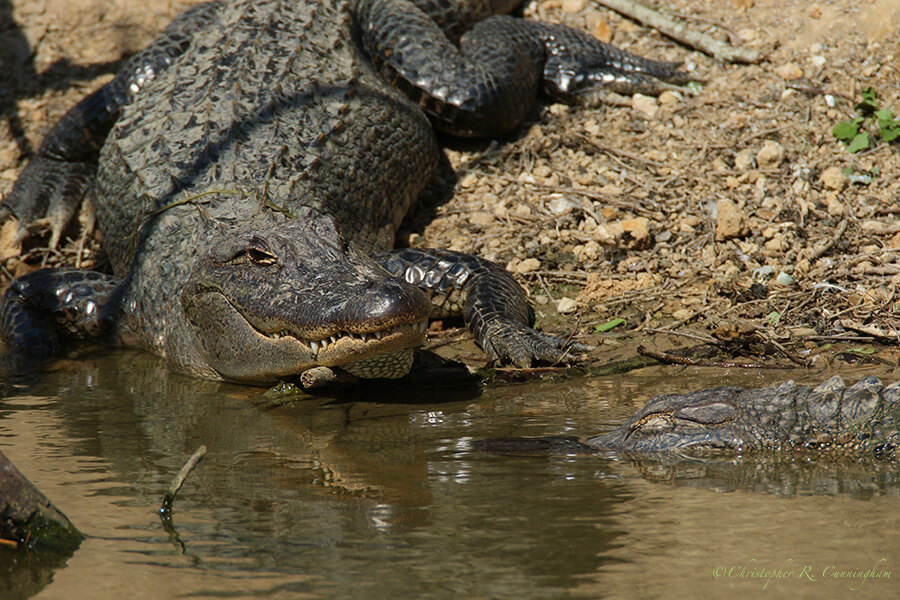
Death Stalks the Rookery, Smith Oaks Rookery, High Island, Texas. Despite the beauty, have no illusions: Nature is red in tooth and claw . . . always. Canon EOS 7DII/600mm f/4L IS (+1.4x TC). Natural light.
For life and death are one, even as the river and the sea are one.–Khalil Gibran
What we achieve inwardly will change outer reality. –Plutarch
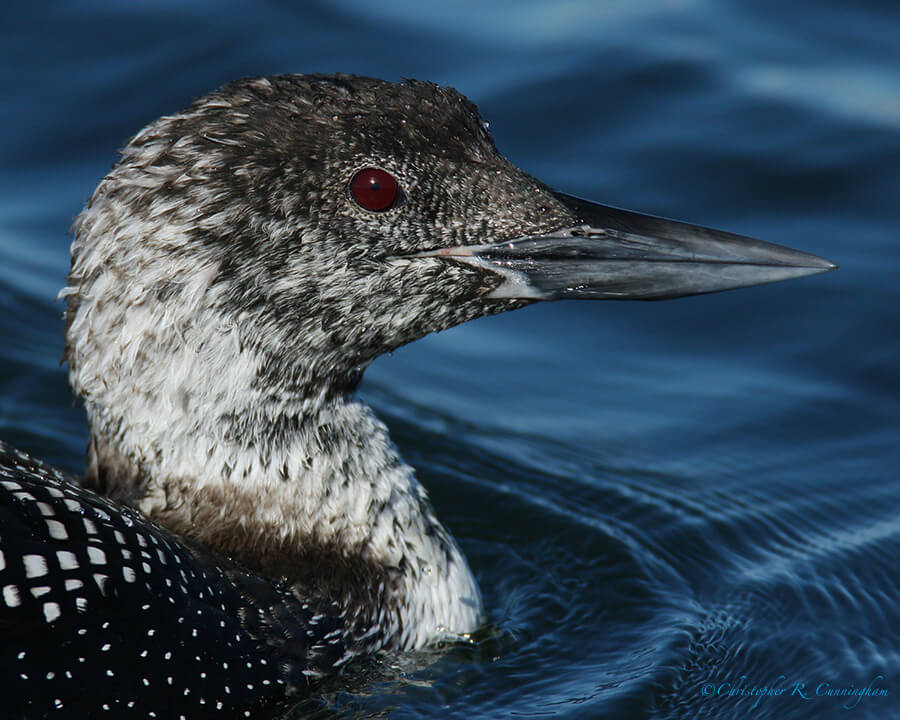
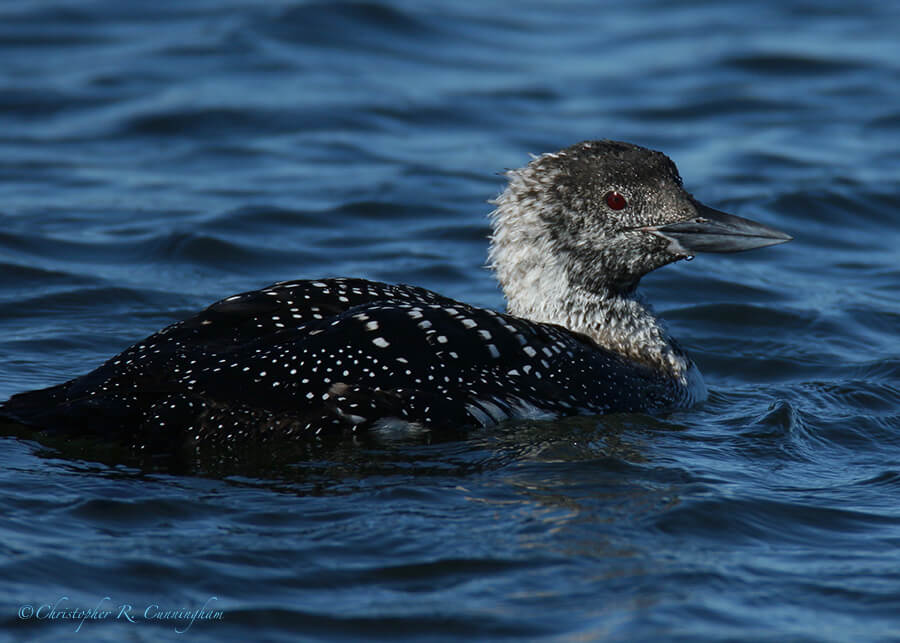
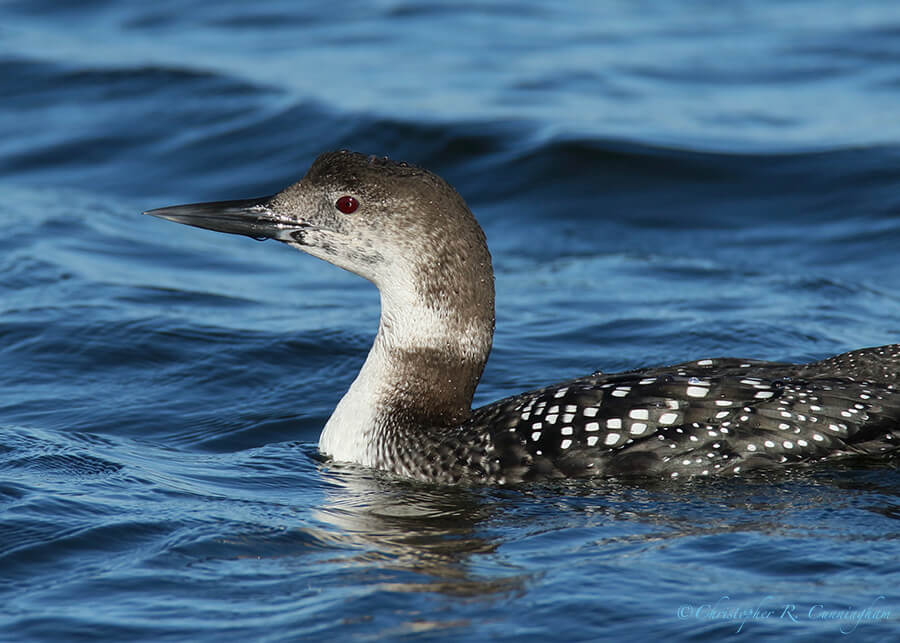
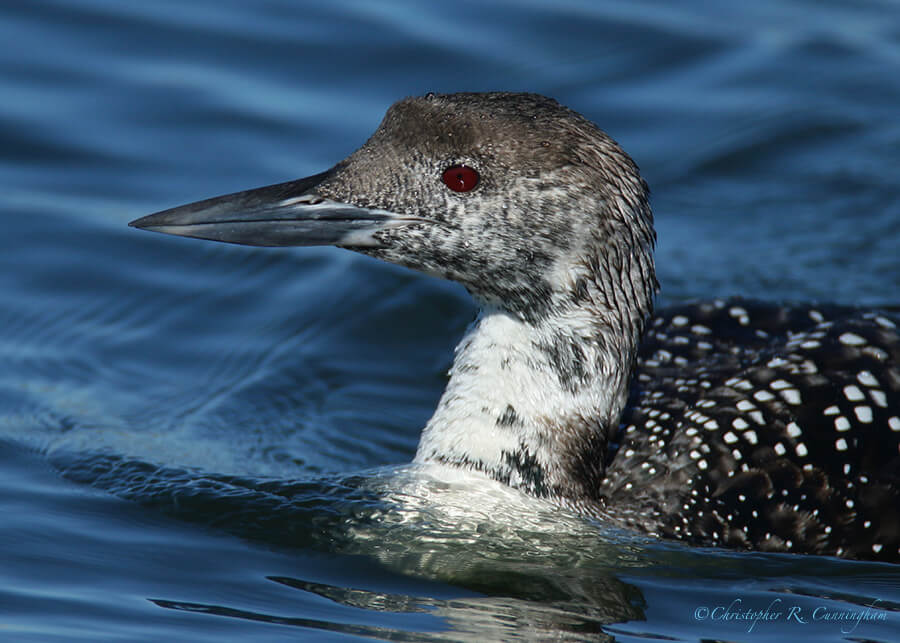
Common Loon in Pin Feathers, Offatt’s Bayou, Galveston island, Texas. The tips of the pin feathers on the neck and head are pigmented black. Canon EOS 7DII/600mm f/4L IS (+1.4x TC). Natural light.Common Loon in Pin Feathers 2, Offatt’s Bayou, Galveston Island, Texas. This is the same bird as above. Note the shagginess of the pin feathers on head and neck. Canon EOS 7DII/600mm f/4L IS (+1.4x TC). Natural light.
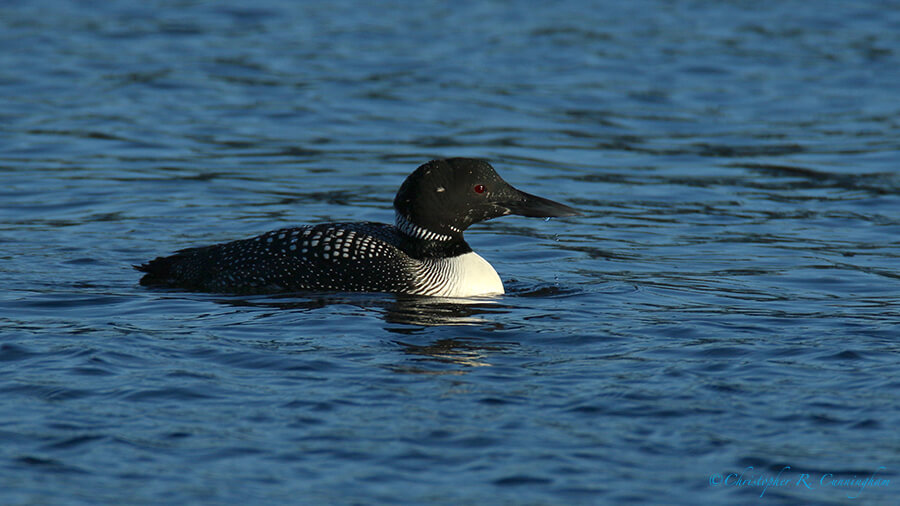
This week on Galveston, Common Loons could be seen in many stages of transitional plumage. Every bird looked slightly different. All the birds I saw had some degree of spotting on the wings, and so lacked the brown, scalloped pattern of nonbreeding wing plumage. I saw one bird with a shaggy mane of pin feathers (Thanks to S.M. for pointing out this bird!) and one bird in almost complete breeding colors—only a stray feather here or there needed to be pigmented.
Common Loon in Transitional Plumage, Offatt’s Bayou, Galveston Island, Texas. This bird appears to be in nonbreeding plumage from the neck forward. Spots on the wings show the transition to breeding colors has begun, though. Canon EOS 7DII/600mm f/4L IS (+1.4x TC). Natural light.Another Common Loon in Transitional Plumage, Offatt’s Bayou, Galveston Island, Texas. This bird is a little further along than the one immediately above. Canon EOS 7DII/600mm f/4L IS (+1.4x TC). Natural light.
Many birds were engaged in hunting behavior much of the time. I saw fish, crabs, and a single mantis shrimp (Squilla empusa) being taken. This is clearly the time of year to be gorging and fattening up. It’s a long way back to Canada and environs for the breeding season! A good deal of preening was also going on, likely related to molting and keeping feathers in shape for the big trip ahead. Two birds had already pair-bonded and spent a significant amount of time together–another reminder that breeding in birds is often a process that unfolds in many stages over much of the year.
Common Loon in Breeding Colors (Nearly), Offatt’s Bayou, Galveston Island, Texas. This bird was more shy than many others and had apparently already pair-bonded. Another bird in less well-developed transitional plumage kept appearing in close proximity. Could shyness toward humans and pair-bonding behaviors be related? Canon EOS 7DII/600mm f/4L IS (+1.4x TC). Natural light.
Life is one long process of getting tired.–Samuel Butler
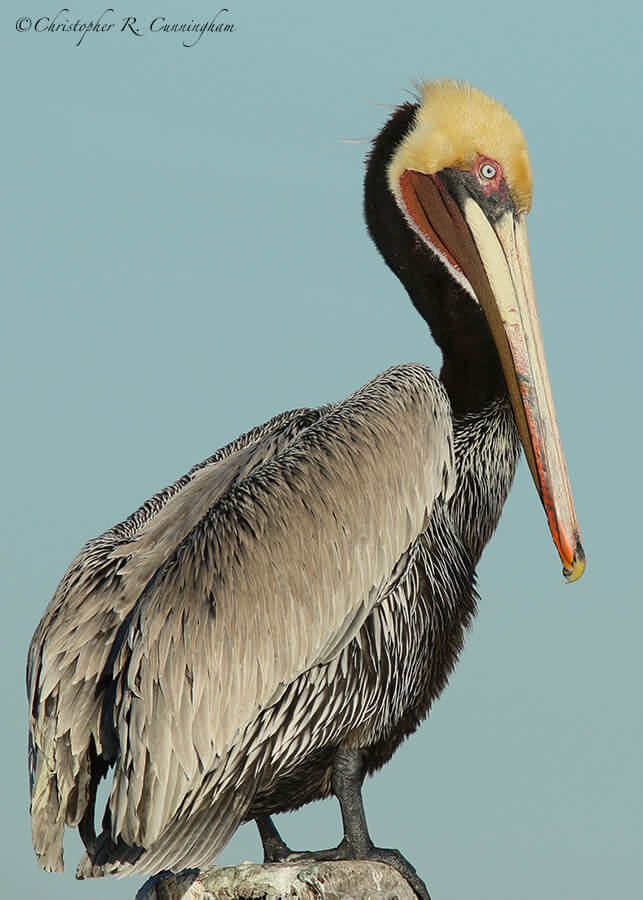
California Pelican, Offatt’s Bayou, Galveston Island, Texas. We always keep an eye out for the red throat pouch—a sign of the Pacific race of the Brown Pelican. The blackish- or brownish-green-throated Atlantic Brown Pelicans greatly outnumber the Pacifics along the Texas Gulf Coast. Canon EOS 7DII/600mm f/4 L IS (+1.4x TC). Natural light.
The house is in shambles, and the yard looks like a post-apocolyptic wasteland (Thanks, sod webworm moth larvae!) so we’re takin’ a break! Not to worry, we’ll be back on the ball soon!
Feet, what do I need you for when I have wings to fly?—Frida Kahlo
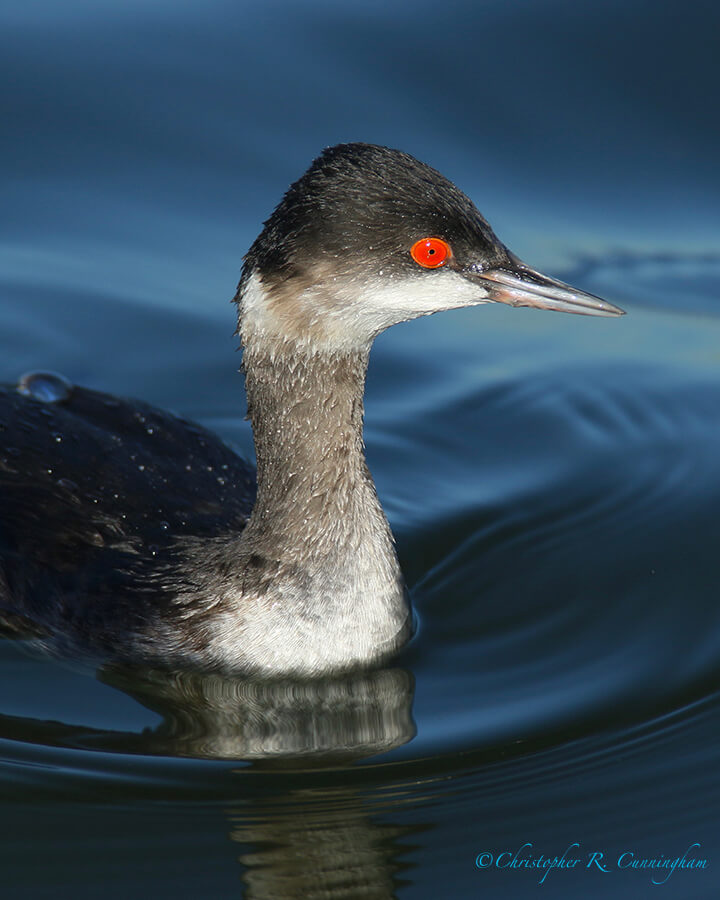
Portrait: Eared Grebe, Offatt’s Bayou, Galveston Island, Texas. Canon EOS 7DII/600mm f/4L IS (+1.4x TC). Natural light.
Among extant birds, grebes have a unique method of foot propulsion. There are other foot-propelled divers, loons, for example, but these birds have significant webbing between the toes. The birds with webbed toes push themselves forward against the drag force of water. Grebes, on the other hand, have separate toes with stiff, collapsible asymmetrical lobes on each side. The lobes on the inside are larger than those on the outside. Grebes are also unusual in that their relatively short femora (thigh bones) are oriented perpendicular to the long axis of the body, and the toes beat along a complex dorso-lateral to ventro-medial path, rather than parallel to the direction of the body’s forward motion.
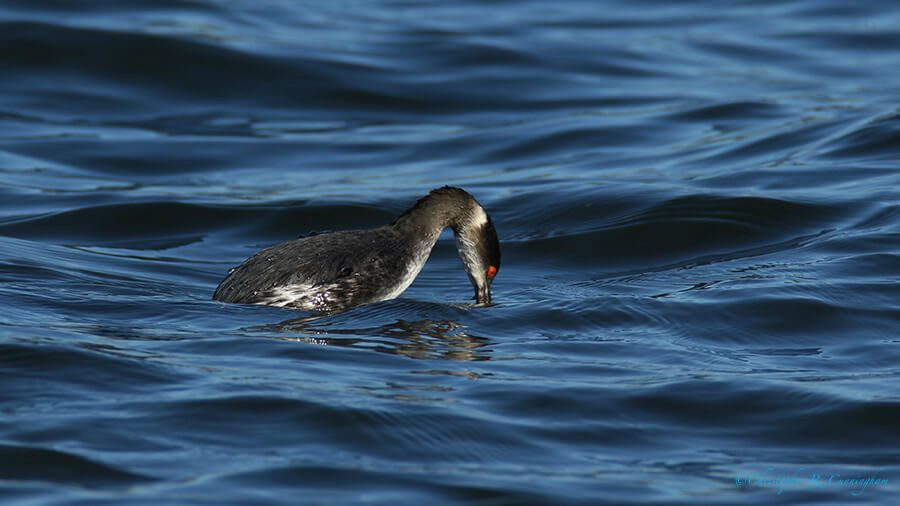
Diving Eared Grebe, Offatt’s Bayou, Galveston Island, Texas. Although grebes have a unique method of foot-propulsion, they look like many other submarine hunters (e.g., loons, mergansers, cormorants) from above the water as they dive after prey. Canon EOS 7DII/600mm f/4L IS (+1.4x TC). Natural light.
The traditional interpretation of how grebes paddled through the water, and the one I was taught, is that the lobes of the toes would unfold during then power stroke to provide maximum drag to push against, and fold up to reduce drag on the the recovery stroke. A more recent interpretation is that the grebe foot acts like a (slotted) hydrofoil and provides a lift force that propels the bird forward from behind (Johansson and Norberg, 2001)–physically similar to the way in which a wing allows a bird or airplane to fly. The lift hypothesis has an immediate visceral appeal to me given the asymmetrical lobes of the toes—like the vanes of a flight feather. Lift is usually explained by elementary physics textbooks as the result of the Bernoulli principle, essentially the conservation of energy for a moving fluid. This explanation is not correct quantitatively. The true explanation likely involves the most terrifying of all physics concepts . . . turbulence . . . .
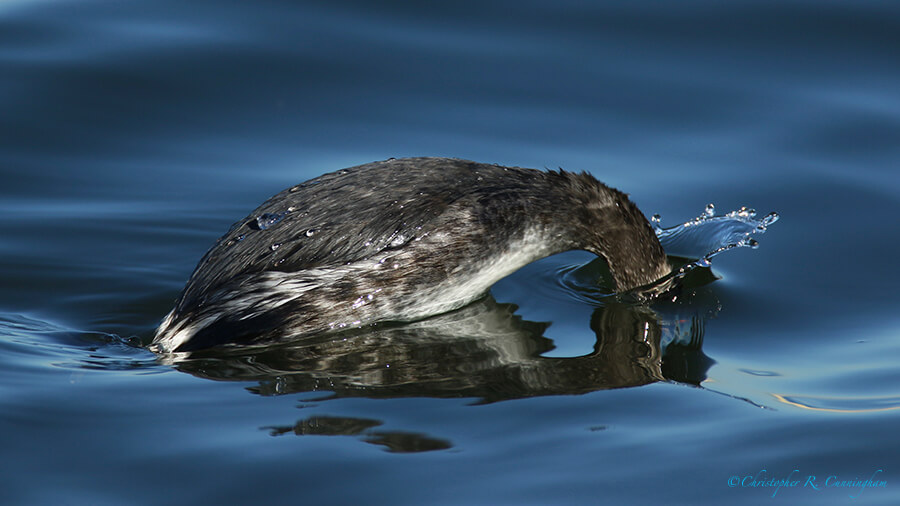
Diving Eared Grebe 2, Offatt’s Bayou, Galveston Island, Texas. Canon EOS 7DII/600mm f/4L IS (+1.4x TC). Natural light.
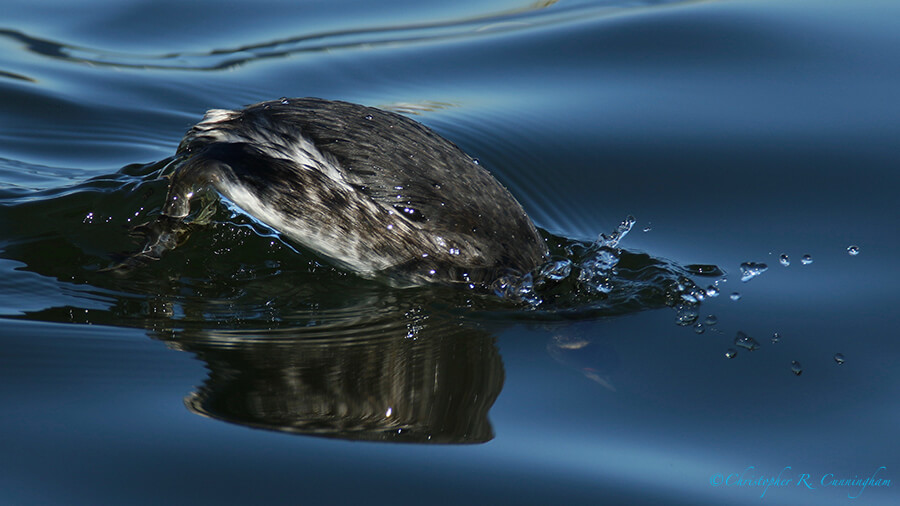
As a photographer on the surface, I haven’t been able to document the strange way in which grebes move through the water. Once and a while, when conditions were right, I have been treated to a glimpse of the legs in motion as in the image below. Swimming with grebes is one more activity to add to an already lengthy bucket list.
I mentioned at the opening that grebes were unique among extant birds. Hesperornithiformes, a group of toothed Cretaceous foot-propelled diving birds, are thought to have had a method of propulsion similar to grebes and to have possessed asymmetrically lobed individual toes. On a recent visit to the New Mexico Museum of Natural History in Albuquerque, I had the opportunity to study the feet of a life-sized model of Hesperornis regalis, the largest of these Cretaceous divers from the Kansas Chalk Sea. Reading the label . . . sure enough, reconstruction supervised by Dr. L. D. Martin, my late (paleo)ornithology professor, a gifted teacher with so many fascinating stories to tell about the lives of birds. . . .
Diving Eared Grebe 3, Offatt’s Bayou, Galveston Island, Texas. Offatt’s Bayou is a great place to see Eared Grebes hunting in winter. Texas City Dike is another. Canon EOS 7DII/600mm f/4L IS (+1.4x TC). Natural light.
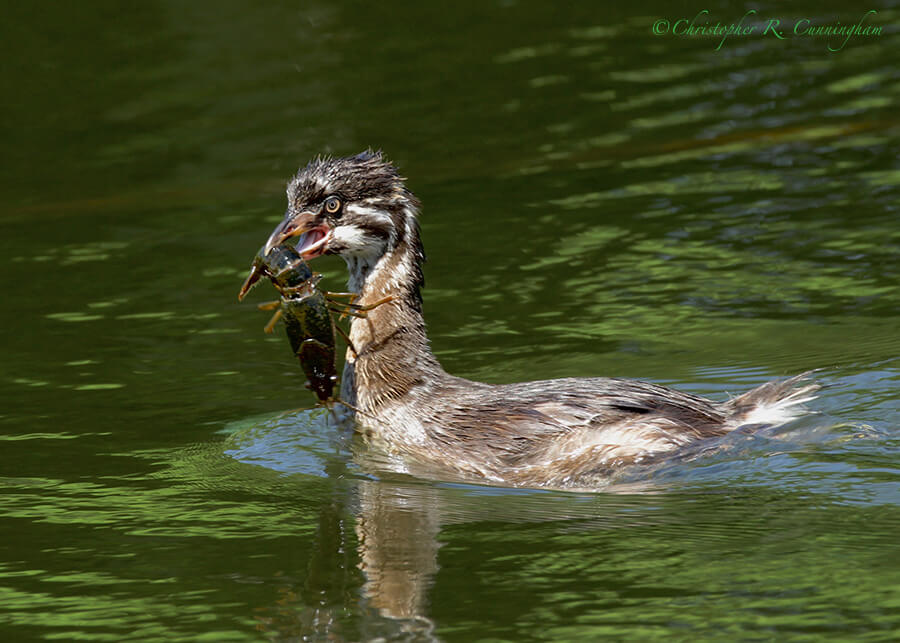
While grebe-watching, I am always interested in seeing these birds return to the surface with prey. In my experience along the Gulf Coast, Eared Grebes rarely return to the surface with prey. After dozens of dives, I have seen only one small fish clamped in a beak. This means that grebes are either remarkably unsuccessful hunters (unlikely), or that they can swallow small prey underwater (likely). Pied-billed and Least Grebes can be seen with large prey on the surface like fish, crawfish, frogs, and dragonflies. Perhaps small prey may be easily swallowed in the submarine realm, whereas large prey items may need to be manipulated into an ideal orientation in the air. In any case, grebes are certainly among the most interesting subjects for study and observation. Elisa doesn’t have to ask me twice to go grebe-watching!
Juvenile Pied-billed Grebe with Crawfish, Elm Lake, Brazos Bend State Park, Texas. In the past, Brazos Bend SP was great place to see Pied-billed Grebes hunting year-round. Recent flooding has decimated the ecology of the park, and water birds are no longer abundant. Canon EOS 7D/500mm f/4L IS (+1.4x TC). Natural light.
Reference
Johansson, L.C., and Norberg, U. M. L. Norberg. 2001. Lift-based Paddling in Diving Grebe. The Journal of Experimental Biology204: 1687-1696.