On Being There

This is just like television, only you can see much further.–Chance the Gardener (from Being There)
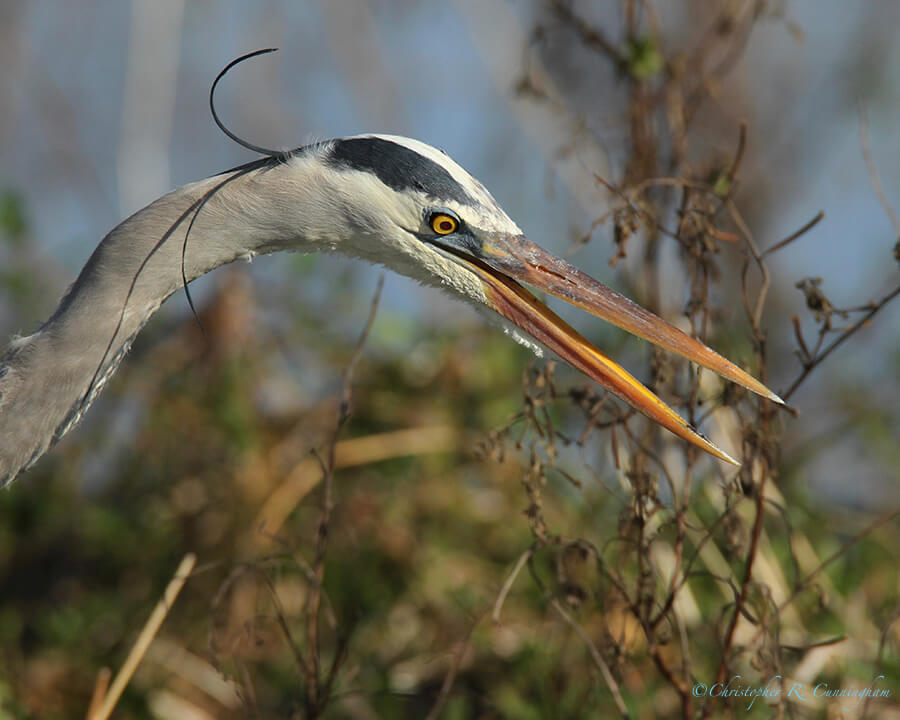
Gaping Great Blue Heron, Pilant Lake, Brazos Bend State Park, Texas
Gaping Great Blue Heron (Breeding), Pilant Lake, Brazos Bend State Park, Texas. This bird was just about to spear a big fat siren and drag it from its burrow. I have stalked Great Blue Herons for many hours always hoping for the bird to grab prey. Canon EOS 7D/600mm f/4L IS (+1.4x TC). Natural light.

Unlike the utterances of simpleton Chance the Gardener in the film Being There, things said or done in strange birding territory are unlikely to be perceived as brilliant by the locals–or anyone else for that matter. Travel birding generally doesn’t give you the time to get many good shots, especially since you don’t know the conditions well or even where the birds are. Generally it takes many hours of observation in a place you know well to see or photograph something interesting or unusual.

Case in point: Entertaining fantasies of becoming a world birder, I have begun building my ornithology library again. I just added Herons and Egrets of the World: A Photographic Journey by James Hancock. Published in 1999, the images contained within were captured on film and are a mixed bag. I can only imagine the difficulties involved in documenting avian species on film under what must have often been hostile conditions. The book has, however, provided some more exotic species to be added to the bucket list to be seen and photographed.
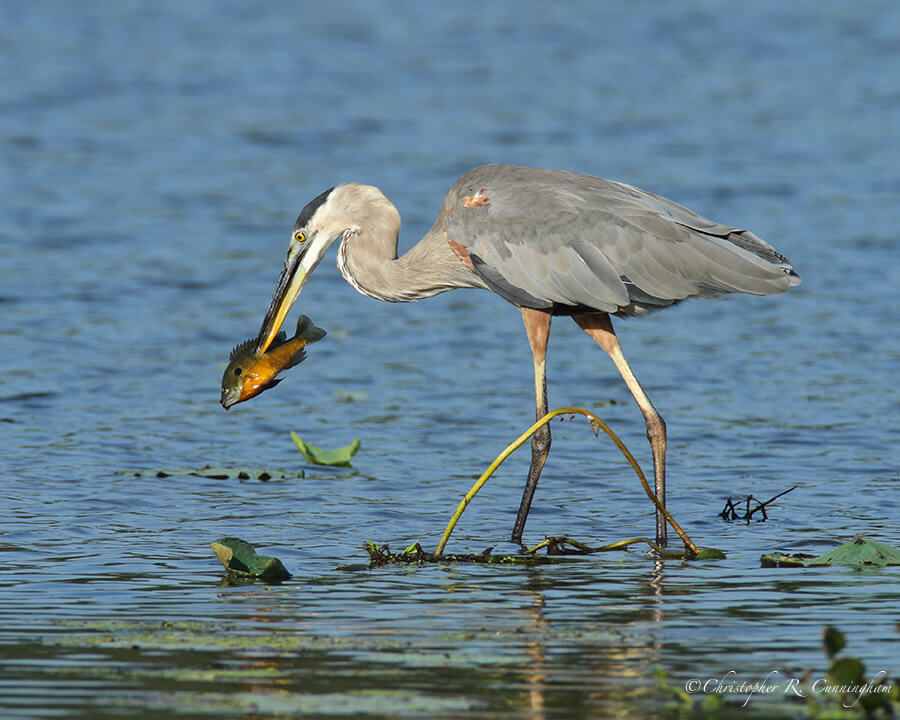
Great Blue Heron with Bluegill, 40-Acre Lake, Brazos Bend State Park, Texas
Great Blue Heron with Bluegill, 40-Acre Lake, Brazos Bend State Park, Texas. I watched this bird for hours. It grabbed several fish and then sat there doing nothing for the rest of the morning. Canon EOS 7D/600mm f/4L IS. Natural light.

Below find my travel birding exemplar. Despite working pretty hard to get a decent shot, the following is typical of my only encounter with a Great White Heron. Some consider this bird to be a color morph of the Great Blue Heron, others a subspecies. Being such a rarity, I’m sure this bird is hounded everywhere it goes by birders. We probably chased this bird for an hour. It was quite wary, and I felt a little guilty about running around after it. As added barriers to success, the light (or should I say glare) was white, and it seemed some knuckle-headed ibis or egret always wanted to stand in the way thus lousing up the shot.

Like my dad used to say, “There’s nothing so bad that it can’t be used as a good example.” In life, as in bird photography, all you can do is keep swinging.
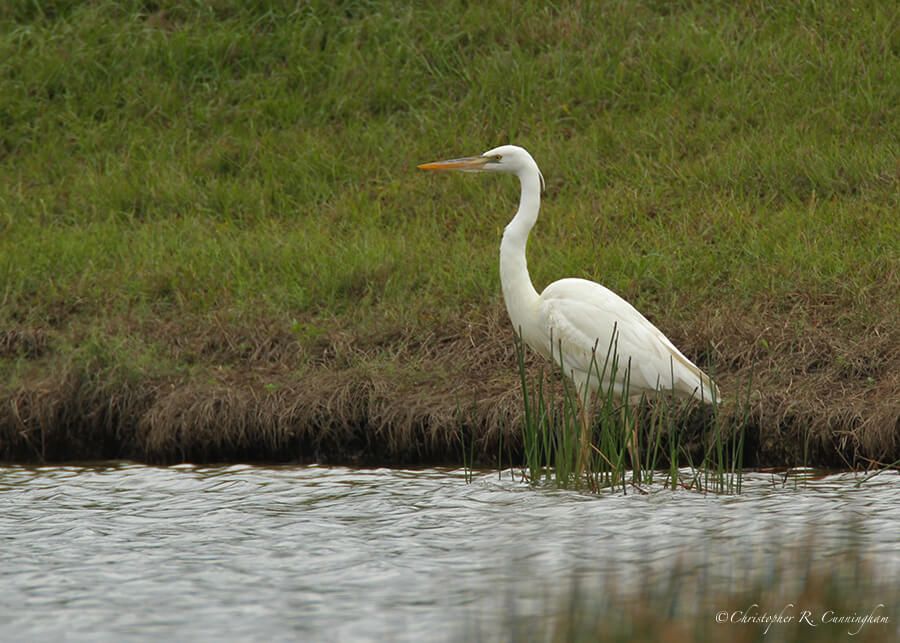
Great White Heron, near Sarasota, Forida
Great White Heron on a Not-so-great White Day, near Sarasota, Florida. A moment later this bird was gone, as I had crossed an invisible rubicon of minimum approach distance. Canon EOS 7D/600mm f/4L IS (+1.4x TC). Natural light.

©2018 Christopher R. Cunningham. All rights reserved. No text or images may be duplicated or distributed without permission.
Wishing for Warblers

A change in the weather is sufficient to recreate the world and ourselves. –Marcel Proust

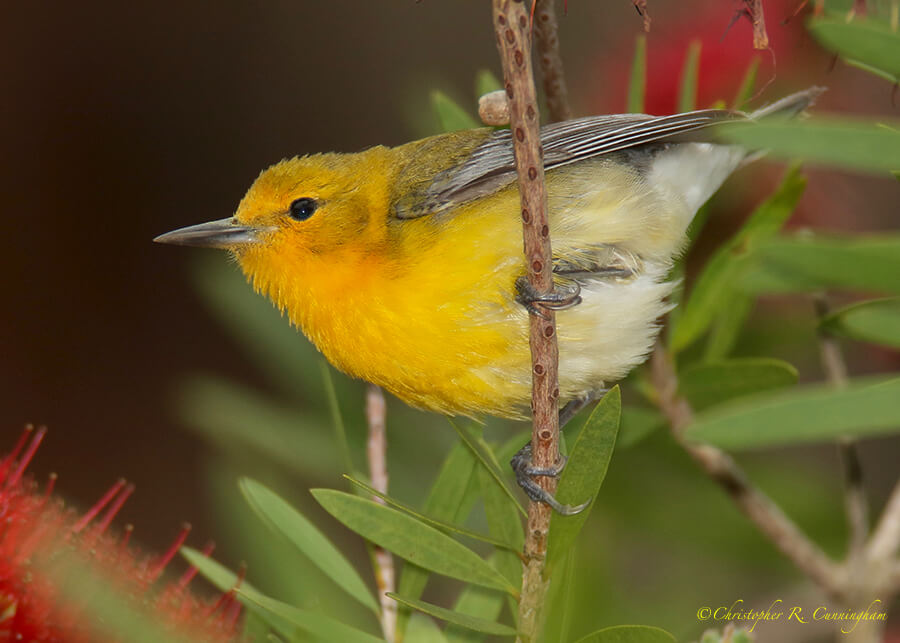
Prothonotary Warbler, Dauphin Island, Alabama
Prothonotary Warbler, Dauphin Island, Alabama. This bird was drinking nectar from bottlebrush flowers. A cavity-nesting species, this songster breeds in the swamps of Brazos Bend State Park. Canon EOS 7DII/600mm f/4L IS (+1.4x TC). High-speed synchronized fill-flash.

This weekend we went binocular birding at Brazos Bend State Park, again. We decided to leave the photo gear at home given the dense clouds and patches of rain and drizzle. While we were sitting on the bench on the west side of Old Horseshoe Lake, I was grousing about how I was tired of only seeing the usual suspects. Just as the words left my mouth, I spotted a pair of Cinnamon Teal drakes dabbling among the aquatic vegetation right off shore–a personal first for this park. These birds were likely early migrants at the extreme eastern extent of their migratory range. A nice sighting, but even with that I’m ready for a change. Of course, the next big change is spring migration . . . and the passage of dozens of glorious wood warbler species across the Upper Texas Gulf Coast.

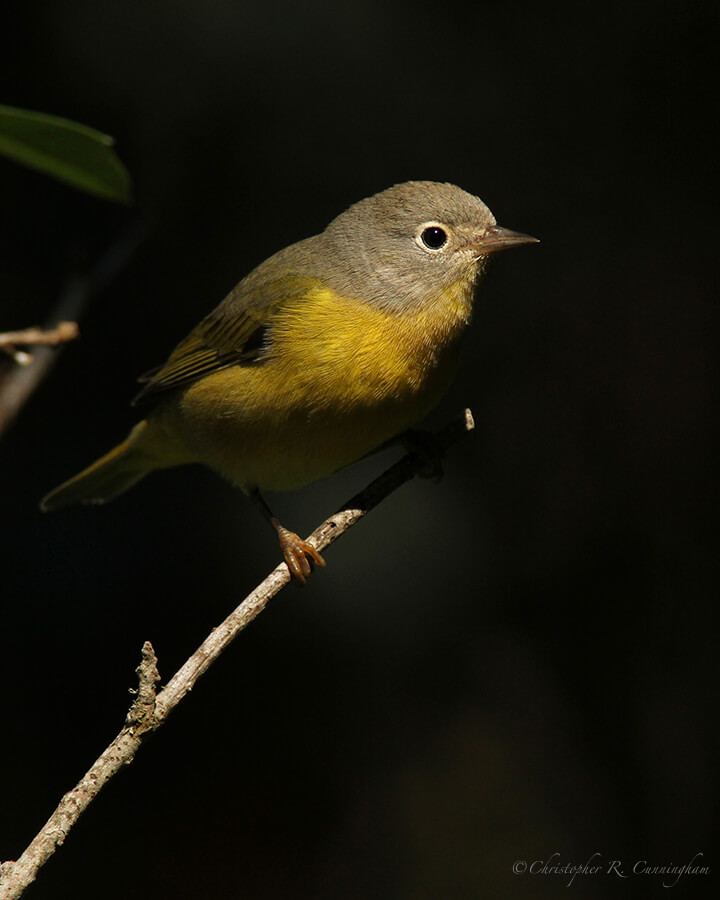
Nashville Warbler, Lafitte's Cove, Galveston Island, Texas
Nashville Warbler, Lafitte’s Cove, Galveston Island, Texas. Warbler photography usually involves finding birds in woods with dappled sunlight. The options are flash or no flash. With no flash in dense woods, artsy shots like this are possible (but rare). Canon EOS 7D/600mm f/4L IS. Natural light.

Now is the time to start brushing up on Warbler identification. It’s amazing how quickly this skill fades over the year, but equally amazing how quickly it returns after a few days in the field in April. Last spring was a fairly good one for seeing new or unusual warblers. Specifically, we saw Blackpoll Warblers, Golden-winged Warblers, Cape May Warblers, and a single Prairie Warbler at Lafitte’s Cove.

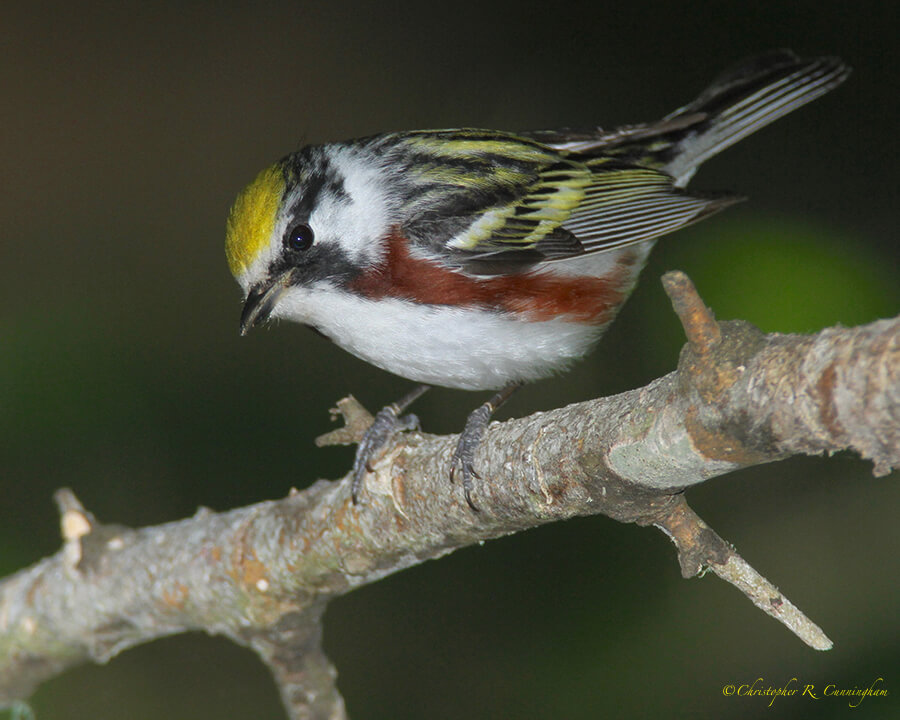
Chestnut-sided Warbler, Lafitte's Cove, Galveston Island, Texas
Chestnut-sided Warbler, Lafitte’s Cove, Galveston Island, Texas. We were lucky enough to hear this species sing on the North Shore of Lake Superior a few summers ago. Canon EOS 7D/600mm f/4L IS (+1.4x TC). High-speed synchronized fill-flash.

After about six years of serious birding, my personal warbler species count stands at thirty-eight, with decent images of about half that many. Soon we’ll be planning trips to see specific tough-to-find species: Big Bend for the Colima Warbler, Michigan for Kirtland’s Warbler, and so on.

Spring brings hope for, if not new species, then better images of birds we’ve seen and photographed before. Maybe this is the year I will find the holy grail of bird photography–a technically perfect shot of a rare warbler, a big juicy caterpillar in its beak. Spring migration brings the sense that anything is possible –yes, Virginia, a storm could blow a Black-throated Blue to Galveston! Dream big or stay home!

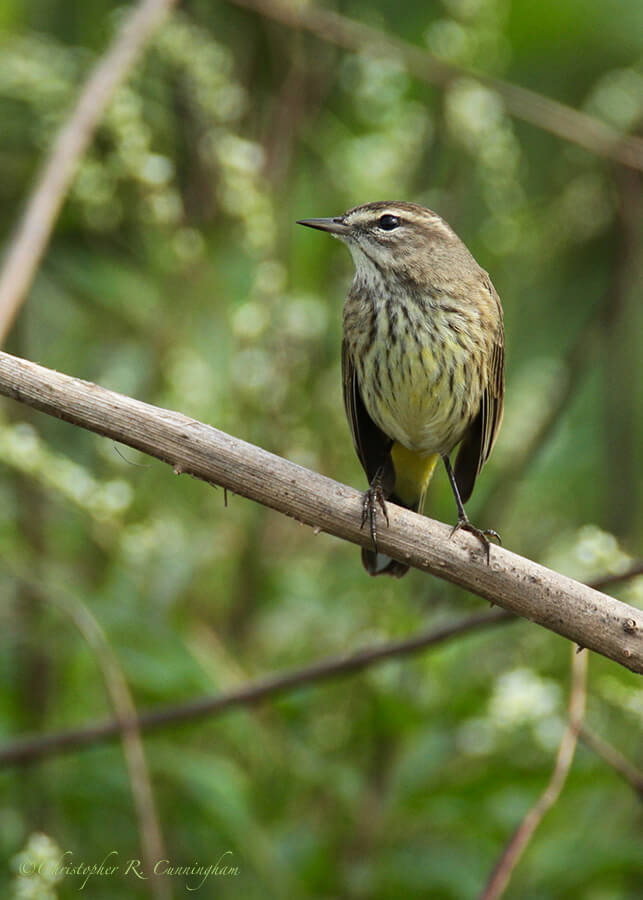
Palm Warbler, Myakka River State Park, Florida
Palm Warbler, Myakka River State Park, Florida. Canon EOS 7D/600mm f/4L IS (+1.4x TC). Natural light.

©2018 Christopher R. Cunningham. All rights reserved. No text or images may be duplicated or distributed without permission.
Fishing Through the Glare

There are two kinds of light – the glow that illuminates, and the glare that obscures. –James Thurber

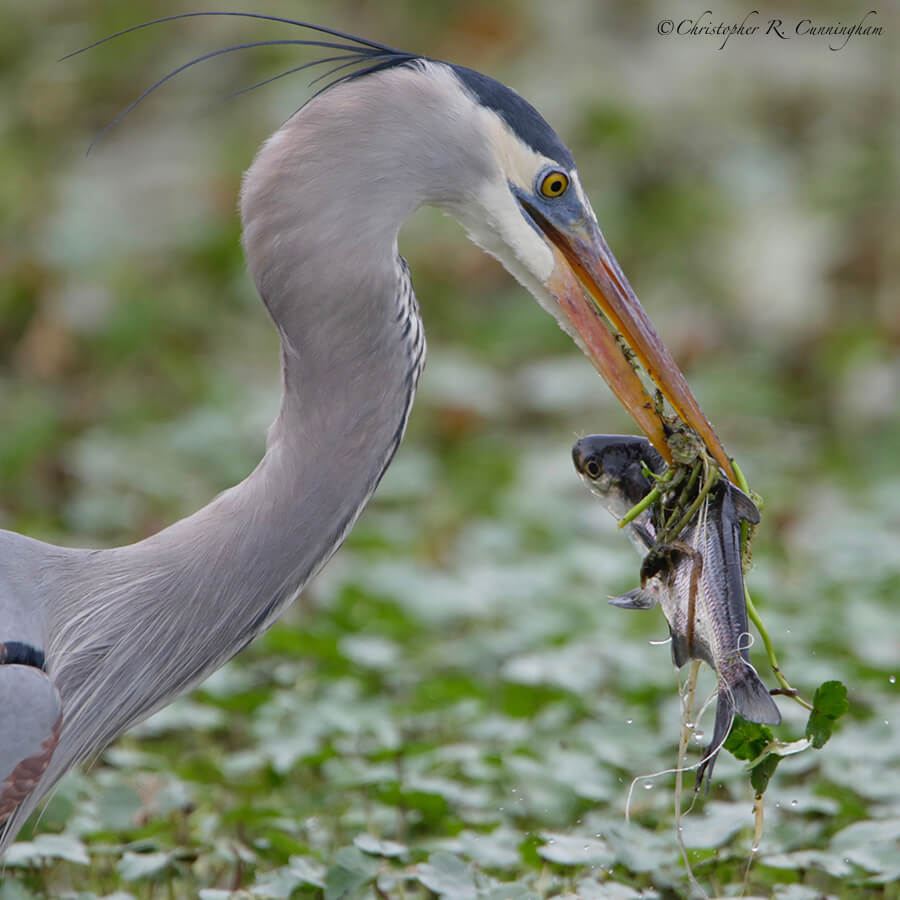
Great Blue Heron (Breeding) with Gizzard Shad, 40-acre Lake, Brazos Bend State Park, Texas
Great Blue Heron (Breeding) with Gizzard Shad (Dorosoma cepedianum), 40-acre Lake, Brazos Bend State Park, Texas. This bird spent a good deal of time with its head low to the surface of the water, neck outstretched. It seemed to be searching for prey by looking for minor disturbances in the surface of the water–and then the bird would go dashing after the makers of these ripples among the aquatic vegetation. Canon EOS 7DII/500mm f/4L IS (+1.4x TC). Natural light.

On Sunday we took a much-needed trip to Brazos Bend State Park. The light in the early morning was white, and the water shone like a mirror. Colors were washed out, and there was a general sense of omni-directional illumination. Shadows were pale, and the water lacked clarity. More than just a problem for photographers, these conditions necessitated particular hunting strategies on the part of waders . . . .

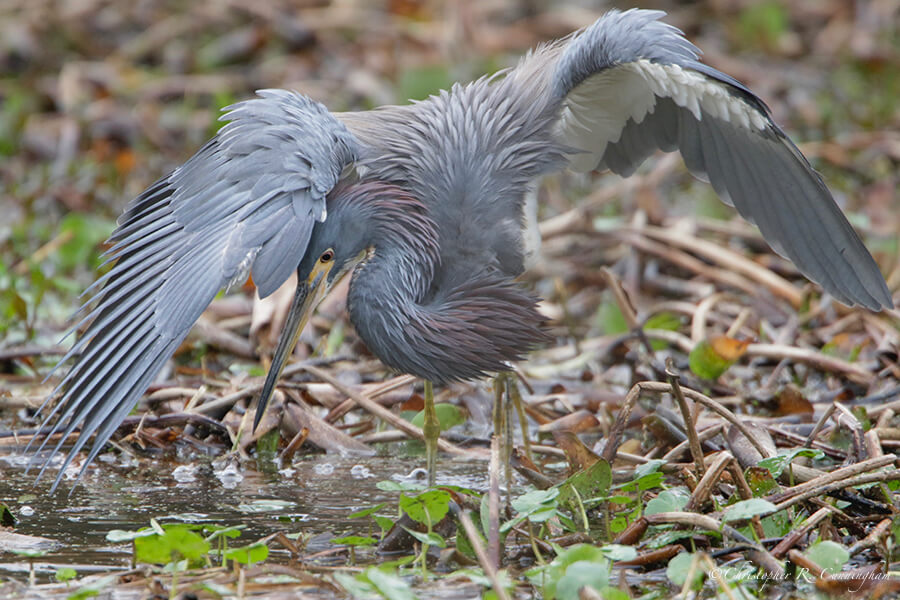
Tri-colored Heron Fishing, Pilant Slough, Brazos Bend State Park, Texas
A Tricolored Heron Utilizes an Underwing Feeding Strategy, Pilant Slough, Brazos Bend State Park, Texas. This bird was shuffling its feet to scare up prey. Likely the shadow of the wings cut the glare from the surface of the water allowing prey to be spotted more easily. Canon EOS 7DII/500mm f/4L IS (+1.4x TC). Natural light.

American Bitterns, Great Egrets, Great Blue Herons, Little Blue Herons, and a Tricolored Heron were harvesting little (and big) fish galore from vegetation-choked water. And a Great Blue Heron bullied a Great Egret into dropping a fish it had caught in 40-acre Lake . . . .

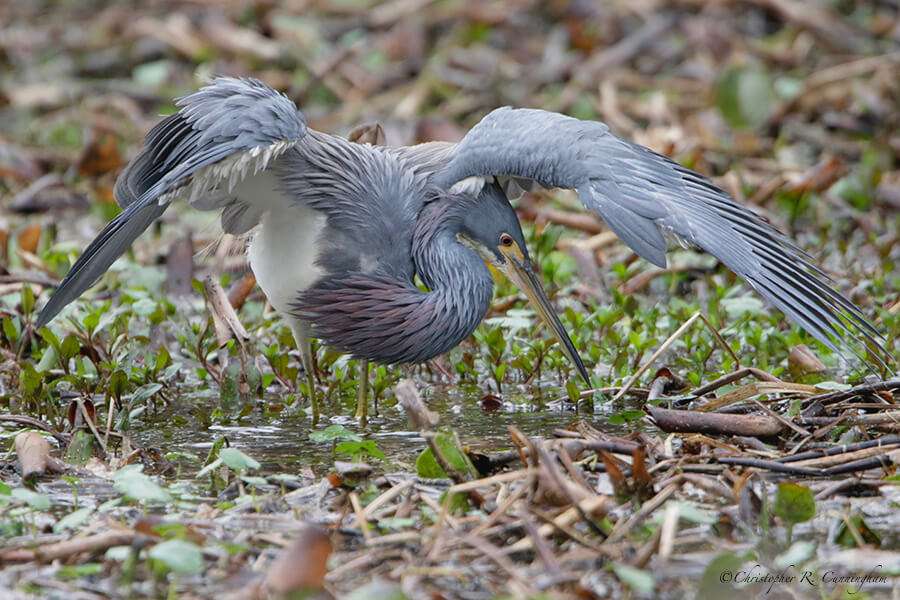
Most interesting, perhaps, was a Tricolored Heron that was employing a (single) underwing feeding strategy, and from time-to-time, a double-wing feeding strategy. Among herons and egrets, these behaviors involve a continuum of postures from shading the water with a single wing, both wings separated, to a complete canopy in which the wings meet in front of the bird as it crouches, feathers touching the surface of the water. This latter behavior, “canopy feeding” sensu strictu, occurs only in the Black Heron of Africa (Egretta ardesiaca), although the Reddish Egret and Tricolored Heron can approach this configuration.

Several functions for these wing positions have been proposed from scaring fish into divulging their positions, to getting fish to swim into the shade (and presumably under cover) after being be spooked by foot movements, to cutting the glare so that the bird can see its prey better. It is the latter I generally favor, primarily because I tend to observed these behaviors on days with a lot of glare. As an aside, the nickname of the Black Heron is the “umbrella bird.” If the shading to reduce glare is the correct interpretation of this behavior, then perhaps the parasol bird would be a better moniker for this creature.

Note: Special thanks go to naturalist and friend R.D. for sharing his high-speed video of a Tricolored Heron that plainly shows how much clearer the water appears in the shade of an outstretched wing.

Tri-colored Heron Fishing 2, Pilant Slough, Brazos Bend State Park, Texas
A Tricolored Heron Utilizes an Underwing Feeding Strategy 2, Pilant Slough, Brazos Bend State Park, Texas. The head of this bird swayed back and forth between outstretched wings. Canon EOS 7DII/500mm f/4L IS (+1.4x TC). Natural light.

©2018 Christopher R. Cunningham. All rights reserved, No text or images may be duplicated or distributed without permission.