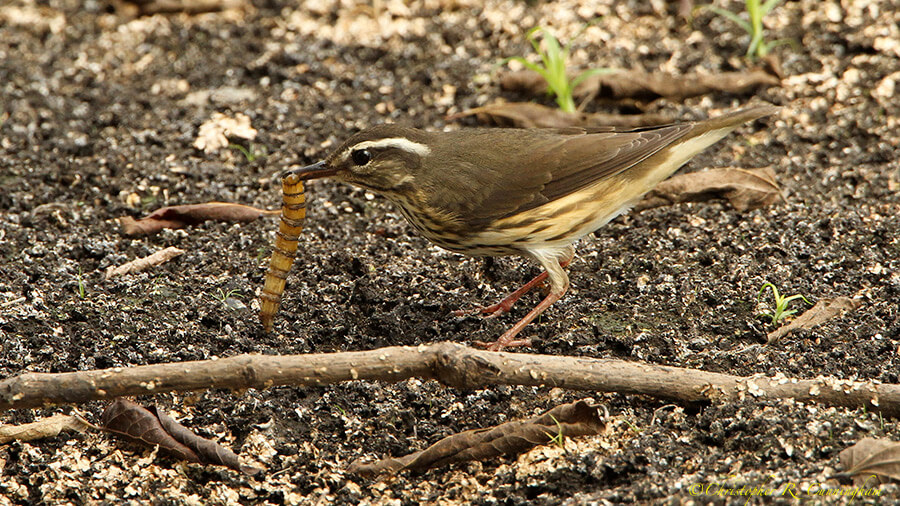
Louisiana Waterthrush with Fly Larva at Pilant Slough, Brazos Bend State Park, Texas. The caterpillar-like arthropod appears to be a large horse fly larva, but I invite comments from anyone who knows better. Canon EOS 7D/500mm f/4L IS (+1.4x TC). Natural light.
Photographing birds is often not easy, and getting them in the act of hunting can be a special challenge. But even after you have the image, the work may not yet be done as prey items can be difficult to identify. Vertebrate prey items (particularly fish) can be challenging, but invertebrates, especially larval forms, can be maddening when your invertebrate biology courses were twenty-plus years ago! The rewards of such research, though, are great. Identifying prey puts you in tune with the bird’s life: Now you know what they’re looking for when you see them poking around in particular habitats, at particular times of the year. For me, this is one of the more interesting aspects of birding, one made possible by the camera.
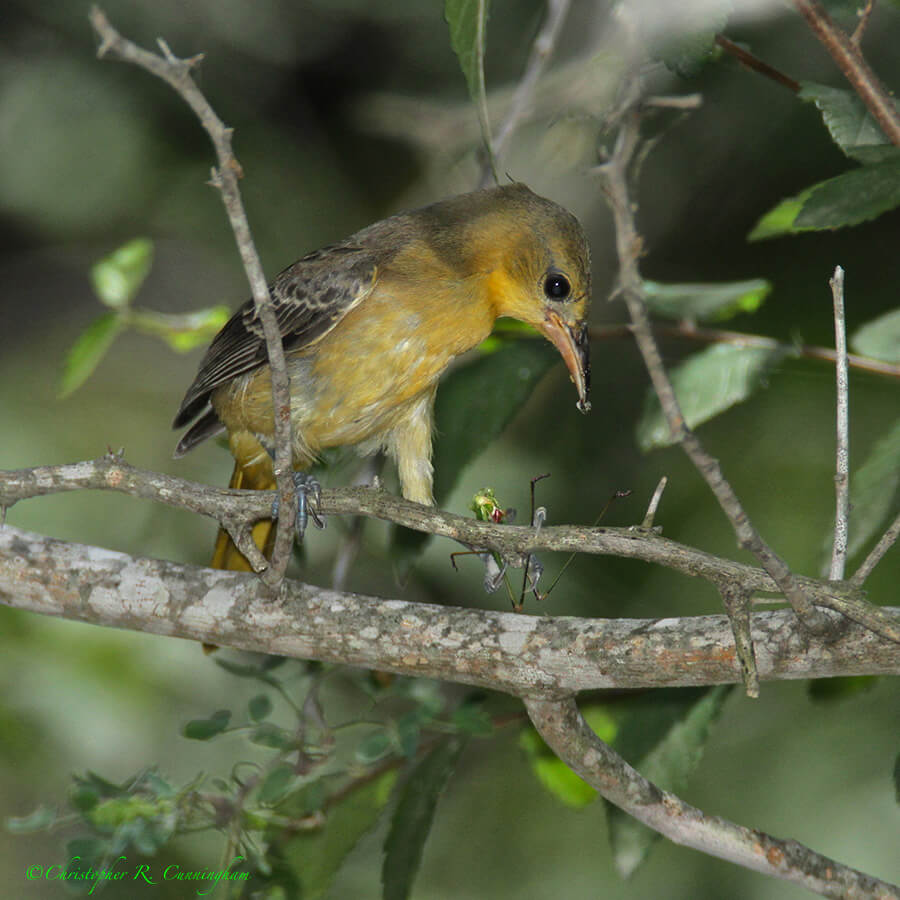
Female Hooded Oriole with Katydid at Santa Ana National Wildlife Refuge, South Texas. The insect appears to be a spoon-tailed short-winged katydid (Dichopetala catinata), or related form, but I invite comments from anyone who knows better. Canon EOS 7D/600mm f/4L IS (+1.4x TC). High-speed synchronized fill-flash.
Our retinas and brains have been wired by a hundred million years of evolution to find outlines in a visually complex landscape. This helps us to recognize prey and predators.—Seth Shostak
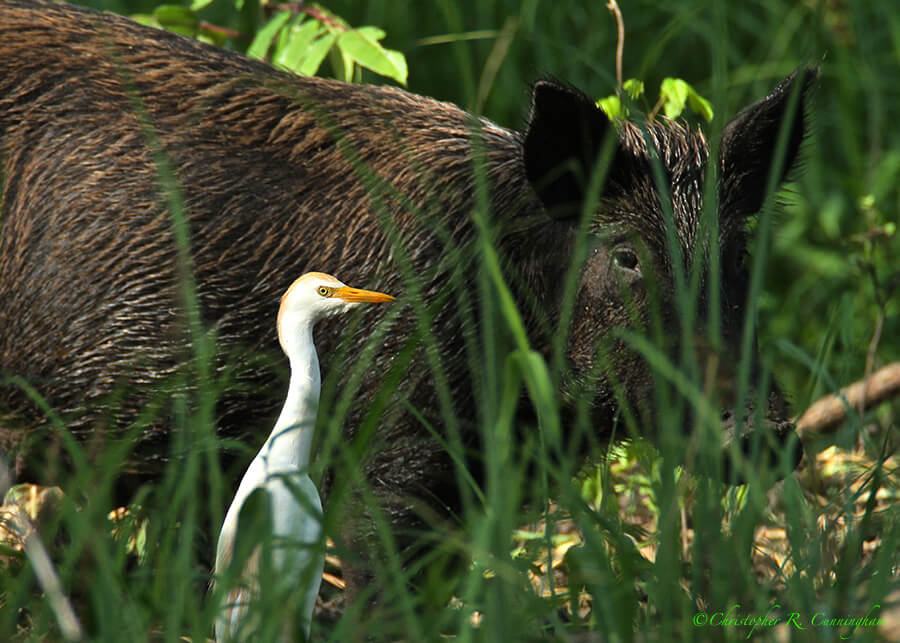
In Deepest, Darkest Texas: Cattle Egret with feral hog at Pilant Slough, Brazos Bend State Park, Texas. True pigs have been in the New World for centuries due to human introduction. Cattle Egrets commonly follow cattle around Texas pastures, but this is the first time I have seen the birds shadowing prey-flushing pigs. All photos Canon EOS 7D/600mm f/4L IS (+1.4x TC).
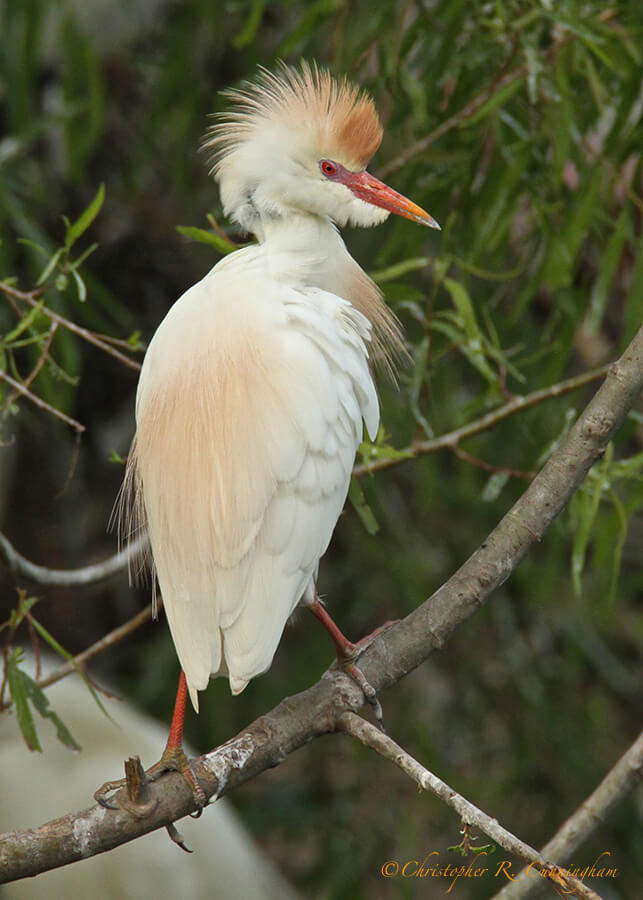
Cattle Egrets are among my favorite waders. They are slightly sinister in appearance and behavior as they sneak and skulk around the margins of grasslands and marshes in search of invertebrate and small vertebrate prey. And judging by their large minimum approach distance they are among the most suspicious and distrustful of birds.
Given their dislike of people, it’s ironic that the rapid expansion of Cattle Egrets across the New World in the latter half of the 20th Century has been aided by human agriculture. Not long before the 20th Century the Cattle Egret was an Old World species. The first Cattle Egret was seen in the New World in 1877; in North America in 1941, and it began breeding in Florida in 1953. Today, Cattle Egrets are widely distributed across the Americas.
Spectacular: A Cattle Egret in Breeding Colors at Smith Oaks Rookery, High Island, Texas. Natural light.
Although we think that the Cattle Egret reached the New World on its own, the widespread distribution of livestock here, particularly cattle, has has greatly facilitated the bird’s spread. Today, Cattle Egrets snapping up grasshoppers and other prey flushed by cattle (or farm implements!) is a common American sight.
So in the Americas, the Cattle Egret is not a human-introduced species. Yet, I find it hard to consider it precisely a native species (over much of its range) given its close association with domesticated livestock. The Cattle Egret exists exactly at the intersection of man and the rest of nature. It is one of those species well adapted to live in a human-influenced, agricultural landscape. And, as the human population increases with its ever-increasing appetite for meat and animal products, the Cattle Egret’s future looks bright indeed.
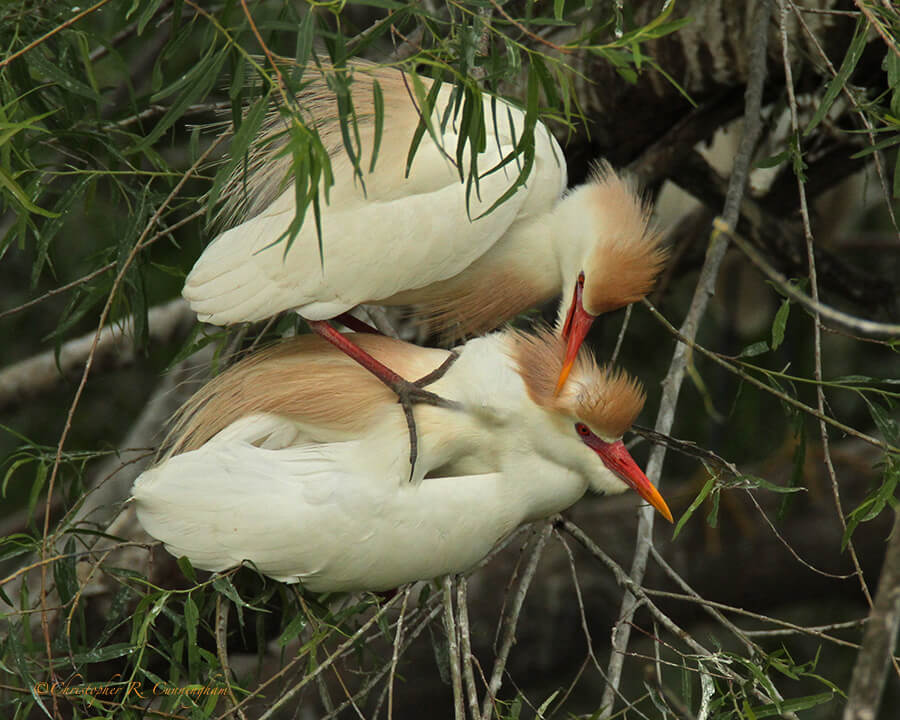
Mating Cattle Egrets at the Smith Oaks Rookery, High Island, Texas. Cattle Egrets now breed in rookeries with native species such as Great Egrets, Roseate Spoonbills, Tricolored Herons, and Snowy Egrets. Natural light.
It is not the strongest or the most intelligent who will survive but those who can best manage change.—Charles Darwin
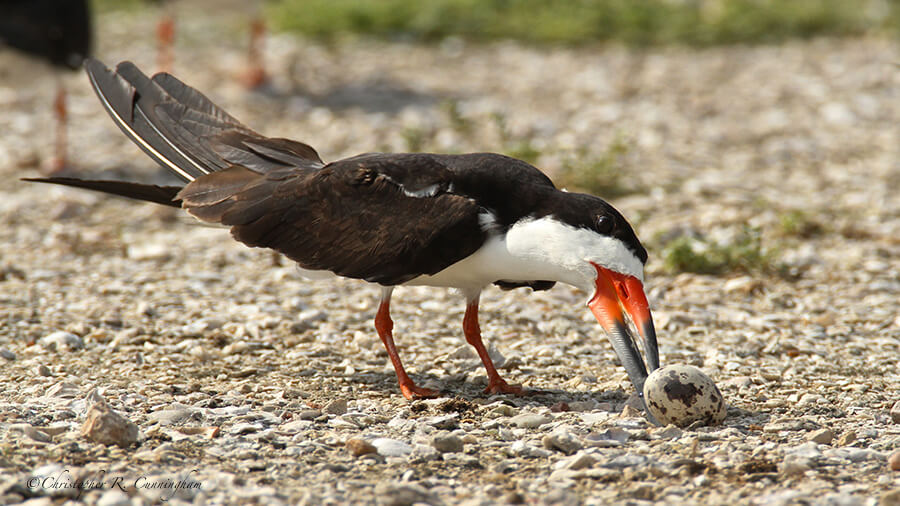
A Black Skimmer Turns an Egg, at Freeport, Texas. All images Canon EOS 7D/600mm f/4L IS (+1.4x TC) unless otherwise noted. Natural light.
Elisa and I recently took the opportunity to visit the Black Skimmer nesting colony at the Dow Chemical plant in Freeport, Texas during the company’s annual open house. In addition to the Black Skimmers, Gull-billed and Least Terns were present within the colony. Defense and reproduction were foremost on the birds’ minds.
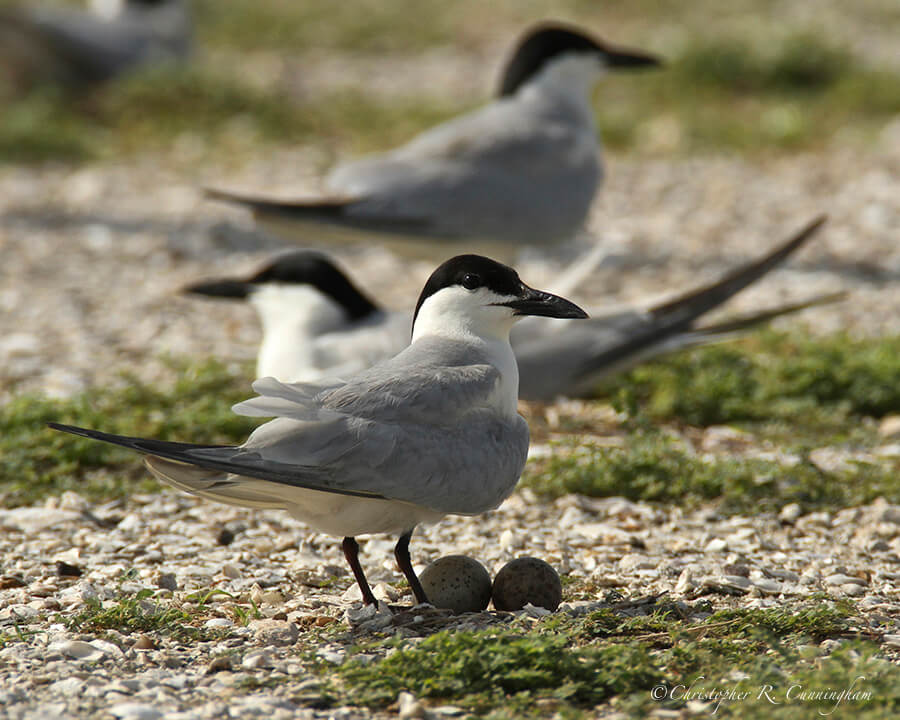
Avian nesting colonies are defense mechanisms against numerous threats to eggs and chicks: Hundreds of pairs of eyes are better than one. Also, Black Skimmers are not aggressive defenders of nests as are some other colonial nesters (Common, Gull-billed and Least Terns, for example), and will nest among these species for protection. On the day we visited, Laughing Gulls loitered like juvenile delinquents on the margins of the colony hoping for a moment of inattention or distraction to grab eggs or chicks. Rats and other mammals like raccoons, can also be expected to prey on eggs and nestlings.
Vigilance: Gull-billed Tern Over Nest at Freeport, Texas.
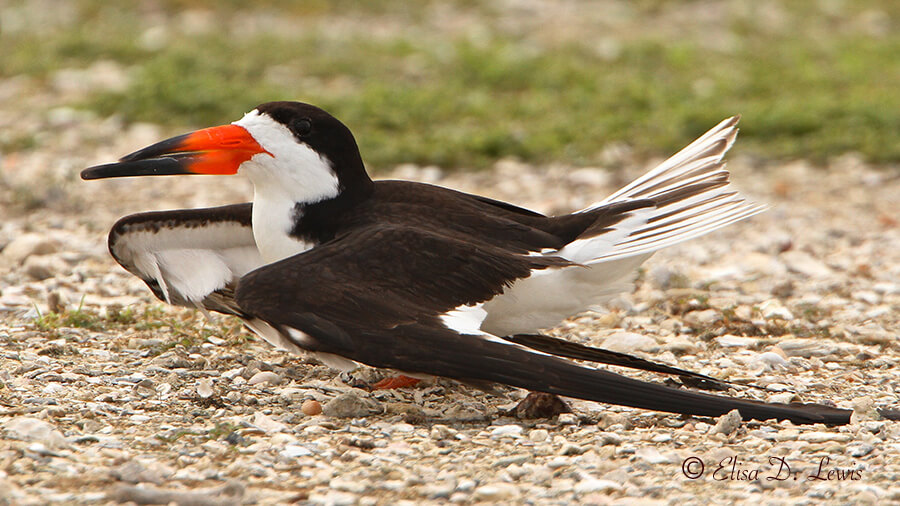
Another Black Skimmer defensive tactic we observed was the “broken wing act” to distract attention from nests. In the cases I observed, I did not perceive a particular threat. Perhaps the birds were simply responding to a general level of stress due to a large number of human observers.
A Black Skimmer Performs the Broken Wing Act at Freeport, Texas. Canon EOS 7D/500mm f/4L IS (+1.4x TC). Natural light.
In addition to defensive behaviors, we observed several instances of Black Skimmers turning eggs. In marked contrast to snake and lizard eggs, almost all bird eggs must be turned often during incubation for proper development.
One of the most charming things I observed was pair feeding as part of the skimmer courtship ritual. In this ritual, the larger male Black Skimmer presents the female with a small fish. If she accepts the fish, the pair copulates. The female skimmer then eats the fish. Interestingly, terns exhibit a similar ritual—but female terns eats the fish before copulation.
On the photographic side, a persistent Tropical weather pattern continued in which moisture flowed up onto the coast from the Gulf providing high humidity and a dazzling, cloudy white sky. The unfortunate placement of the observation areas coupled with the atmosphere meant conditions for photography were poor. Because the birds were backlit, I had to wait for instances when they would turn their heads such that raking light could reveal feather detail and provide catchlights. Sometimes shooting during the Texas summer requires a little creativity.
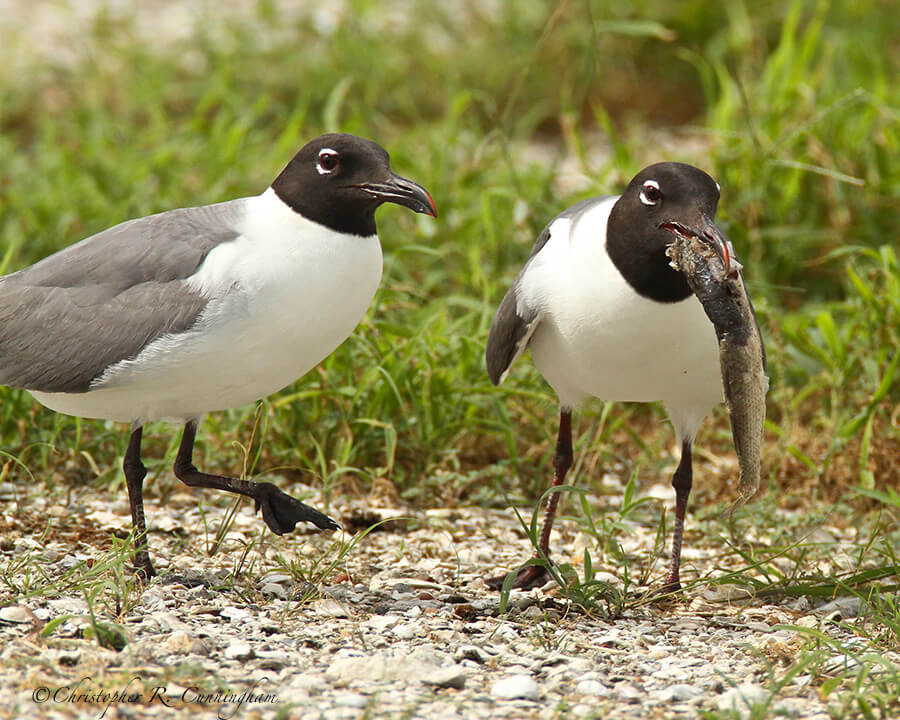
No Laughing Matter: Laughing Gulls with a fish at Freeport, Texas. Small groups of Laughing Gulls flanked the colony waiting for opportunities to prey on eggs and young. These two gulls couldn’t decide whether to eat or abandon (or bring back to their own young?) their nearly dried-up fish carcass. They kept dropping it and hestitantly picking it up again. Were they hoping for something better? A plump, juicy tern or skimmer chick, perhaps?